 AbMaxxStory
How 18-Year-Old Lino Leighton Built AbMaxx to $55K a Month Without Coding
AbMaxx was founded by 18-year-old Lino Leighton, who couldn't code. A gym conversation, two AI app builders and a creator equity deal took it to $55K a month.
A few friends at the gym, shirts off, comparing abs. Nobody could say exactly whose were better or what to do about the ones that weren't. That small locker-room moment turned into AbMaxx, an app that scores your abs from a photo and builds a plan around your weakest area.
Its maker had never built an app and couldn't code. By October 2026, he said AbMaxx was making about $55,000 that month, with more than 3,000 paying users. AbMaxx was founded by Lino Leighton. Here's how an 18-year-old got there, with the real screens.
The founder: 18, one semester of college, no code
Leighton is 18 and left college after his first semester. Before AbMaxx, he had no technical background at all. In his interview with Starter Story, he admitted, "I didn't even know how to vibe code." What he did have was a feed full of app founders on X, and he learned by watching what they shipped and how they marketed it.
The idea itself was simple. After that conversation at the gym, he kept thinking that everyone cares about their abs. When he went looking for an app built specifically for people who want visible abs, he couldn't find an obvious one. So he decided to make it, and he used Sensor Tower to size up the competition and confirm the niche.
Two tries at building it
His first attempt was in Lovable, an AI app builder. He spent about two months prompting it and still didn't have something he felt was ready to launch. So he started over in Rork, a tool for building native mobile apps with AI, and rebuilt the whole thing in about a month.
The rest of the stack is the kind many small app founders use: Supabase for sign-in, PostHog to see where people drop off, and RevenueCat for subscriptions. In the first month after the rebuild, AbMaxx made just over $7,000.
The app is narrow on purpose. It doesn't try to be a full fitness tracker. It scans your abs, scores areas like the upper abs, lower abs and obliques, and gives you a training and nutrition plan aimed at your weak spots. Leighton has said that when he started, the niche had essentially no direct competitors.
Onboarding: a score you can almost see
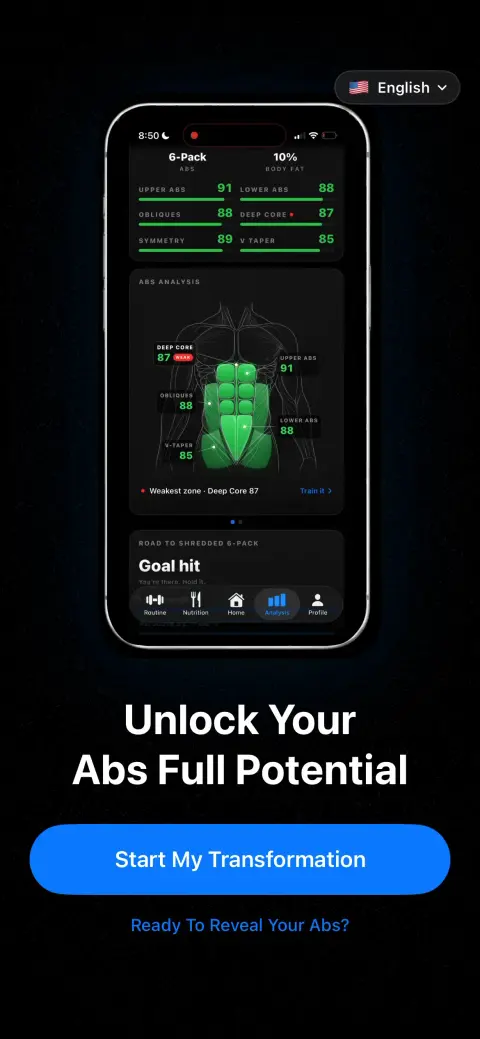
The onboarding runs about 30 screens. The first one shows the app's analysis screen on a phone, with a score for each zone, under the headline "Unlock Your Abs Full Potential" and a button that reads "Start My Transformation." Before you've answered anything, you can already see what you're going to get.
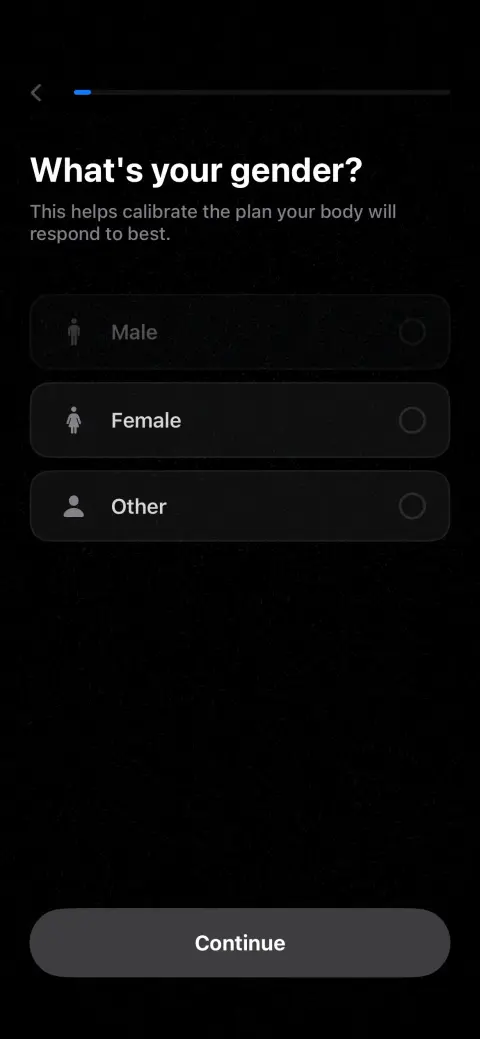
Then come quick questions, starting with gender and your main goal. Early on, the app compares results with and without it in a bar chart.
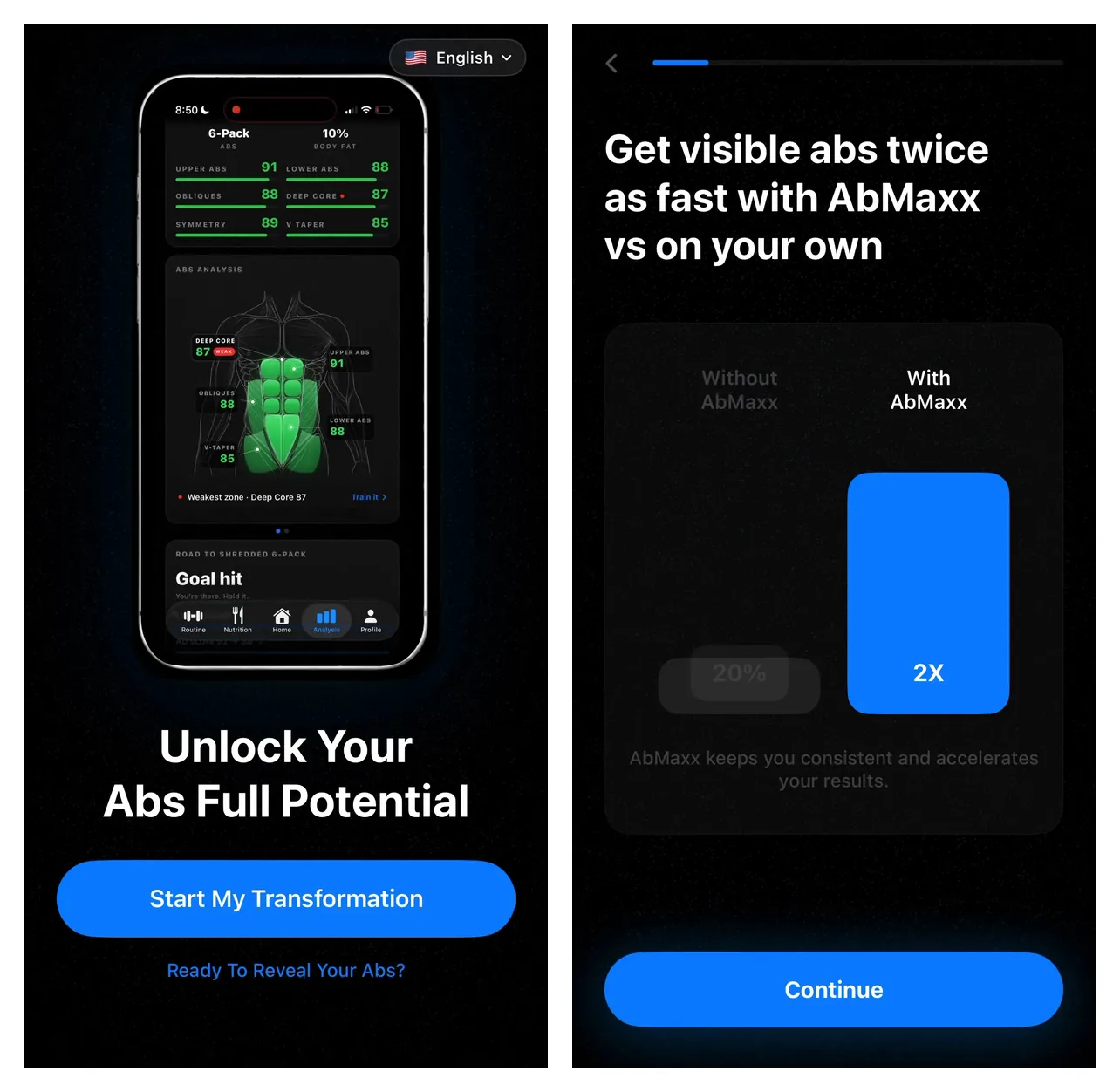
After more questions about your body type and goals, the app asks for your name and invites you to scan your abs. You can skip the scan. If you do it, the results only go so far: you see scores for some areas, while the overall score stays blurred. A "plan ready" screen with your own photo comes next, and then the paywall. The thing you want to know most, how good your abs actually are, sits right behind it.
Paywall: no trial, then a bigger discount
The paywall has two plans, weekly and yearly. The yearly plan is selected by default and labeled as saving 85%. No free trial is offered. If you cancel the purchase, a limited-time offer appears with 90% off.
Growth: paying creators was the expensive lesson
Leighton calls his first marketing approach one of his biggest mistakes. He paid large fitness influencers for UGC videos, at thousands of dollars per video, before he knew which kind of content actually worked. Along with faceless TikTok slideshows that he posted by hand, it brought in only about $3,000 to $4,000 a month, with thin margins.
What changed things was a different kind of deal. Instead of paying a big fitness creator in cash, he gave the creator equity in AbMaxx in exchange for content. Monthly revenue then passed $10,000, and he recommends this route to other founders without much experience.
After that, he put paid ads behind content that was already working. He reported a return on ad spend of about 2 to 2.5x on Meta and 4 to 5x on TikTok with the same creatives, aimed at people aged 15 to 30. According to Meta's ad library, AbMaxx started advertising there in July 2026 and had 68 active ads. The ads are mostly videos that point out which areas to train on a 3D body, and creators talking while showing their own ab scores. One opens with a line any lifter has heard: "You don't have bad genetics."
The slideshow format still shows up on TikTok, now from fitness creators. The most-viewed post on Onbo Hub's list is an anime-style cheat sheet that puts a "wrong" and a "right" exercise side by side for each body part. Only one slide mentions AbMaxx, showing the app's analysis screen.
The post has close to 300,000 views and more than 13,000 saves. It works because it's useful first and an ad second.
Note: Leighton's story, the revenue figures ($7K in the first month after the rebuild, $3K to $4K a month early on, about $55K a month in October 2026), paying users and ad returns come from his Starter Story interview (October 2026) and Stork.ai's write-up, and have not been independently verified. Some coverage spells his name and the app's name differently; this story uses Lino Leighton and AbMaxx. Onbo Hub's own figure for AbMaxx, about $53K a month, is an estimate. The "2X" comparison is the app's own claim shown in onboarding. Ad counts are from Meta's ad library, and view counts are as of when this story was written.
Ideas worth copying
See AbMaxx's full onboarding
This story only shows a few of the screens. Onbo Hub has all 33, from the first screen to the last.
View the onboarding
Newsletter
Founder stories and growth teardowns of apps that are actually making money.
Sources
- Starter Story, "This unbelievable app idea makes $50K/month" (October 4, 2026)starterstory.com
- Stork.ai, "How One 18-Year-Old Built a $60K App With 5 Tools" (October 7, 2026)stork.ai
- AbMaxx: Become Shredded (App Store)apps.apple.com
- Wrong vs. right exercises for each body part (TikTok @zayn.calisthenics)tiktok.com
 Lyfta
 Liftoff

 Unchaind