18 Months of Failure, a $100K Loan, and a Bet That Took an AI Photo App to $300K/Month in Just 2 Months
After 18 straight months of failure, he bet everything on a single viral TikTok format. The result: $300K in monthly revenue within 2 months. It's a genuinely insane growth story.
August 31, 2026

The man I’m covering today is Dillion Verma.
He took an AI photo-editing app from zero to $300K MRR in just two months.
Look at that number alone and you might think, “Okay, just another genius.” But the road there was 18 months of nonstop failure. And when he finally made this bet, he had almost no money left. For a year and a half he’d been building products that flopped, one after another, and his bank account was running on empty.
From the edge of that pit, he took on $100K in debt, made his bet, and clawed his way back up. That’s not a normal mindset. But he could see the odds in his favor.
Today I’m going to dissect the entire strategy: how Dillion went into debt to make this bet, and how he took a solo app to $300K/month at absurd speed. Researching this was genuinely one of the most useful things I’ve done in a while.
In the final section, I’ve written out a thought experiment — how I would apply this playbook myself — so please read to the end.
🛠️ The thing is — Dillion was already an elite engineer
First, don’t get the wrong idea. Dillion is not “a total beginner who suddenly struck gold.” If anything, the opposite: his engineering background is seriously elite.
He studied computer science at a top Canadian university while simultaneously studying business at another. And his internship résumé is absurd — NVIDIA, Shopify, Splunk, the e-scooter company Lime. He cycled through some of Silicon Valley’s most famous tech companies. He’s done 21+ hackathons for fun. He is, completely, the type of person who just loves to build.
In late 2022, he quit his engineering job to go all-in on building and growing his own SaaS business.
And his run as a solo builder was, honestly, impressive in its own right. His open-source UI component library, Magic UI, became a hit project with over 16,000 GitHub stars. His tool for visualizing AI usage logs, llm.report, was picked as the top team in Vercel’s AI Accelerator and won $120K in prize money.
So far this sounds like “an elite who succeeded, big surprise.” But here’s the catch: despite all that skill and all those wins, he failed at consumer (toC) apps for 18 straight months.
You can ship results with developer tools and still find that landing an app that resonates with ordinary consumers is a completely different game. Technical ability isn’t enough — without marketing and an understanding of the “viral equation,” a consumer app won’t hit.
I feel this constantly in my own indie work: consumer products and developer products are played completely differently. The way and the place you do marketing are totally different. To make a product succeed you need both “the ability to build a good product” and “the ability to deliver and sell it” — but for consumer products, the weight sits heavily on the latter. And in a world where AI is rapidly democratizing the ability to build, the latter is becoming the far harder skill. Yet, ironically, the more die-hard the engineer, the more they pour their time into the former and neglect the latter.
Dillion was the same at first. But here’s what makes him remarkable: he threw out that old mindset and switched to a marketing mindset. An elite engineer who, after 18 months of failure, finally arrived at the conclusion: win with marketing, not technology.
🤝 Why was Halo AI born? A “final bet” after 18 months of struggle with a partner
So why did he end up building an AI photo-editing app?
Dillion has a co-founder, a partner named Grishon. For 18 months the two of them built and failed, built and failed. They tried all kinds of ideas; none of them landed. Their bank balance ticked down and down — until it was basically zero. Completely against the wall.
Then, in summer 2025, the turning point came: Google released a new image-generation model (Nano Banana). The world was buzzing about the sheer quality of the images Nano Banana could generate — you probably remember it well.
They didn’t miss the opening. Honestly, they had no real conviction. But they had nothing left to lose. In an “eh, let’s just try it” spirit, the two of them started building an app on this API. Development took just 2–3 weeks. And in mid-October 2025, they quietly launched Halo AI.
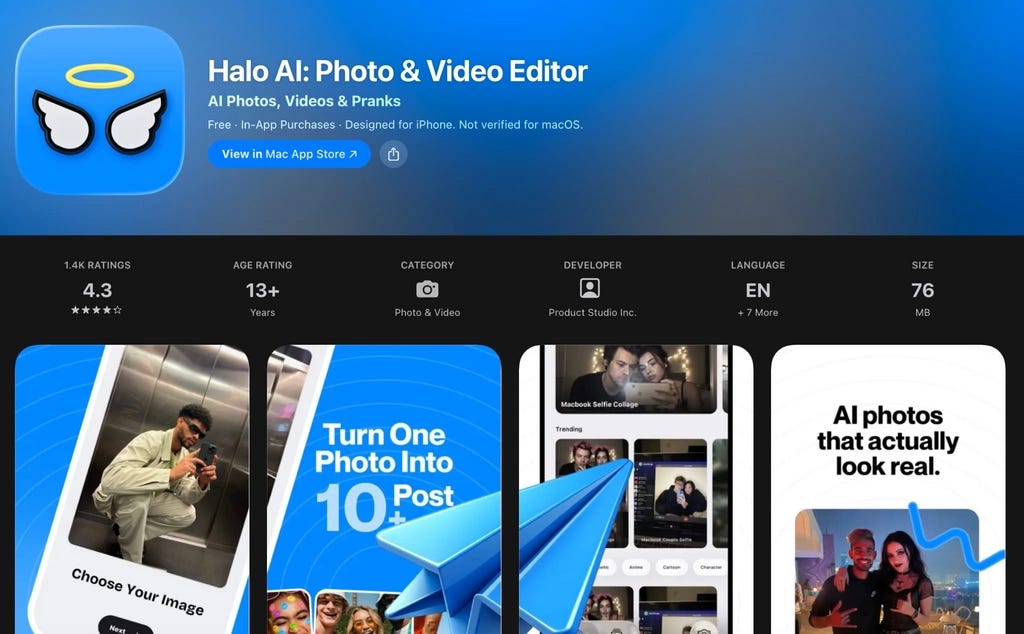
The app’s function is dead simple: you upload an image, type in a prompt, and it edits the image accordingly. Honestly, it’s the kind of thing you can easily build by wiring up an image-gen model’s API — but back then, image generation was still in a transitional phase and the novelty carried it.
The key point: the product itself is intensely watchable as video. Changes like “instantly swap someone’s outfit” or “generate a shocking image” are themselves the perfect hook for a short-form video. In other words, Halo AI’s core function and its viral content are directly connected. That’s incredibly powerful.
I’ll show you the actual viral video format later, but the lesson holds: what matters most is that the product itself ships with a viral feature built in.
And when the product’s own feature carries the virality, the product gets exposed inside the video automatically — so you don’t need to insert an “ad section.” Normally the flow is: you have a viral format, then you tack an app promo on the end. When you do that, users go “ugh, an ad” and a lot of them bounce. But if the product itself is viral, you’re naturally showing the product in use, so you don’t have to force a promo — users get curious on their own. And conversion shoots up. That’s hugely powerful.
So: anyone building a toC app from here on should design the product’s features by working backwards from the viral content. My own product, honestly, is missing that viral element — so right now I’m thinking hard about how to bake a viral feature into it. If you’re stuck growing an existing product, baking in a viral feature with this mindset might be your way out. In today’s world, if you want to grow a consumer toC product, having a viral feature built in feels like a hard requirement.
So from here, let me walk through the entire marketing playbook by which Dillion went from the edge of despair — taking on $100K in debt and betting it all — to $300K/month in just two months. Researching this case was genuinely incredibly instructive.
Specifically, I’ll cover these six things:
The identity of the “ultimate viral format” that racks up 1M+ views over and over and never runs out of material — and its 3-step structure
The technique for burning the app’s name into people’s brains with zero ad-feel
The Win-Win “milestone reward design” that skyrockets creator motivation, plus the actual payout table
The “Discord AI coach” system that runs 360 videos a day with zero managers
And the almost too-beautiful “soft → hard paywall” monetization funnel that produced a 16.5% conversion rate
There are several things from this research I’ve already decided to implement or test immediately. And in the final section, I’ve written a thought experiment on how I’d apply this case to my own products.
The full playbook of a man who, after 18 months of failure, flipped it all in just two months. If he could do it, there’s no reason we can’t. Essential reading for anyone who wants to grow an app — and every builder who’s stuck.
🎯 The ultimate viral format
So let’s look at how Dillion grew the app so fast. He grew Halo AI on a single format. What was it?
The format is, bluntly, the prank format.
First, watch this video 👇️
It’s a prank where he generates an image of his father’s beloved koi fish being cooked, to scare his dad. The structure is four steps:
1. A powerful hook. The opening stops the scroll with an AI-generated “shocking image” and a strong hook.
2. The “Halo AI” logo shown huge during generation. Next, the process of how the image is actually generated is shown. The crucial part: while the image generates, the “Halo AI” logo is displayed large. With no ad-feel, it casually drills “oh, you make this with an app called Halo AI” into the viewer’s subconscious. Brutally effective.
3. Pranking the father via a chat UI. It shows the screen of the “prank message exchange” using that shocking image. The snappy rhythm of the exchange and your curiosity about the dad’s reaction pull you in until the very end.
This format is genuinely too strong. That koi video pulled 2.9M views. Another video on the same account uses the exact same format — this time a prank that “I wrecked Dad’s beloved car” 👇️
— and got 3.4M views.
This prank format can be reworked in endless variations and the material is effectively infinite, which makes it incredibly powerful. They even built an account targeting the Japanese market, where this video got 3.2M views 👇️
— an “the air conditioner caught fire” prank. The Japanese phrasing in the video is quite skilled and natural. Regardless of country, the prank really is the strongest format. You can’t help but stop and watch.
So, having found this overwhelmingly strong format, Dillion decided to bet on it hard.
🧑🤝🧑 The strategy: hire creators in bulk and win on sheer volume
So how did he scale it? Through creator recruitment. Honestly, every fast-growing app lately recruits creators, directs them well, and grows that way. In his case, he took on $100K in debt to amass a chunk of capital and recruited creators all at once to widen the funnel.
But recruiting isn’t easy. How did he recruit creators efficiently? They scattered simple job posts across Reddit communities where UGC creators gather, and hundreds of niche Facebook groups. That alone got them 600+ applicants in a few weeks.
But with 600 people, quality varies wildly, so they set strict screening criteria:
Must be a US-based creator (easier to target US users — conversely, that Japan-targeting account is likely run by someone living in Japan)
Must have experience posting app-style content (e-commerce and fashion UGC creators excluded)
Must have a Gen Z sensibility
That’s the first-stage filter. And here’s where the real genius of Dillion’s recruiting shows. The promising applicants who pass the first filter all enter a 5-day trial. Pay is a flat $100 ($20/video × 5 videos). For five consecutive days, they post one video per day.
What the trial measures is just three things:
Consistency: Can they keep a daily posting schedule? Do they slack or fall behind?
Communication: Are they active in the Discord channel? People who stay silent and never ask anything are a no.
Viral instinct: Do they understand hook-driven editing? Flat, boring openings are a no.
The critical part: during the trial they demand zero high view counts. Because with only five videos, you can’t tell whether something will go viral — even a perfect format going viral is down to luck. Judge on views alone and you’ll drop real talent.
It’s perfect format × volume that finally, probabilistically, produces a viral video.
The creators who clear this narrow gate get formally hired.
💰️ A Win-Win reward design
When hiring creators, the thing you agonize over is the reward design. Reward design is genuinely really hard. In my own case it ultimately didn’t work out, but when I previously had creators make videos, I paid hourly + performance bonus. The performance bonus design is pretty tricky, though. Over what window do you base the view count for calculating pay? Is the reward uncapped? There’s a lot to think through, and the operations get annoying.
Against that backdrop, Dillion’s reward design made me go “ahh, I see.” He tested multiple reward models — flat pay per video, pure CPM (pay per 1,000 views), mixes of the two, and so on.
In one experiment, he presented 30 creators with two options:
Pure CPM model (technically earns more if you get high views)
“$20 base per video + milestone bonus” model
The result: an astonishing 29 of 30 chose the latter — base + milestone. In the latter model, specific milestones are set and you earn a reward each time you hit one. For example:
20K views → $60
100K views → $200
500K views → $500
1M views → $800
In the former model, with say $3 per 1,000 views, 200K views earns you $600. Calculated against the creators’ expected view counts, the pure-CPM former model should pay more — and yet, even when told this, almost all creators chose the latter.
Why? Because this model gives creators the reassurance of a “minimum guarantee” while gamifying the “ceiling.” Humans are moved more by the game-like thrill of “I’m one step away from that bonus!” than by “grinding up unit by unit.” You can probably relate. Having milestones set at 20K, 100K, 500K views is overwhelmingly more motivating than simply earning linearly via CPM.
The result: inside Halo AI’s Discord, an atmosphere emerged where creators compete with each other to reach the next milestone — a great effect. And for the operator, the milestone method is far easier to manage than tracking CPM in fine detail every day. I thought this reward system was excellent. Creators enjoy it like a game and get motivated, and management is easier on your end too.
📊 Just post volume and let probability converge
From the start, he saw the importance of volume in going viral. If the format is excellent, virality happens probabilistically. To make that happen, you simply have to put out volume. It’s the “volume above all” mindset. You can’t predict in advance which video goes viral, so all you can do is increase your “at-bats,” he says.
That’s why he went into debt to hire creators in bulk. At peak, he had 85 creators. Every single person posts one video, without fail. He says daily mass production beats one high-quality video a week.
He also has every short-form video posted to all four platforms (TikTok, Instagram, YouTube Shorts, Facebook). This matters. I myself started with TikTok → Instagram → Facebook, but I should have done all of them from the start. You can’t predict which will pop, so there’s no reason to hold back.
So, using his creators, he posts 85 × 4 = 360 videos every day. A few of them go viral. Virality is probabilistic, but secure overwhelming volume and it converges to a stable number.
🤖 The “Discord AI coach” that runs 300 posts a day
Even more impressive is the creator management method. As I covered above, the reward system is great — but the direction method is great too. 85 creators posting daily: do this the normal way and you’d need a huge management team. But Halo AI solved this with an AI agent.
They built a custom AI agent inside the creators’ Discord. It becomes a “coach” working 24/7/365. The mechanism is simple: pick up all videos that broke 1M views, download their transcripts, and feed them to the AI. The AI pattern-learns the emotional arcs, tempo, and hooks of these “winning videos,” and can then generate new scripts that imitate them.
When a creator runs out of ideas, they don’t need to wait for a manager — they just ask the Discord bot, “give me a script idea.” The bot references the library of past viral videos and spits out a new idea that fits the “Halo AI mold.”
This AI is also connected to TikTok’s keyword API and scrapes trending hashtags and keywords in real time. For example, if “the Olympics” or a specific meme starts trending, the AI detects the spike and immediately suggests “plug this keyword into this mold.” Incredible.
And they never skip horizontal rollout among creators. When one video goes viral and racks up 10M views, the script is instantly shared with every creator in the Discord. Within 24 hours, 85 people post their own versions, and a single winning idea creates a “spike” of millions of views. Incredible.
⚡️ The “soft → hard” paywall hack that produced a 16.5% conversion rate
So far we’ve looked at how they gather users with short-form video. That alone is genuinely impressive, but no matter how many impressions you collect, if the in-app monetization funnel is broken it’s all wasted. Yet Halo AI’s paywall strategy is almost obscenely beautiful. No wonder conversion went up.
The optimal answer Dillion arrived at is the “soft → hard” paywall strategy. The apps I’ve covered in this newsletter usually place a hard paywall from the very start. That captures highly motivated users immediately, but it drops users who haven’t yet had the app’s “aha moment.”
Halo AI’s breakthrough was a two-stage flow:
1. Soft paywall. During onboarding, the paywall is shown once — but it’s “skippable.” This lets users enter the app dashboard with no friction. Inside, they browse trending AI templates and get their curiosity sparked: “whoa, I can make this?” If they pay at this first soft paywall, great. If not, no problem — there’s another paywall coming.

2. Action-triggered hard paywall. Users can upload a photo and write a prompt — all for free. But the moment they press the “Send” button to actually generate the image, the hard paywall appears. This one makes you pay. By the time you press “Send,” you’ve already invested the effort of choosing a photo and writing a prompt. You’re one tap from seeing the result. At that point, conversion shoots up.
The pricing is also strategic. Halo AI centers on a price of $8.99 per week. Many developers reflexively introduce an annual subscription and funnel users toward it, without considering the app’s nature. But entertainment-style AI apps are used in extremely short bursts — users just want to try a specific prank or trend; they don’t picture using it for a whole year. That’s exactly why the low-commitment “weekly” price resonates.
Which paywall price band is optimal varies by app, so it’s worth doing competitive analysis and testing. Habit apps suit annual plans; entertainment apps suit weekly.
If you learn more about successful app's onboarding, please check “Onbo Hub“ that I’m working on.
💰️ How would I apply this success case?
Finally, let me write out how I’d apply this case — partly as my own thought experiment.
First, I think the success factors here were:
The app’s concept had overwhelming virality
It was mapped onto the strongest format: the prank
That said, the “viral feature” Dillion built wasn’t some genius idea — he just adopted the latest image-generation API ahead of others. Generally, there’s a lag in how AI information spreads. The latest AI info circulating on X takes time to reach the ordinary consumers who casually scroll Instagram and TikTok. In other words, if you discover a feature from a brand-new AI API that screams “this is a hook!”, building an app around it and making short-form videos that hook on it is something you can pull off with pretty high repeatability.
Halo AI was images, but building something with the same concept in video and aiming for prank virality feels viable.
This Halo AI case had many other lessons too:
Showing the “Halo AI” logo large on the generation screen to casually promote the app
The milestone reward design for creators
The combination of soft and hard paywalls
These felt immediately applicable to my existing products. I build and grow a fairly niche Japanese-language AI flashcard app, and showing the app logo during generation, on the short-form video, is something I can do right away. But the thing that gets generated has to be a powerful hook, or the video itself won’t go viral, so I need to think it through. Even if a feature isn’t for daily use, building out a feature that can serve as a content hook — hammering the API regardless of cost — and making videos hooked on it feels like a viable move.
Also, the creator-recruitment marketing I once tried and gave up on — I feel it’s time to design a milestone reward system and take another run at it. And the soft + hard paywall combination is another idea I can execute right away. I currently run a fully hard paywall, but placing a “hard-paywall-ish soft paywall” — letting people who cancel the paywall still touch the app UI, and showing the hard paywall once they decide to use it seriously — feels very worth doing.
So — this case was incredibly instructive! Based on it, if you’ve got ideas like “wouldn’t this kind of app be interesting?!” or “couldn’t you apply it this way?”, please drop a comment! Let’s actively steal the good parts from overseas success cases.
That’s it for today’s focus on Dillion Verma. Thanks so much for reading this far! If anything’s on your mind or you have questions, feel free to just reply to this email. And if you mention my X account with your thoughts, I’ll be thrilled — I always respond!
References
https://apps.apple.com/us/app/halo-ai-photo-video-editor/id6740445587