Genius Brian Shin: From Launch to $35k Monthly Revenue in 5 Months with a Disposable Camera App
"Once" hit $35k/month in just five months through perfect execution—from validation and gritty marketing to stunning UI/UX. It’s a masterclass in product design that inspires me.
August 31, 2026

Today, I’m introducing “Brian Shin”
He created an app called “Once,” which brings the experience of a disposable camera to your smartphone.
Whether it’s a wedding, birthday party, company retreat, or corporate event — it’s an app that perfectly targets every scene where “everyone gathers to capture fun moments.” The UI/UX is truly top-tier, and both the concept and the product execution are stunning.
I couldn’t help but think, “It would be amazing to build an app like this.” And, as expected, this app grew at a staggering speed, generating over $35k per month just five months after launch. I thoroughly researched the process behind scaling this app, and every single step was efficient and incredibly insightful. With over 10,000 weekly active users and $35k in monthly revenue — I dug deep into the question: “Why is this resonating so strongly?” Let’s take a look!
🇰🇷 From VC-backed B2B Startup to Indie Developer
First, let’s look at Brian Shin’s background. He originally co-founded and managed a VC-backed B2B startup. It was a sales-driven company with about 50 employees — a world completely opposite to what “Once” is now.
However, in the midst of that, he encountered a world he didn’t even know existed. That was the world of “indie hacking.” It’s a wonderful world where you can pursue your own vision by building things you love with your own funds. Falling in love with this approach, he chose the path of indie development for his next challenge.
To start, he decided to buy a product that was already gaining traction. He chose a product called “Xnapper,” which was the talk of the town at the time as a tool for “taking beautiful screenshots.” In fact, this “Xnapper” was created by Tony Dinh, a genius indie developer. Although Tony is now earning over $150k per month, “Xnapper” was one of the early products he built.
Despite the revenue at the time of acquisition being only $4,000 per month (and a one-time purchase model), its potential was recognized, and it was acquired for $150,000. According to Tony, he received higher offers from others after the deal with Brian was decided, so considering the hype around Xnapper at the time, this deal might have even been a bargain. The details of this acquisition story are summarized in Tony’s newsletter below: Another 6-figure exit, and the future
⚡️ Challenging Himself to Build and Bootstrap an App
After acquiring Xnapper and stepping into the indie development world, Brian began the challenge of building a product from scratch by himself. That process led to the launch of “Once.” The trigger for his idea for Once was a trip abroad with his girlfriend.
They reportedly traveled to 7 or 8 countries in the year leading up to Once. And every time they visited a city, they always carried a “disposable camera.” Disposable cameras are products full of “limitations.” You can’t see the photos immediately, the number of shots is fixed, and you can’t retake them. In an era where you can take 100 or 1,000 photos on your smartphone, they are clearly inefficient objects. But Brian realized something.
It is these “limitations” that make the experience feel magical. Because you can’t check them on the spot, there is excitement waiting for the film to be developed. Because the number of shots is limited, each photo gains weight. Because you can’t retake them, the moment becomes “real.” I really get this.
Because we think we can take photos anytime with our smartphones, our awareness of “needing to capture this very moment” actually fades. And in fact, this disposable camera culture is trending massively as a new phenomenon. Even in short-form videos, content using disposable cameras is going viral.
That’s when Brian thought: “Can I natively recreate that disposable camera experience with an app?” This is the origin of Once.
🎃 Validating the Core Experience with a Web Version at a Halloween Party
The first thing he built was a super-simple “web app.” It was a minimal prototype that extracted only the core functions planned for the mobile version. The development period was 1 to 2 weeks.
He built it quickly to validate it at a Halloween party hosted by a friend. Brian brought the web version to his friend’s party, and all the participants took photos with it. Honestly, he says the product broke multiple times during the event. But that was fine. The only thing he wanted to confirm was: “Does the disposable camera experience work when shared among multiple people?” It didn’t need to work perfectly.
It was enough to know if the core experience of “everyone saving photos into a shared album” would be loved. And the result was clear. The party participants absolutely loved the concept. Having confirmed the bare minimum required functions, he proceeded to mobile app development.
🛠️ Don’t Let AI Handle the Design! Brian’s Development Approach
An interesting aspect of his approach as he moved to app development is that he never lets AI handle the design. His tech stack looks like this👇
Design: Figma (No AI used)
Coding: Claude Code
Database/Backend: Supabase
Hosting: Vercel
Design requires a sense of taste. The more the creator’s opinion is strongly reflected, the better the design becomes. You realize this when you actually use Once. The design is sophisticated. There is no “AI feel” anywhere. It is true that when you inevitably use AI, everything ends up with a similar, strong AI-UI look.
I am not a designer by trade and don’t know much about it, but in the age of AI, I deeply feel the importance of design. In this era, since functions can be easily created with AI, how well you can design the UI/UX is what matters. In that sense, people who can design are incredibly powerful. I think this is an incredibly opportune era for those with strong design skills.
🏡 Joining the “Hacker Residency” Launched by Tony and Others to Finish the Mobile App
What makes Brian smart is that he participated in the first cohort of a project called “Hacker Residency,” launched by the aforementioned Tony and his peers in 2025. The “Hacker Residency Group (HRG)” is a hackathon project launched by four people, including Tony, based in Da Nang, Vietnam.
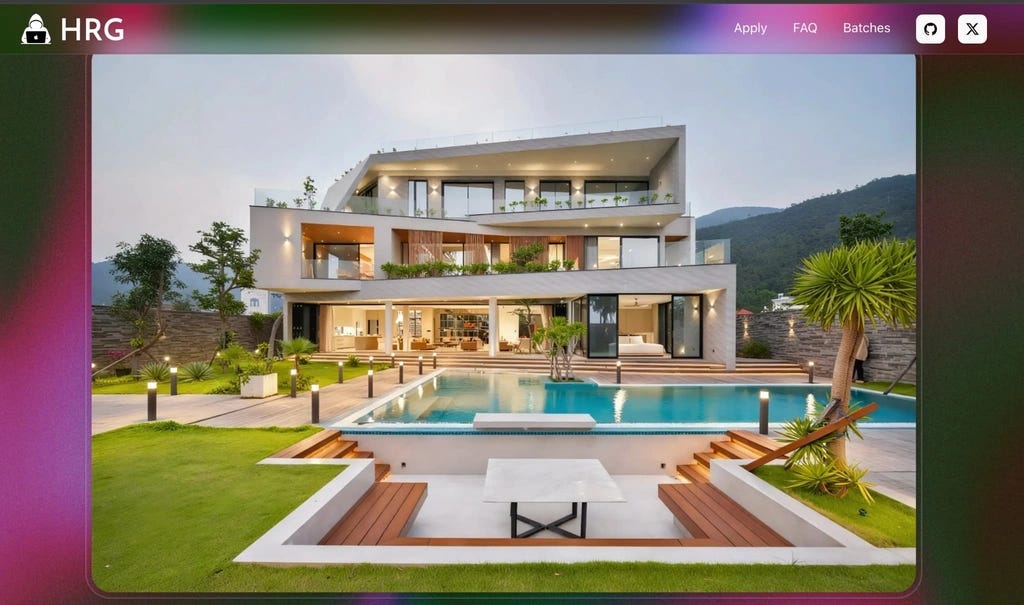
It is held by renting out a villa. Selected participants live in a luxury villa in Da Nang for a month, finishing their products while living together. It’s generous enough that accommodation and food costs for the month are free. Finally, the completed products are presented on Demo Day.
It is a very interesting project that is buzzing on X. The first cohort was held in the fall of 2025, with about 10 indie developers participating.
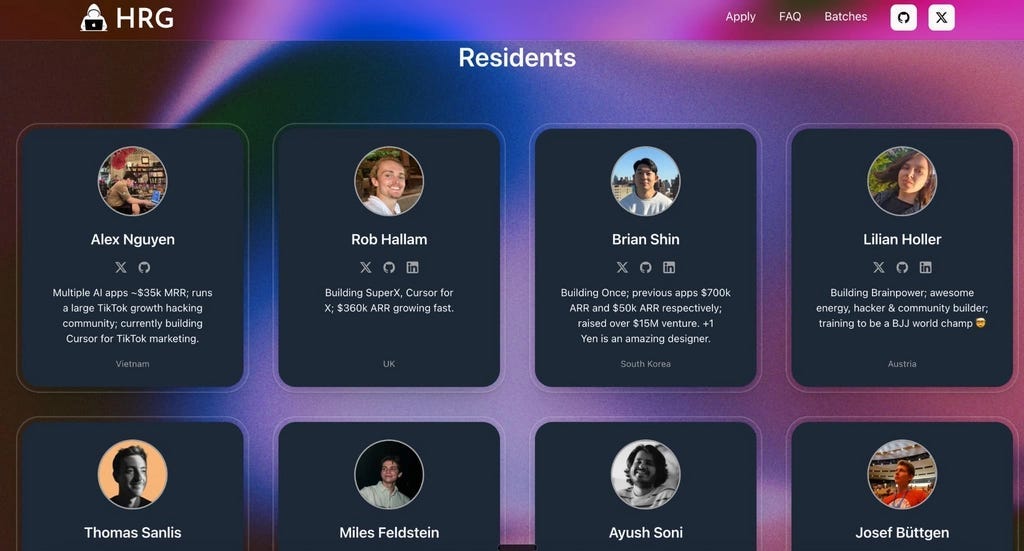
It attracted people who were already somewhat famous and had achieved a certain level of success. One of them was Brian. I thought this approach was smart. Brian was rich in experience, but he didn’t have much influence on platforms like X. However, by participating in this project, he could connect with influential people across many social media platforms and leverage their influence to give his app a boost at launch.
From the HRG management side, it is also important for the project’s reputation that the initial members succeed, so they would naturally promote him. So, Brian jumped into HRG with the needs already confirmed and spent a month building the app. That said, just relying on the power of HRG wouldn’t result in growth to $35k per month.
I thoroughly researched the actions he actually took, and specific strategies emerged that explain why he succeeded. I’ll say it again, the app is so cool and excellent. I truly wish I could build an app like this. And this is where the real work begins. From here, I will completely dissect the strategies Brian actually implemented, one by one. Specifically👇
Gritty cold outreach approaches
The TikTok video that hit 7 million views and the winning format
The design philosophy built into the product for natural virality
The strongest UI/UX and well-designed monetization structure
After investigating it all, I thought, “This is definitely going to sell.” It feels like the battle was already decided before building the product. Of course, the insane volume of action after launch was necessary, but I felt that one should develop with a roadmap of actions for post-launch in mind. I think there is a clear difference in results between developing with this in mind and not.
🧑🤝🧑 Getting a Commitment from “Inner Circle” Users First
Well, before launching the app, the first thing he did was to get a commitment from users that they would “use it.” He worked grit-and-grind to aim for 10 users before app development.
So, how specifically did he get these “10 usage commitments”? The first thing he did was to thoroughly scrub his network. X, LinkedIn, Instagram, Facebook. He opened his friend lists on every platform and checked one by one: “Is this person going to hold an event soon?” This is super tedious work. But it is incredibly powerful. And in fact, four friends said they would “like to try it.” Four events: a Halloween party, a birthday party, a wedding, and a networking event.
Here, he mentions a concept called the “Mom Test” as an important rule. The idea is that if you tell your mother (or family) about an idea, they will praise it by saying, “That’s lovely!” no matter what. Family is kind, so they won’t evaluate you seriously. Therefore, you must not mistake the praise of family for “validation.” Brian focused on honest validation rather than seeking encouragement. Instead of “That’s a good idea,” he asked, “Will you really use it at your event?” He raised the hurdles significantly to find only those who would truly commit.
When people talk about pre-validation, they often talk about “making a landing page and collecting email addresses.” This is still effective, but honestly, the commitment is weak with just that. There is an insurmountable wall between “I’m interested” and “I will definitely use it.” In that sense, Brian’s true pre-validation is incredibly strong.
📩 12 Event Bookings Secured via Instagram Cold Outreach
The action Brian took after exhausting his personal network is gritty, but important. It was a cold approach to potential customers beyond his inner circle. Since Once is a product used for parties and weddings, he searched for hashtags like #wedding and #birthdayparty on Instagram one after another.
He listed about 300 people across platforms. Then he sent a simple 2–3 sentence cold DM to everyone, pitching the idea. As a result, he received replies from 15 people, and 12 event bookings were decided within that month. The reason the conversion rate is so high here is because there are events right in front of him — weddings and birthday parties — that “will definitely be held,” and there is a “must-have” need for photography.
🚀 Breaking Through the Limits of Cold Outreach: “Do it until you get banned twice”
Let me introduce a famous quote from Brian here: “If you aren’t doing it enough to get your account suspended (banned) at least twice on the platform where your target audience is, you aren’t trying hard enough.” Wow, this is electrifying.
The average person tends to think, “If I get banned, it’s over,” but the mindset of successful overseas indie hackers is the exact opposite: “If I got banned, it’s proof that I pushed to the limit.” “If I haven’t been banned, it means I still have room to push.” Julian, whom I introduced before, also got banned for sending too many DMs on X to gather initial users.
Of course, spammy, annoying behavior is bad, but if you have conviction that your product has real value, you need to push to the platform’s limits to reach your targets. Especially for a product with zero awareness at the initial launch, it will never grow unless you take appropriate risks.
🚀 The Disposable Camera App “Once,” Launched This Way
So, having secured usage commitments before development, he launched the app “Once” in one month at the hackathon at Hacker Residency in Da Nang.
 X (formerly Twitter)
Brian Shin (@brianshinsh) on X
new app is finally live!
was soo nervous that it wouldn’t be ready by demo day but apple thankfully approved it on the last day 🥲
goal is to reach $10k/month in 100 days and i’ll be sharing my lessons on the way!
(super happy that the first photos ever taken on the app are my friends from HRG …
X (formerly Twitter)
Brian Shin (@brianshinsh) on X
new app is finally live!
was soo nervous that it wouldn’t be ready by demo day but apple thankfully approved it on the last day 🥲
goal is to reach $10k/month in 100 days and i’ll be sharing my lessons on the way!
(super happy that the first photos ever taken on the app are my friends from HRG …
Brilliantly, the launch tweet went viral and gained about 200,000 impressions. It was exactly a case of leveraging the influence of Hacker Residency. With the customers who were already committed and the influence of the launch post, he was able to gain traction from the start.
Now, let’s briefly look at what kind of app Once is! As mentioned at the beginning, it is an app that provides an experience like a disposable camera. An event host can use this app to encourage participants to take photos at an event. Photos taken during the event are stored in a common folder, allowing everyone to look back on the memories together. Also, to bring the experience closer to a disposable camera, you can choose when the photos are made public👇
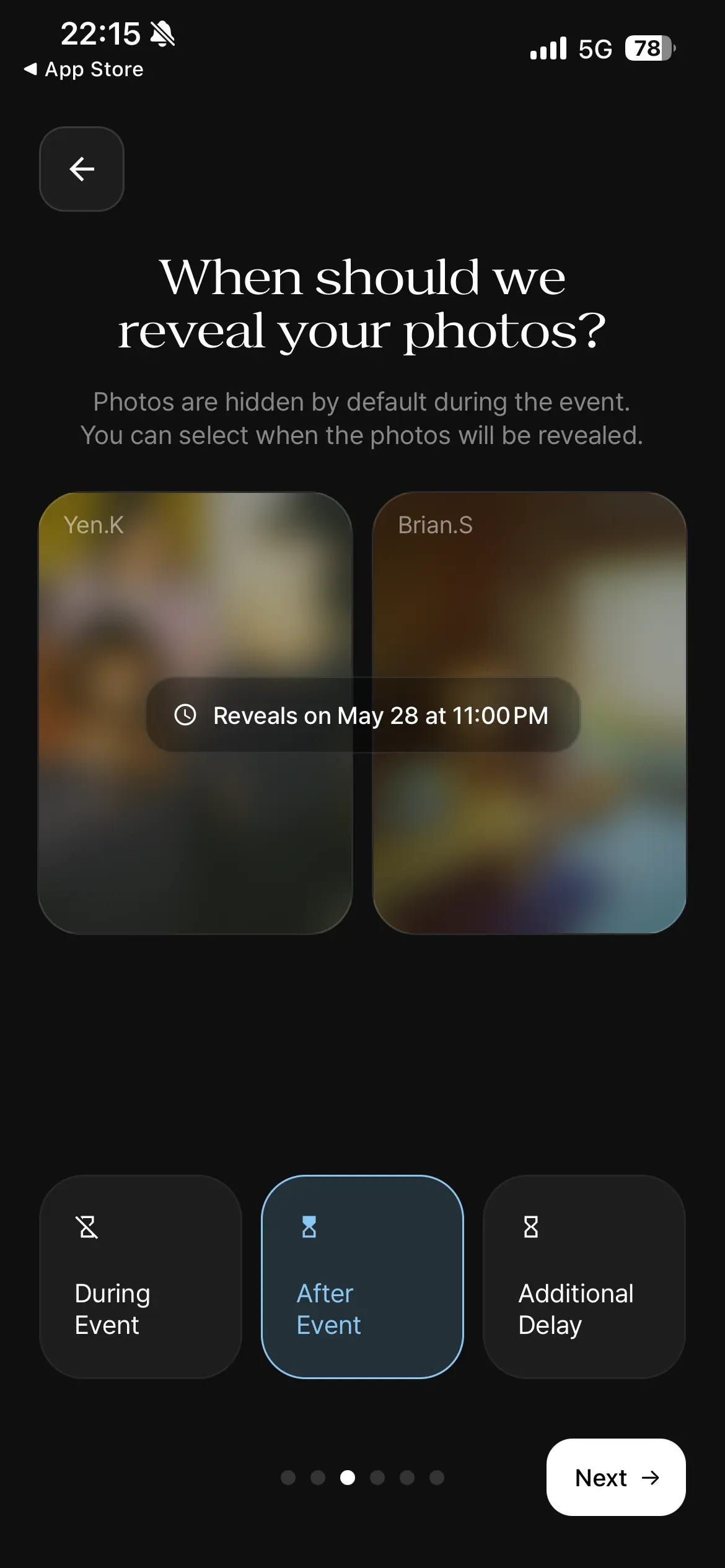
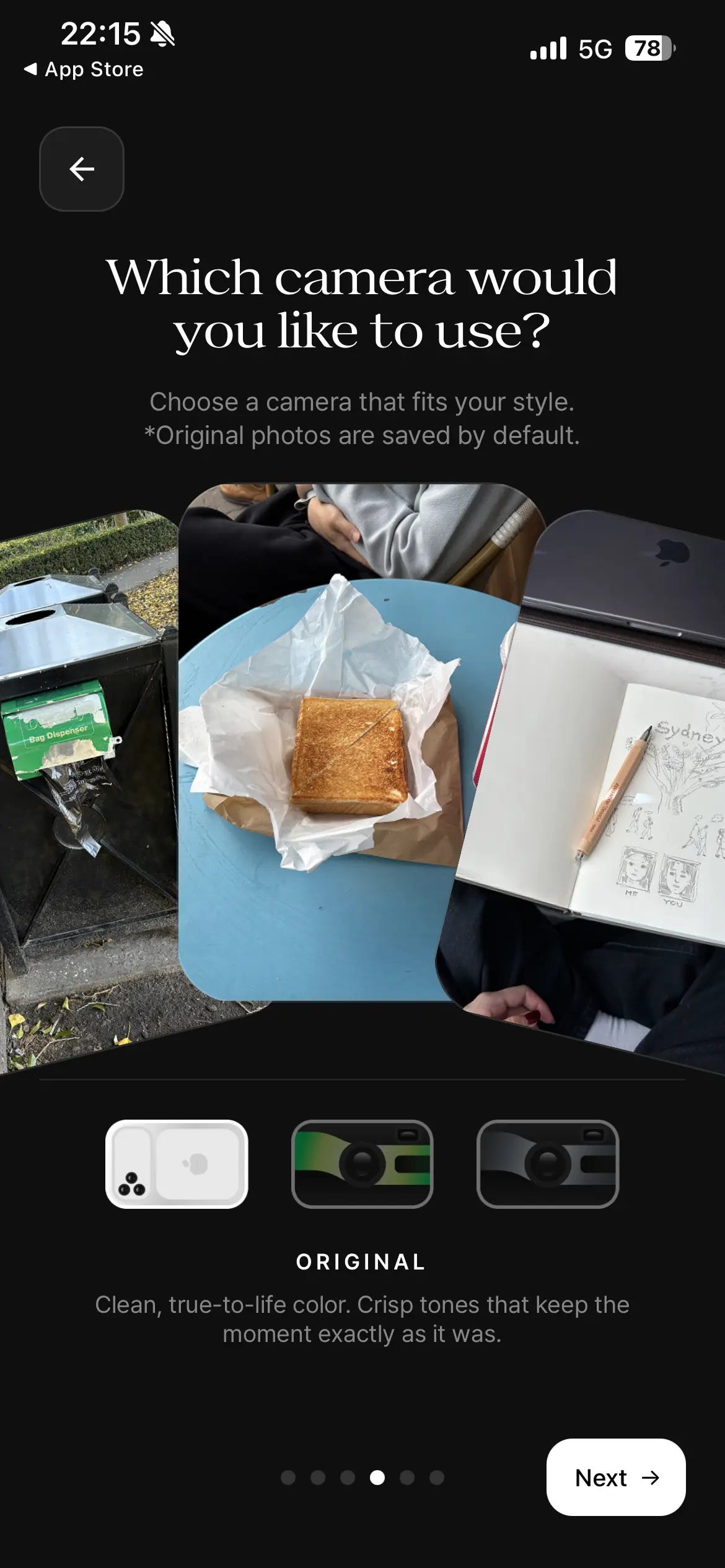
The restriction that they can only be checked after the event is also good. You can choose retro filters for the photos👇
And the host decides the number of photos that can be taken in advance👇
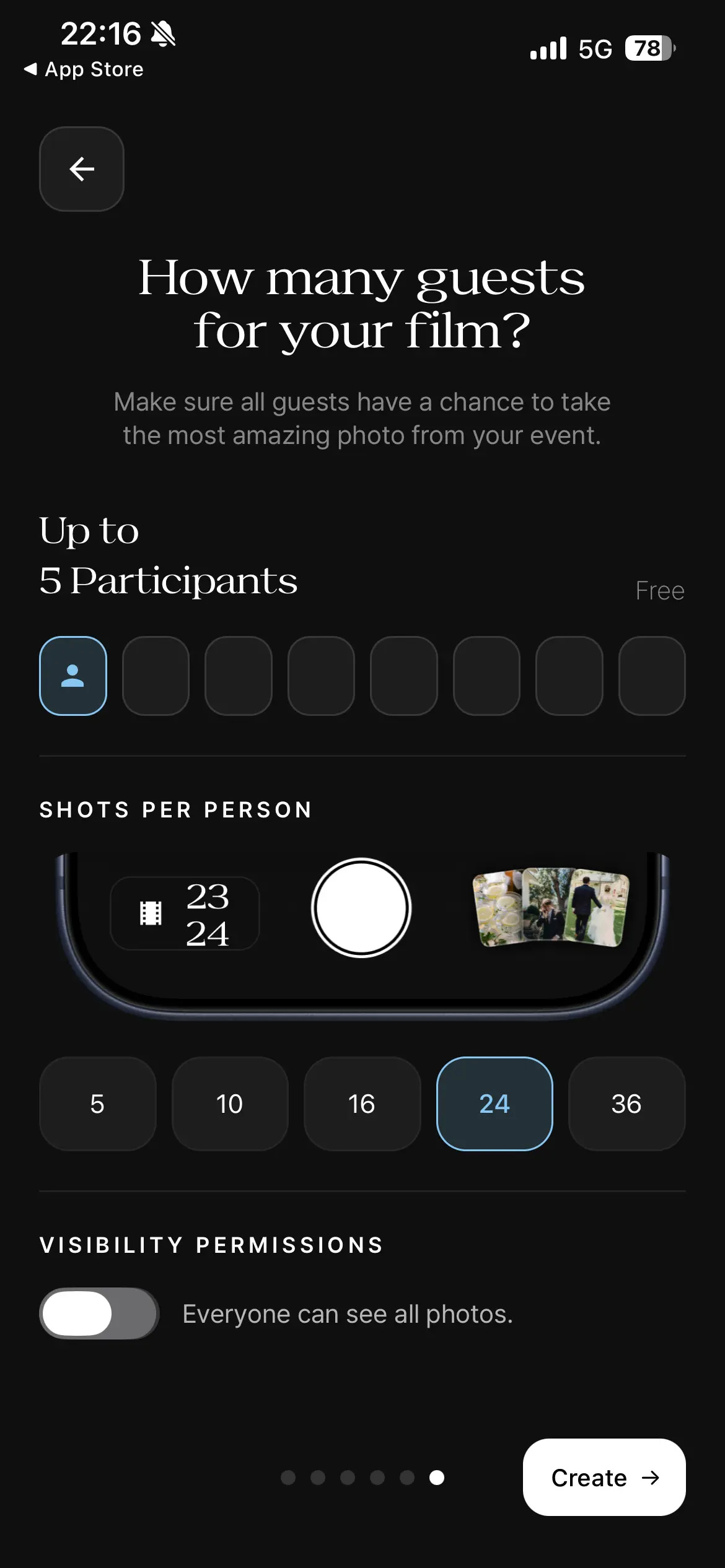
It is free for up to 5 users, but a pay-as-you-go system applies if you invite more people to the event. The specific pricing is like this↓
Up to 5: Free
10: $1.99
25: $4.99
50: $14.99
100: $29.99
150: $49.99
200: $69.99
Unlimited: $99.99
This pricing is truly genius. It is designed with a smooth price range where you “try it for free, and if you like it, it naturally upgrades according to the number of people.” $1.99 for 10 people is dirt cheap for a friends’ birthday party; $29.99 for 100 people is a rounding error from the total cost of a wedding; and $99.99 for unlimited is an instant decision from a corporate event budget. And the point that it is “one-time payment, not a subscription” is also important. A wedding only happens once in a lifetime, and you don’t hold birthday parties every week. Subscriptions don’t fit for such event-based services. It is important to design an experience where the user feels “once I pay, I’m done.” If you actually touch it, you will understand how superior the UI/UX is. You can also check the screen transitions of Once from the “Onbo Hub” below.
So, Brian continues to grow his revenue steadily. One month later, he exceeded $1,000 in monthly revenue.
 X (formerly Twitter)
Brian Shin (@brianshinsh) on X
Woke up to $1k revenue!
Can’t believe this happened in just 33 days of launching.
I think we found the right content format that resonates well with our target audience.
Time to double down.
X (formerly Twitter)
Brian Shin (@brianshinsh) on X
Woke up to $1k revenue!
Can’t believe this happened in just 33 days of launching.
I think we found the right content format that resonates well with our target audience.
Time to double down.
However, with this speed of growth, it seems impossible to reach $35k in monthly revenue five months later. How was he able to accelerate growth so much from here?
Naturally, it was the explosive power of short-form videos and the viral mechanism built into the product. Let’s take a look specifically.
💃 Short-Form Video Marketing via TikTok
As expected, he also made it go viral through short-form video marketing on TikTok. In this day and age, if you want to succeed with a toC product, short-form video marketing is a must. One should think about the product’s experience and functions on the premise of short-form video marketing. If you can build a product with a strong hook, you can naturally go viral with short-form videos. For example, the following video has been viewed 7 million times👇
In a video of a woman crying at a wedding party, intense hook text is displayed. From there, it naturally leads to the promotion of Once. The “promotion feel” of Once is not strong, and it is designed so that users who see it thoroughly will want to try it. And he is making things go viral with the same composition as this👇
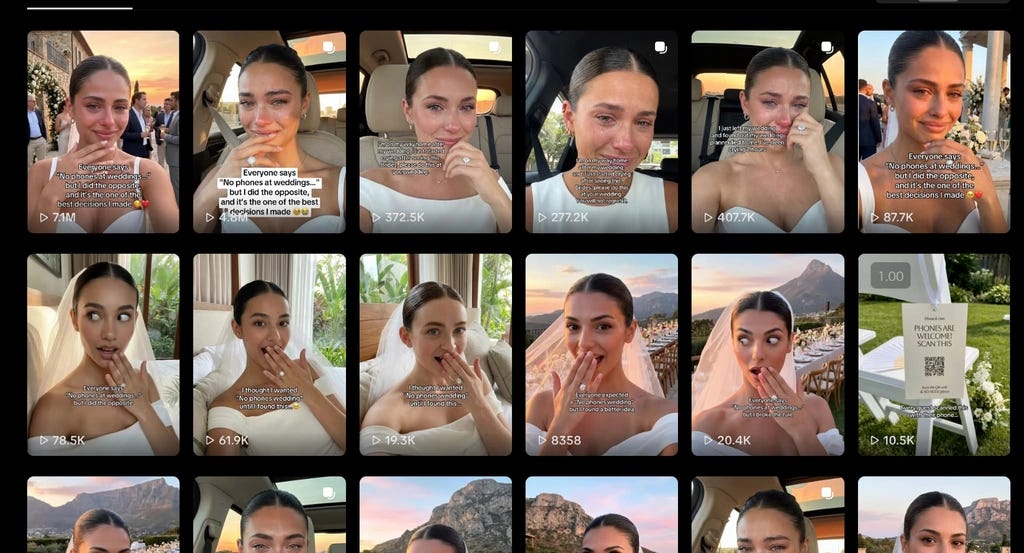
The woman’s video in the hook scene is likely all made with AI. “Woman” × “Crying face or Surprised face” × “Powerful hook text” is the standard method for going viral. He has tried this with various patterns and successfully made them go viral. With this, the revenue grew explosively. As a result, within 90 days of launch, he reached $20,000 in monthly revenue.
However, the problem here is that their product is not a subscription. In other words, there is a possibility that even if it goes viral on TikTok short videos, it could end up as one-time revenue. But the amazing thing about this app is that it has a viral design naturally embedded in the product that transcends that one-time payment. I thought, “This is going to grow even more.”
🎯 Mechanism for Natural Virality Embedded in the Product
In fact, the true greatness of Once is not the initial gritty sales or the virality from TikTok short videos. These are just for giving the initial movement momentum.
Once the initial momentum is gained, the mechanism for it to go viral naturally afterward is embedded in Once. In this app, first, one host installs the app and pays. Then the host just places a QR code at the event. Users who participated in that event experience this app here. And a user who has used it once as a participant will then want to use it as a host for another event! By repeating this, the app spreads further and further.
It is not at the level of one person bringing in 2 or 3 users. It is an app where one person brings in nearly 100 users at once. A classic but super powerful “viral loop” structure. Due to this app design, word-of-mouth spread with overwhelming speed and it went viral. Indeed, embedding viral design into the product is incredibly important for realizing sustainable growth. Products that grow long-term are generally designed this way.
Thus, finally, 150 days (5 months) after launch, the monthly revenue exceeded $35k.
 X (formerly Twitter)
Brian Shin (@brianshinsh) on X
today is day 150 of launching my app and we just crossed $35k/mo
it's been a while since I last posted about our growth and that's because sharing my journey has been doing more bad than good:
- negative reviews from users who haven't even tried out the app
- attempts to attack our servers
- blat…
X (formerly Twitter)
Brian Shin (@brianshinsh) on X
today is day 150 of launching my app and we just crossed $35k/mo
it's been a while since I last posted about our growth and that's because sharing my journey has been doing more bad than good:
- negative reviews from users who haven't even tried out the app
- attempts to attack our servers
- blat…
📝 Summary
So, we have looked at Brian’s story up to this point. It really feels like success was destined to happen. First, he proceeded to product development after thoroughly validating needs and acquiring initial customers. Then, he participated in Hacker Residency and launched by borrowing the influence of the participants and the management.
Stable virality with TikTok short videos. It is thought that he had properly anticipated short video virality from the beginning and designed the product accordingly. And the clincher is the mechanism where the product goes viral naturally. It is really strong to have a mechanism for going viral embedded in the product. Strong. Too strong. And the product concept is too good. The level of perfection is too high. In this day and age, the market is flooded with similar products. Now that anyone can easily create products using AI, it has become easy to trace successful apps. In fact, among the success stories introduced in this newsletter so far, there are many cases where they imitate successful apps to increase revenue.
Of course, imitating to some extent is important for success, but even so, we have come to a world where there are many similar apps. In such a world, I felt it was a novel app with a good concept for the first time in a while. I want to build an app like this someday. I should be able to! I have to do it!
reference
https://apps.apple.com/us/app/once-disposable-camera-event/id6754265953