This Ridiculously Simple Product "Outbid.lol" Made $132K in 48 Hours
outbid.lol is essentially a leaderboard where companies pay for their rank. That’s it. So how did something this simple go viral and attract over 1 million visitors?
August 26, 2026
A ridiculously simple product just went viral overseas and put up numbers that don't look real.
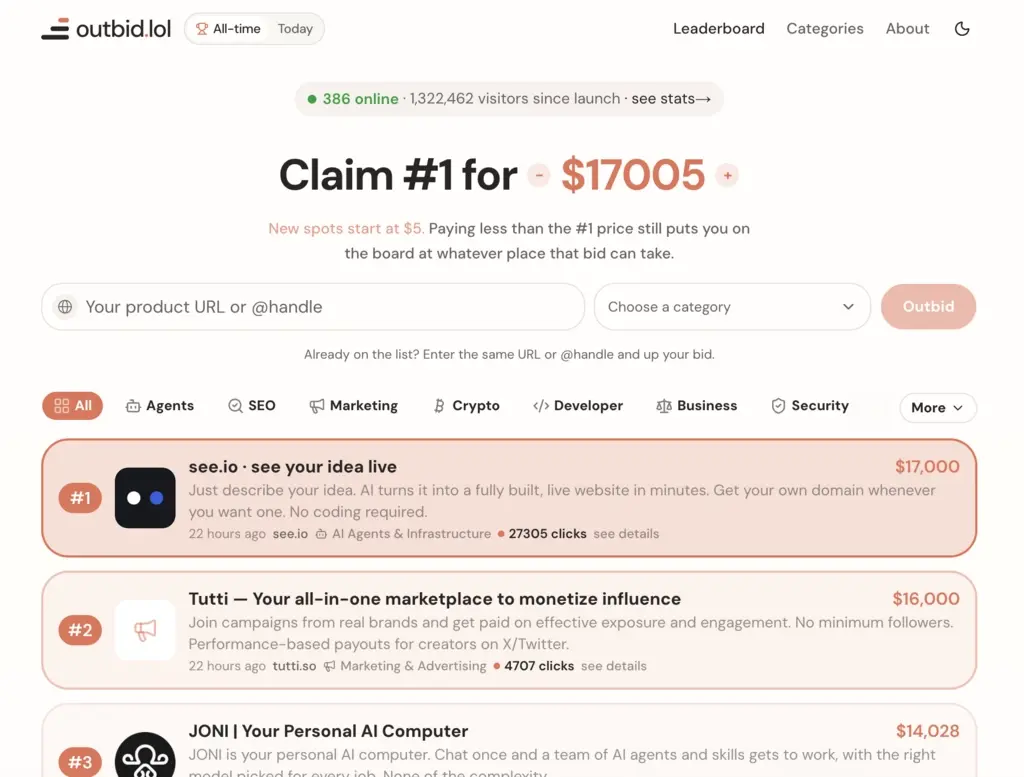
It's called outbid.lol. The entire product is a leaderboard where products are ranked by how much money people bid for a spot. That's it. That's the whole thing.
This almost insultingly simple idea generated roughly $132,000 in bids within 48 hours of launch.
A simple product, with the right idea behind it, can still produce numbers like this. So this piece digs into exactly how outbid.lol pulled it off.
🇩🇪 A Freelance Engineer Since Age 16
Start with who built it. Jonathan Wilke is a 29-year-old software engineer based in Germany.
He started freelancing as a software engineer at 16, doing contract work for multiple companies while building his own products on the side.
His first real hit was supastarter, launched in August 2021.
After years of client work, the same two things kept annoying him on every project: authentication and billing. Every SaaS build meant reimplementing the same tedious groundwork.
So he built himself a template with all of that already wired up — then turned it into a product. That became supastarter. Marc Lou's Ship Fast is the best-known comparable product in this space. AI has since made it much easier to build these features from scratch without a template, but before AI, boilerplates like this carried real weight.
supastarter launched at $49. The price has climbed steadily since; the cheapest plan today runs $224. It grew into a solid business, eventually clearing $10,000 a month.
A side project he built in three hours just beat supastarter's entire annual revenue — in two days.
💡 The Launch of outbid.lol
supastarter wasn't his last product. He kept shipping things after it. But growth is never easy to manufacture.
In the AI era, marketing has become disproportionately valuable. Product Hunt used to be enough — post there, get a ranking-driven wave of attention. Not anymore. Product volume exploded, and so did the number of people gaming the rankings.
Most of these ranking platforms decide position by user votes. And increasingly, that meant paid votes, bot farms, and every dishonest tactic imaginable.
Jonathan's answer: why not just make the ranking about money, openly? Skip the pretense of a fair vote and let people pay to be #1. That's outbid.lol.
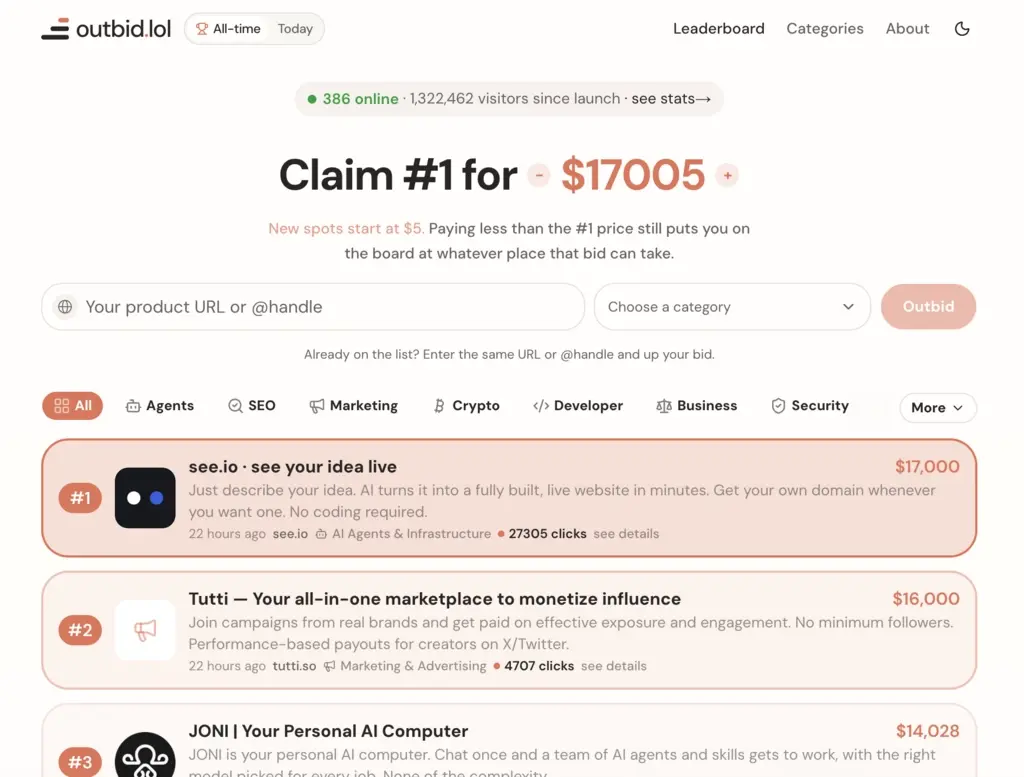
Let's walk through exactly how he announced it and grew it. The trajectory is remarkable.
He'd been posting "build in public" style on X well before launch.
First, he bought the domain for $1.80.
Nobody wants a .lol domain, so of course it was cheap. The domain alone signals this is a joke project. At this stage, nobody was paying attention.
He tweeted while building it:
Launch landed around 11pm German time on August 19:
That timing isn't an accident. 11pm in Germany catches Europe right at the tail end of its evening scroll, while landing at a solid hour for the US. If you want attention from both sides of the Atlantic at once, that's close to the ideal launch window.
Fittingly, he built and shipped outbid.lol using his own supastarter template.
🚀 outbid.lol Takes Off
Here's the timeline of exactly how loud it got.
24 hours after launch:
Revenue: $21,499
Visitors: 200,000+
Highest bid: $10,000
New X followers: 1,500+
Acquisition offer: $100,000, declined
Over $21,000 in a single day, plus a six-figure acquisition offer, for a product that's a spreadsheet with a bidding button. That's an absurd 24 hours.
It didn't slow down. 48 hours in:
Total bids: $132,000
Visitors: 1,100,000+
Products listed: 867
Highest bid: $14,000
You can see the acceleration in those numbers. A dead-simple idea, growing at a rate that's hard to explain by luck alone. So this is where it gets interesting: I went back through the full product design and Jonathan's entire posting history to work out exactly why this thing grew the way it did — from a product standpoint and a marketing standpoint.
Specifically, this is what's actually driving it:
Virality that's built directly into the product mechanics
Trust, engineered through total data transparency
A bidding flow stripped down to almost nothing
Design choices that keep late arrivals from being priced out entirely
The exact posting pattern he used to light the fuse
I'll also walk through a couple of historical precedents for this exact kind of stunt, and what they suggest about whether outbid.lol turns into something that lasts or fades out like every hype cycle before it. If you build things on your own, this is a movement worth studying closely.
Let's get into it.
🎯 The Virality Is Built Into the Product Itself
The first reason outbid.lol took off: the product mechanics themselves are inherently viral. Look at the actual rules:
New listings start at a $5 minimum, capped at $999,999, in $1 increments
To take the #1 spot, you must beat the current leader by at least $5
Every other rank moves in $1 increments
To climb without taking #1, you only need to pay the difference above your current bid
Listings are limited to a product site or an X account — no Discord invites, no affiliate links, no shortened URLs
These rules look minor, but they're doing a lot of work.
Only the #1 spot requires a $5+ jump to flip. That single rule drives the price war for the top position specifically.
And every time #1 changes hands, it becomes its own moment — Jonathan tweets it, and so does whoever just took the crown. The bid-to-rank structure has virality baked into the mechanic itself: it grows by pulling more and more people directly into the competition.
As of this writing, the top bid has climbed to $17,000 (it may well have flipped again by the time you're reading this).
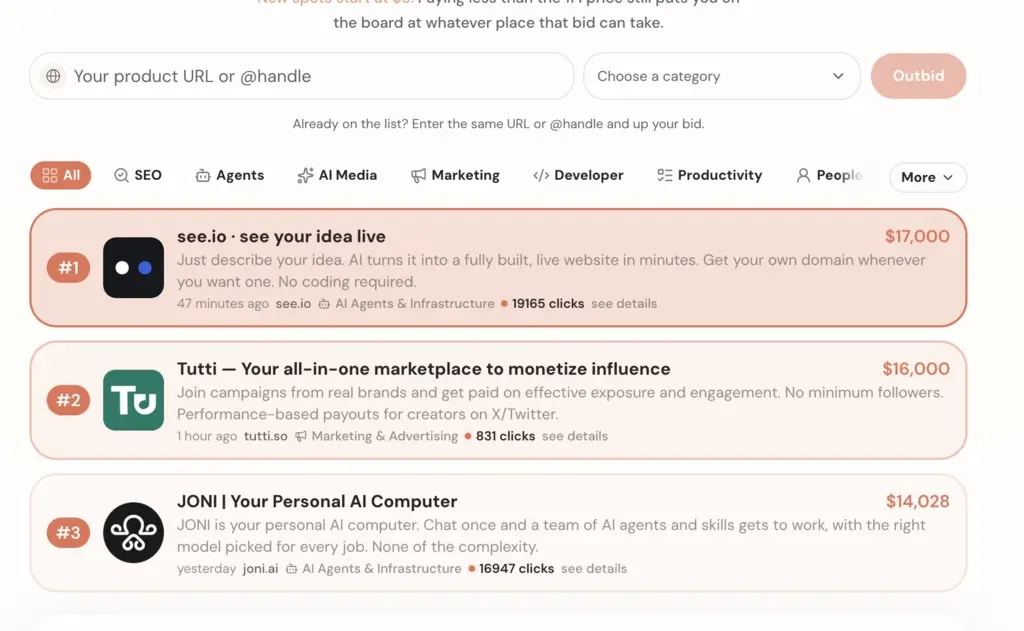
On a leaderboard like this, holding #1 obviously matters — the click-through gap between #1 and #2 is enormous. Second place isn't good enough. Which is exactly why the fights get so intense. If you're sitting in second, an extra thousand dollars or so buys back the top spot.
In a normal auction, the winner pays and takes everything; the runner-up walks away and pays nothing. Here, second place has already paid their full bid. Which means topping up by a relatively small amount to reclaim #1 feels almost free by comparison — the sunk cost is already spent either way.
That's a much stronger pull toward escalation than a standard auction produces, and it's exactly why prices keep climbing.
Pay-to-rank leaderboards aren't new. What's different here is the total honesty of it: you're simply paying for position, full stop, no vote-gaming pretense involved. Logically, nobody should want to look at a leaderboard where placement is bought outright. But the sheer bluntness of that mechanic is precisely what made it a story.
📊 Radical Transparency: Real-Time Traffic, Displayed on the Homepage
Another smart move: live visitor counts, shown directly on the homepage.

Click through and you get a full traffic dashboard.
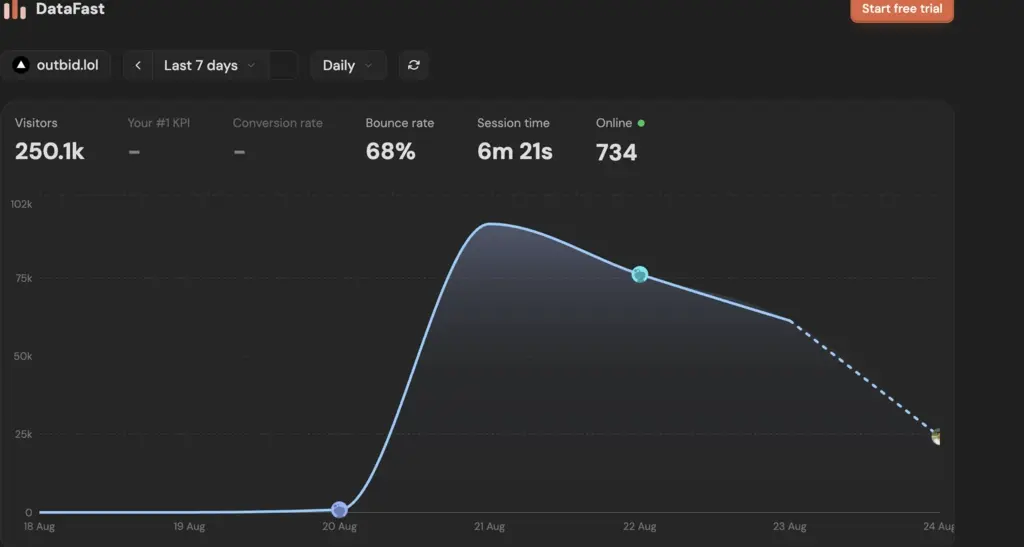
That dashboard runs on DataFast, an analytics tool built by Marc Lou. Jonathan integrated it partway through to track traffic properly.
Click totals for each individual listing are shown too.

Putting these numbers in the open — how much traffic the site gets, how many clicks a given rank is likely to generate — lets bidders estimate their return before they ever place a bid. Having that data visible versus not visible almost certainly moves conversion significantly.
💸 Bidding Takes About Ten Seconds
The other defining trait: how easy it is to actually place a bid.
The typical path to getting someone to pay involves onboarding, then account creation, then checkout. outbid.lol skips all of it — no onboarding, no signup.
Above the leaderboard sits a big, direct call to action: "Claim #1 for $X." You adjust the number and bid straight from there.
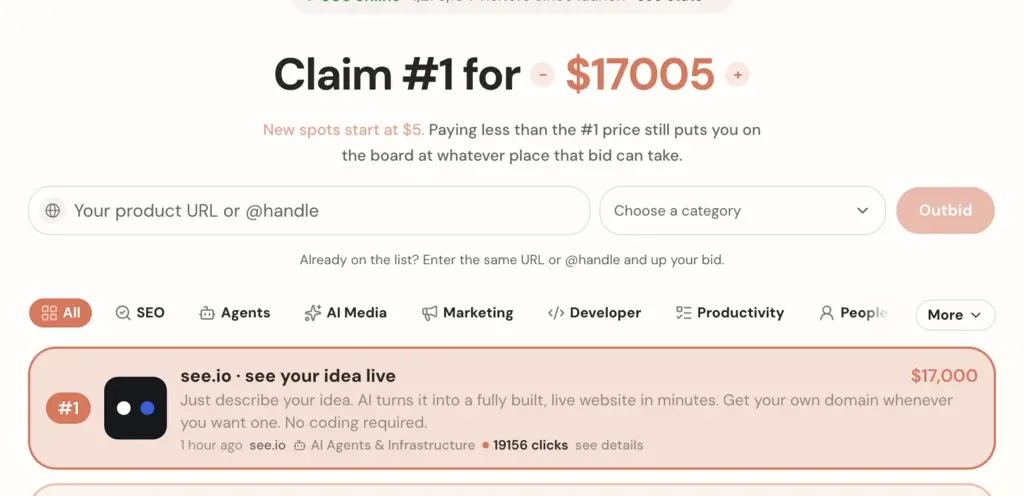
Change the amount and it instantly shows you what rank that buys.
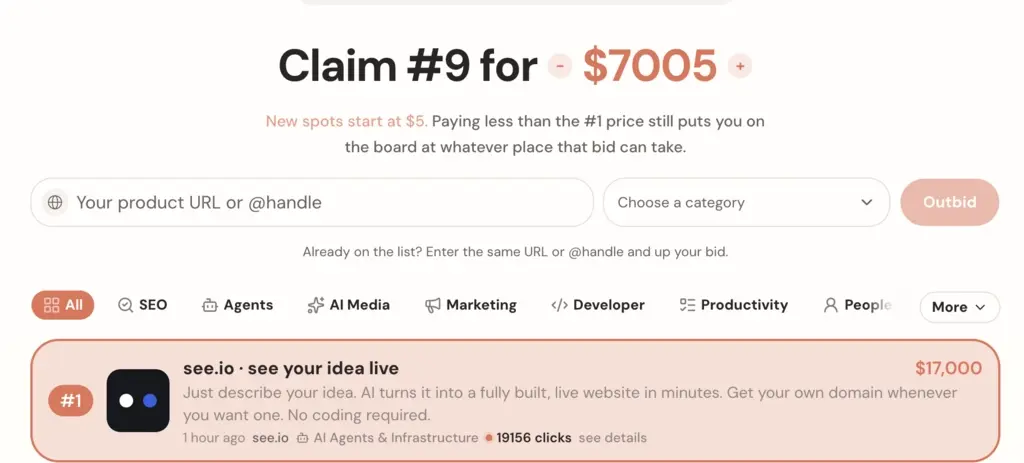
Enter your product's URL, pick a category, hit the Outbid button, and you're straight into checkout.
I've covered plenty of apps in past pieces that drive revenue through long, carefully engineered onboarding flows. outbid.lol does the exact opposite — it strips away as much friction as physically possible before payment.
Native mobile apps tend to lean on long onboarding; web apps typically keep it short, since the landing page itself does the job onboarding would otherwise do. When the value is obvious upfront and the whole point is essentially advertising, minimizing friction before checkout is clearly the right call. It's product-dependent — more onboarding isn't automatically better.
Worth noting: you don't need to enter a product URL — an X handle works too. There's no account verification of any kind, so nothing requires the listing to actually belong to you.
Which is how someone managed to place a bid under prominent indie developer Pieter Levels' X handle (possibly Pieter himself, who knows):
That casualness is very likely part of why people found it so easy to jump in.
📚 Splitting the Leaderboard Into Categories
Originally there was just one all-time, all-category leaderboard. Jonathan later added per-category rankings and a daily leaderboard.
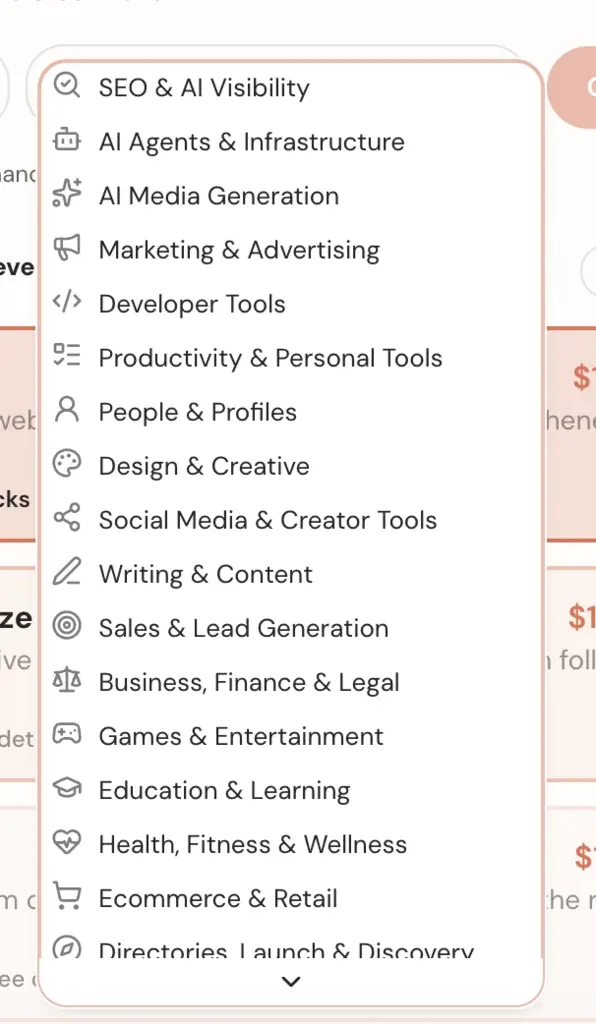
Prices on the main board had climbed high enough that new entrants were effectively priced out — so a daily and category-based board gave latecomers a real way in, lowering the barrier for anyone joining after the initial rush.
🎯 Lighting the Fuse on the Flywheel
The product mechanics are clearly well designed. Once a positive feedback loop is running, something like this can compound fast.
But none of that spins up without an initial push. So Jonathan posted relentlessly on X. He's since crossed 20,000 followers, but at launch he almost certainly had under 10,000.
He quote-tweeted his own launch post over and over, manufacturing attention at every opportunity.
Domain cost $1.80, so $3 in revenue puts me in the black:
115 visitors in the first 10 minutes:
Then, roughly 30 minutes after launch, the first bid came in:
Once a single person bids, momentum takes over — competitive instinct pulls others in. And every time it happened, he posted about it again.
Alongside that loop, he posted revenue updates as they rolled in, generating another wave of attention on their own:
He was building hype around the product itself while simultaneously turning revenue milestones into content — a classic build-in-public playbook, and revenue-reveal posts reliably perform well on X.
Because a rank change on his leaderboard is, by definition, a revenue update, the product and the platform's incentives line up almost perfectly. That combination compounded exponentially: his original launch post eventually crossed 3.6 million cumulative impressions — nearly all of it earned through repeated quote-tweeting, not passive growth off a single post.
🕺 Influential Indie Developers Start Bidding
Once the movement had real size, well-known indie developers on X started jumping into the bidding themselves.
Jack Friks bid $420 and took #1:
He has 150,000 followers and has been on a real run lately. That single tweet alone pulled in 160,000 impressions.
Every time a developer with real reach joins in, attention on outbid.lol compounds further.
Tibo bid $12,000 and took #1:
Big-name indie developers piling in kept generating fresh attention, and with the auction structure underneath it, revenue climbed accordingly.
💰 Did the Money Actually Pay Off?
Which raises the obvious question: did the companies dropping serious money actually get anything for it?
Tibo followed up with this:
His bid, he reported, brought in 58 more trial signups than his baseline. By his math, if just 6 of those 58 convert to paying customers, the bid pays for itself on lifetime value. He called it a good deal.
SEO tool CrowdReply shared their own numbers publicly: they paid $12,700 for the #1 spot. Reported results:
"6,550 clicks, 1,800 signups, and roughly $50,000 a month in pipeline generated."
If that number holds up, that's roughly $12,700 in spend generating an estimated $50,000 a month in pipeline value — an extraordinary return, on paper.
📜 This Has Happened Before
"A dead-simple rule set that captures everyone's attention at once" isn't new. The internet has produced this exact shape of moment repeatedly.
The most famous version: The Million Dollar Homepage, built in 2005 by Alex Tew, then a 21-year-old British student. The entire site sold a million pixels at $1 each. It sold out almost immediately and made him a millionaire.
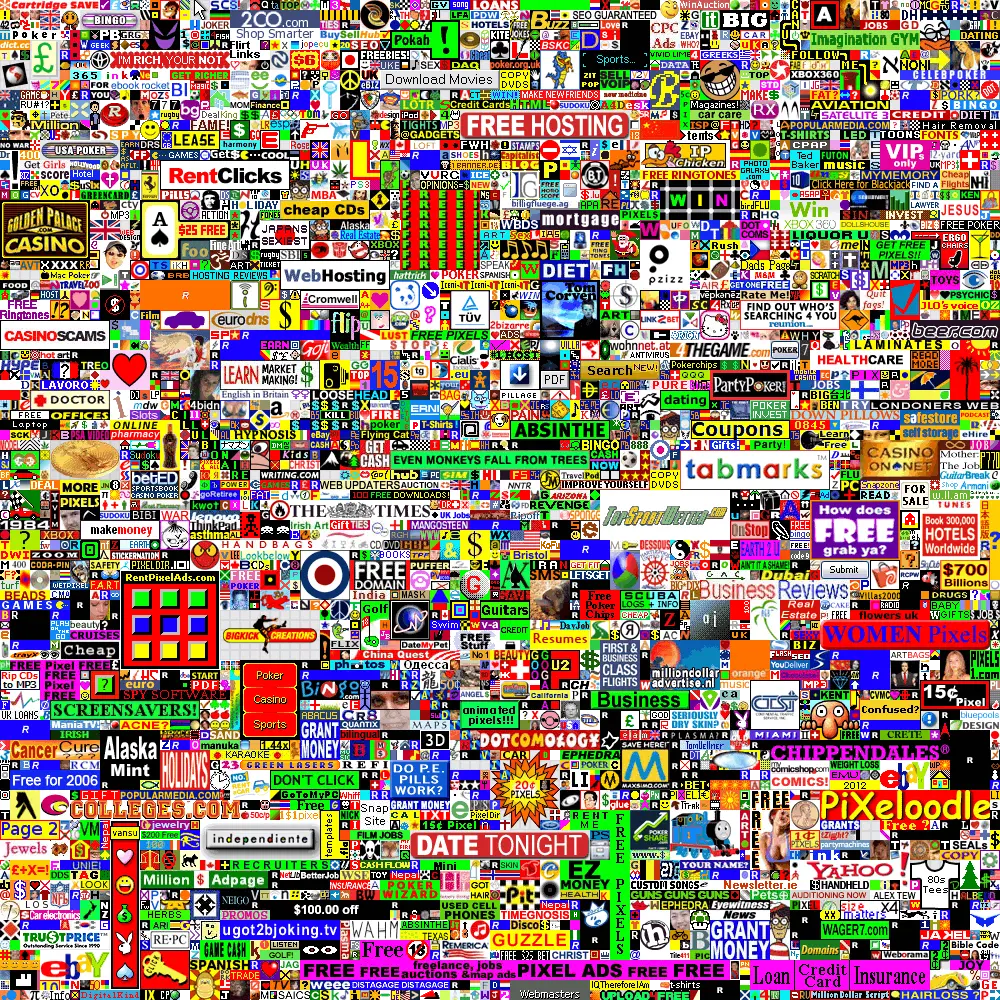
The simpler the rule set, the lower the barrier to joining — and the more visible "everyone's watching this" becomes. That's structurally almost identical to outbid.lol.
The difference: the Million Dollar Homepage was a one-time sellout. outbid.lol has built-in continuity — ranks can flip indefinitely as new bids come in. That single design choice gives what would otherwise be a one-off stunt some real staying power.
Even so, history isn't kind to formats that run purely on novelty and hype. Almost none of them last.
Two recent examples from the indie developer world come to mind:
Pieter Levels' flight simulator
Marc Lou's TrustMRR
Pieter Levels built a flight game in three hours riding the vibe-coding wave, got it to go viral, then sold ad placements inside the game — banners on in-game blimps, that sort of thing — and grew it to roughly $85,000 a month within 20 days. (Since the ad deals were monthly subscriptions, that revenue was recurring on paper, though churn was almost certainly steep.)
Watching that unfold, my honest reaction was: of course Pieter Levels pulled that off. Getting an audience genuinely invested in something being built in real time is exactly his skill. But the product itself never had staying power — it was a flash of attention, and within a few months, almost nobody was using it anymore.
Marc Lou's case played out differently. He built TrustMRR — a leaderboard where users publish verified, trustworthy revenue numbers rather than bidding for position. This one also went viral fast, and ad revenue climbed to nearly $20,000 a month.
That's usually where the story ends: novelty fades, traffic drops, done. Instead, TrustMRR is still growing, and it's become the single biggest earner in Marc Lou's entire portfolio.
His move: rather than leave it as a leaderboard, he evolved TrustMRR into an M&A marketplace — a place where the businesses on the leaderboard can actually be bought and sold. The M&A fee itself is only around 3%, so most of the revenue is still advertising.
But adding real transactional value gave people an actual reason to keep coming back, not just to check a ranking once. TrustMRR still pulls enormous traffic today, and because there's a steady stream of repeat visitors, there's always a fresh pool of advertisers willing to pay for placement. It's a genuinely smart pivot — turning a novelty leaderboard into a durable business. I wrote about Marc Lou previously here as well:
📝 Wrapping Up — and What's Next for outbid.lol
So that's the full breakdown of Jonathan Wilke's outbid.lol.
The product design and the way he lit the marketing fuse were both genuinely well executed.
Whether this turns into a lasting business is a separate question entirely.
The TrustMRR path — pivoting into M&A — doesn't obviously translate to outbid.lol. The ranking itself carries no inherent value or information; it's purely pay-for-position. Without a steady stream of new visitors, there's no reason for anyone to keep advertising there.
One plausible fix: make the default homepage view "Today" instead of all-time. If a handful of dominant bids permanently lock up the top of an all-time leaderboard, there's no incentive left for anyone to bid. No incentive means the buzz dies and traffic falls off. Reset the featured leaderboard every day and give it real day-to-day turnover, and there's a case for bidding to stay worthwhile — and for the platform to hold attention long-term.
Where outbid.lol actually ends up is still an open question.
So that's a full look at Jonathan Wilke this week.
Thanks for reading all the way through! If anything caught your attention or you have questions, just hit reply — I read everything.
And if you post your thoughts on X and mention me, it makes my day. I always respond.
See you next time.
References
 Indie Hackers
Hitting $12k/mo with a boilerplate
Jonathan Wilke built a boilerplate to scratch his own itch. Now, it
Indie Hackers
Hitting $12k/mo with a boilerplate
Jonathan Wilke built a boilerplate to scratch his own itch. Now, it
 starterstory.com
How Supastarter Grew to $10K/Month as a Side Hustle - Starter Story
Who is Jonathan Wilke?Jonathan Wilke, a 27-year-old full-stack developer from Germany, launched Supastarter as a side project to streamline SaaS development after years of freelancing and working in startups, leveraging his background in computational visualistics and design. What prob...
starterstory.com
How Supastarter Grew to $10K/Month as a Side Hustle - Starter Story
Who is Jonathan Wilke?Jonathan Wilke, a 27-year-old full-stack developer from Germany, launched Supastarter as a side project to streamline SaaS development after years of freelancing and working in startups, leveraging his background in computational visualistics and design. What prob...
 automatio.ai
Inside outbid.lol: the pay to rank board taking over tech
Discover how Jonathan Wilke built outbid.lol in 3 hours, generating $1,000+ bidding wars and a $100k buyout offer on day one.
automatio.ai
Inside outbid.lol: the pay to rank board taking over tech
Discover how Jonathan Wilke built outbid.lol in 3 hours, generating $1,000+ bidding wars and a $100k buyout offer on day one.
 explainx.ai
Outbid.lol: Why the Pay-to-Rank Board Went Viral | explainx.ai Blog
Outbid.lol made a pay-to-rank leaderboard go viral. Why founders paid $14,000, clones appeared, and its revenue claims remain unverified.
explainx.ai
Outbid.lol: Why the Pay-to-Rank Board Went Viral | explainx.ai Blog
Outbid.lol made a pay-to-rank leaderboard go viral. Why founders paid $14,000, clones appeared, and its revenue claims remain unverified.
 SaaSCity
The .lol Bidding Directory Frenzy of August 2026: Payluck, Outbid & the New Wave of Pay-to-Rank Launch Platforms
Outbid.lol pulled $21k and 200k visitors with a pure pay-to-rank leaderboard, and within 48 hours dozens of .lol clones, reverse auctions, map-conquest boards and directories-of-directories followed. Here's every site in the wave, how bidding vs luck models work, and whether founders should spend a dollar on any of them.
SaaSCity
The .lol Bidding Directory Frenzy of August 2026: Payluck, Outbid & the New Wave of Pay-to-Rank Launch Platforms
Outbid.lol pulled $21k and 200k visitors with a pure pay-to-rank leaderboard, and within 48 hours dozens of .lol clones, reverse auctions, map-conquest boards and directories-of-directories followed. Here's every site in the wave, how bidding vs luck models work, and whether founders should spend a dollar on any of them.
 All Blog Things — The Best in Business and Tech!
outbid.lol: Simple Pay-to-Rank Website Generates $139,041 in 65 Hours
On the night of August 20, 2026, German software engineer Jonathan Wilke completed a three-hour coding session and released a minimal website called o
All Blog Things — The Best in Business and Tech!
outbid.lol: Simple Pay-to-Rank Website Generates $139,041 in 65 Hours
On the night of August 20, 2026, German software engineer Jonathan Wilke completed a three-hour coding session and released a minimal website called o
 Best AISO
Outbid.lol Review: Pay-to-rank Public Leaderboard Website
Outbid is a simple, pay-to-rank public leaderboard website where your position is determined directly by how much you pay. Read more at BestAISO.com!
Best AISO
Outbid.lol Review: Pay-to-rank Public Leaderboard Website
Outbid is a simple, pay-to-rank public leaderboard website where your position is determined directly by how much you pay. Read more at BestAISO.com!
 Yahoo Finance
$120,000 and One Million Visitors in 48 Hours for Solo Founder
More than 700 companies placed bids within two days, turning a one field website into a viral live market for search visibilityOsnabruck, Germany--(Newsfile Corp. - August 23, 2026) - Outbid.lol, a leaderboard where rank is set entirely by what a company pays, drew more than one million visitors and $120,000 in bids within 48 hours of its August 19, 2026 launch. It applies the logic of keyword auctions to a single public page, and one developer built it alone.$120,000 and One Million Visitors in
Yahoo Finance
$120,000 and One Million Visitors in 48 Hours for Solo Founder
More than 700 companies placed bids within two days, turning a one field website into a viral live market for search visibilityOsnabruck, Germany--(Newsfile Corp. - August 23, 2026) - Outbid.lol, a leaderboard where rank is set entirely by what a company pays, drew more than one million visitors and $120,000 in bids within 48 hours of its August 19, 2026 launch. It applies the logic of keyword auctions to a single public page, and one developer built it alone.$120,000 and One Million Visitors in
 en.wikipedia.org
The Million Dollar Homepage - Wikipedia
en.wikipedia.org
The Million Dollar Homepage - Wikipedia