How This 21-Year-Old Built 11 Apps with AI to Make $70k+/Month
How this 21-year-old builds AI apps at lightning speed, goes viral, and prints $70K+/month—and the exact growth playbook showing that if he can do it, we can too.
August 31, 2026

This newsletter is dedicated to dissecting the secrets of overseas developers who are making a killing in this AI era.
The person I am introducing this time is Ernesto Lopez!
He is an incredible 21-year-old who launched over 10 B2C mobile apps in just 10 months and is making over $70,000 USD per month in total. Remarkably, he generated $700 in revenue just 5 days after launching an app, and hit $9,300 in revenue within 14 days.
From there, he started a challenge to build 52 products in 52 weeks, aggressively growing his business while shipping products at a massive scale. At the same time, he has been putting immense effort into growing his presence on X. He started his X account in March 2025. While his apps are amazing, the way he grew his X account is absolutely insane. Posting an outrageous volume of content, he surpassed 40,000 followers in less than a year. This time, I thoroughly researched his social media and analyzed:
What kind of apps he built and how he scaled them
How he managed to capture this much attention on X
I have summarized the analysis below. I hope you read through to the very end. Let’s dive in!
💻️ Transitioning from an SNS Agency to the App Business
Hailing from Miami, USA, he achieved a solid level of success at a young age running a social media agency. He spent his days working relentlessly while making good money.
However, no matter how hard he worked or how much money he made, his time didn’t increase—it only shrank. Every day was consumed by work, and time was slipping away. He realized he wasn’t becoming wealthy at all. Then, one day, it hit him. The agency business is “merely exchanging your time for money.” Endless sales calls.
Endless delivery work. Endless meetings. Endless troublesome clients. Days spent exhausted by all of this. No matter how much money he made, he wasn’t truly wealthy. This is absolutely true. In the contracting or agency business, no amount of money earned will ever grant you free time. To achieve “financial independence” and “free time” to live a wealthy life, you must build “software or media”—leverage mechanisms that generate money even when you aren’t actively working. Naval, a titan of Silicon Valley, also says, “If you want to get rich, build software or media!”
However, once you get a taste of the quick cash from “contracting” or “agency work,” it is incredibly hard to break free. Of course, contracting and agency work aren’t entirely bad. They generate product insights, stabilize cash flow, and have their own benefits. But if you get too deeply immersed in them, you get stuck.
Personally, since I moved to Georgia at the beginning of 2024, I fundamentally decided not to take on contracting work. Before that, I was handling data science projects and providing analysis support for large corporations, which was decently lucrative, but nothing was building up.
I was just exchanging my experience, skills, and time for money. While my revenue dropped sharply in the short term, I am certain this decision was right. As a result, I was able to build numerous products and media assets, and my revenue has now surpassed what it was before I stopped contracting. If you are currently overwhelmed with contracting or agency work, I highly recommend letting go of projects little by little and committing to building software or media. Software and media don’t yield results overnight, but they become long-term assets.
🚀 Leveraging AI Tools to Launch Apps at Lightning Speed
Now, let’s get back to Ernesto. Convinced that he could never achieve true wealth through a social media agency, he entered the app business. From this point on, he would launch apps at an incredible speed, make content go viral, and rapidly grow his revenue.
So, what specific steps did he take to turn his ideas into reality and scale them? He says, “Most people fail before they even start.” Initially, everyone prioritizes their own desires and tries to build “the ultimate genius app that I thought of.” However, nobody wants that. In a highly viral X post, he states: “It’s vital to pick a niche idea and validate it first.” His app-building steps are as follows:
Find a painful problem Find a problem that people struggle with every single day. Think about whether it can be solved with an app. → I believe this doesn’t have to be other people’s problems; it can be your own. Especially at the beginning, focusing on your own problems makes it much easier to build.
Check the App Store Confirm whether money is already changing hands. If there are a few apps making over $10,000 a month, that is a good sign. → You can use tools like SensorTower to see how much an app is making. Also, since many apps overseas publicly share their revenue, you can use them as a reference. The apps introduced in this newsletter are also great references.
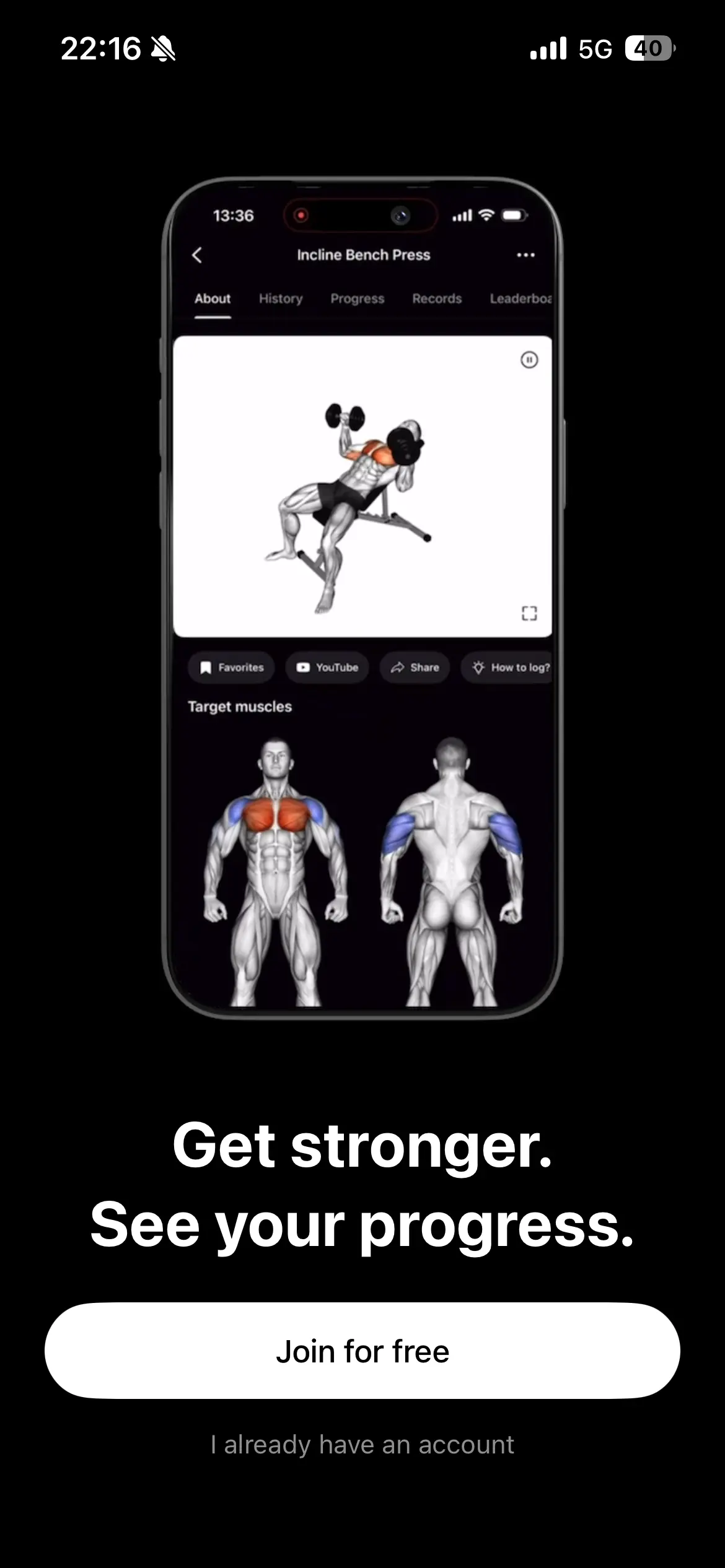
Download competitor apps Thoroughly study the top-earning competitors. Screenshot their onboarding (the initial setup screens) and core loops, and analyze them down to the finest detail. → This is incredibly important. You must study and replicate onboarding experiences in particular. Download successful competitor apps and check them out! If you find that tedious, please try using a tool I recently built called “Onbo Hub.” It allows you to check out the onboarding flows of the “top-selling apps” that have been introduced in this newsletter.
Check TikTok / Instagram Analyze the main growth strategies of competitors. They generally fall into four categories: “Influencers,” “Faceless slideshow videos,” “UGC creators,” and “Ads.” → This is also incredibly important. Just find content that is already going viral, replicate it, put your own twist on it, and pump it out continuously.
Whether it’s development or marketing, everything starts with competitor analysis. Hardly anyone succeeds without analyzing the competition at all. While you shouldn’t copy them entirely, feel free to heavily borrow concepts, selling methods, and user flows.
Now, following these steps, he began his competitor analysis. The app he likely used as a reference at this time was Alex’s app, QUITTR.
The concept of the app is “quitting porn,” and it has become a hot topic overseas for racking up insane revenue. Using the design and features of this QUITTR app as a foundation, he built an MVP at lightning speed. He then launched the MVP in about a week. He reportedly uses the following tech stack to launch apps rapidly:
Rork & Cursor → AI Coding
ChatGPT → Brainstorming & Ideation
Superwall → Paywall
Firebase → Database
Pinterest & Dribbble → Design Reference
Xcode → Release
My stack is mostly the same, though I use Supabase instead of Firebase. I also release using Expo without touching Xcode directly. We truly live in an era where anyone can easily launch a product using AI, so you should keep putting them out there. There are some tedious parts, but compared to the old days, it is shockingly simple. A massive number of mobile apps have been released recently, and the competition is expected to get increasingly fierce, so it’s best to act as quickly as possible. If you’ve never shipped one, just try putting one out there for now!
💰 Launching Apps Fast and Making $700 in 5 Days
So, the app he launched using QUITTR as a reference was “SNAPOUT.”
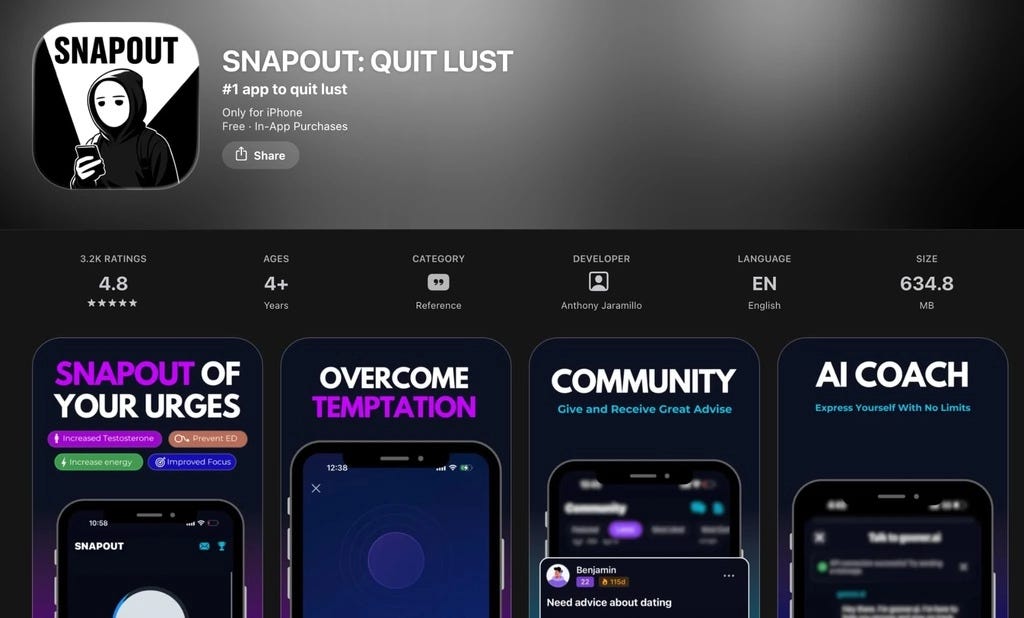
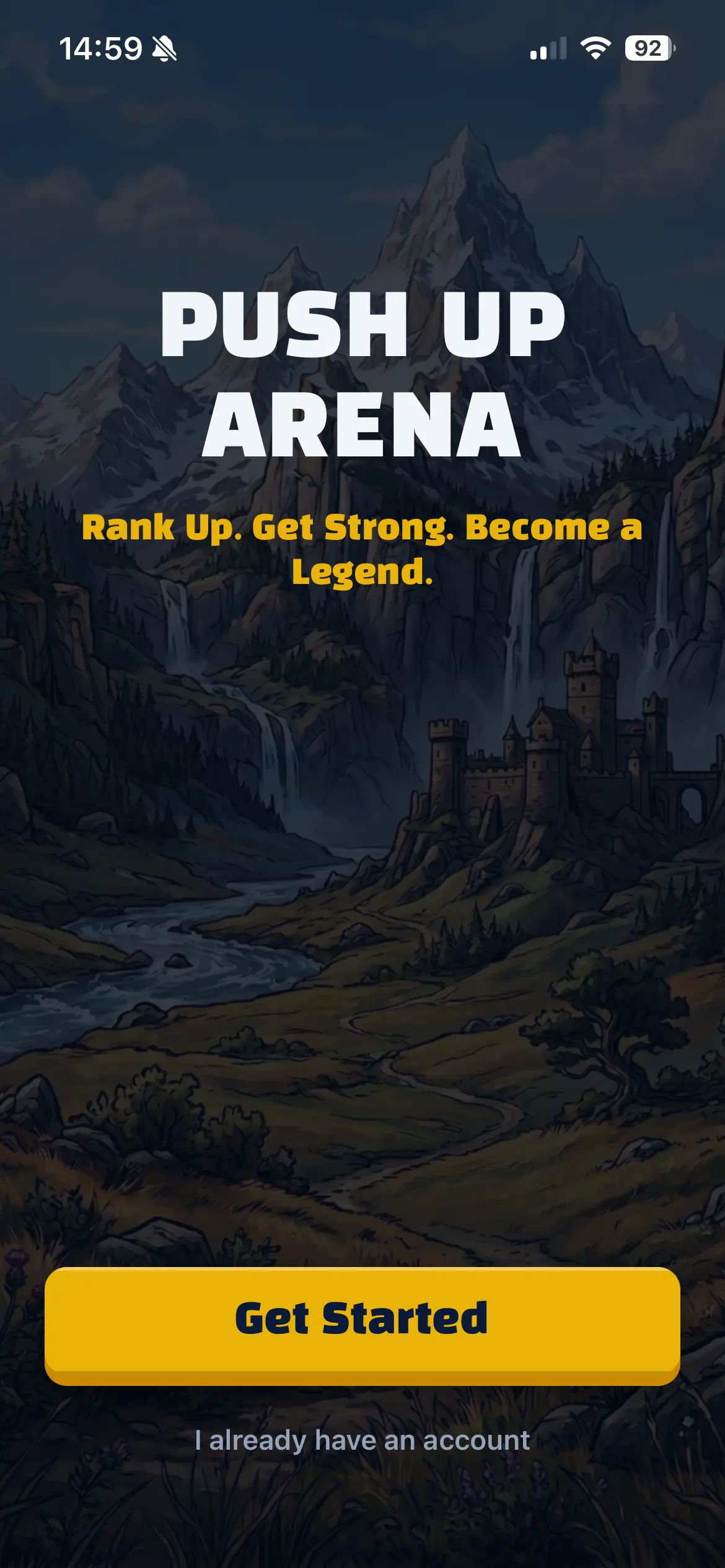
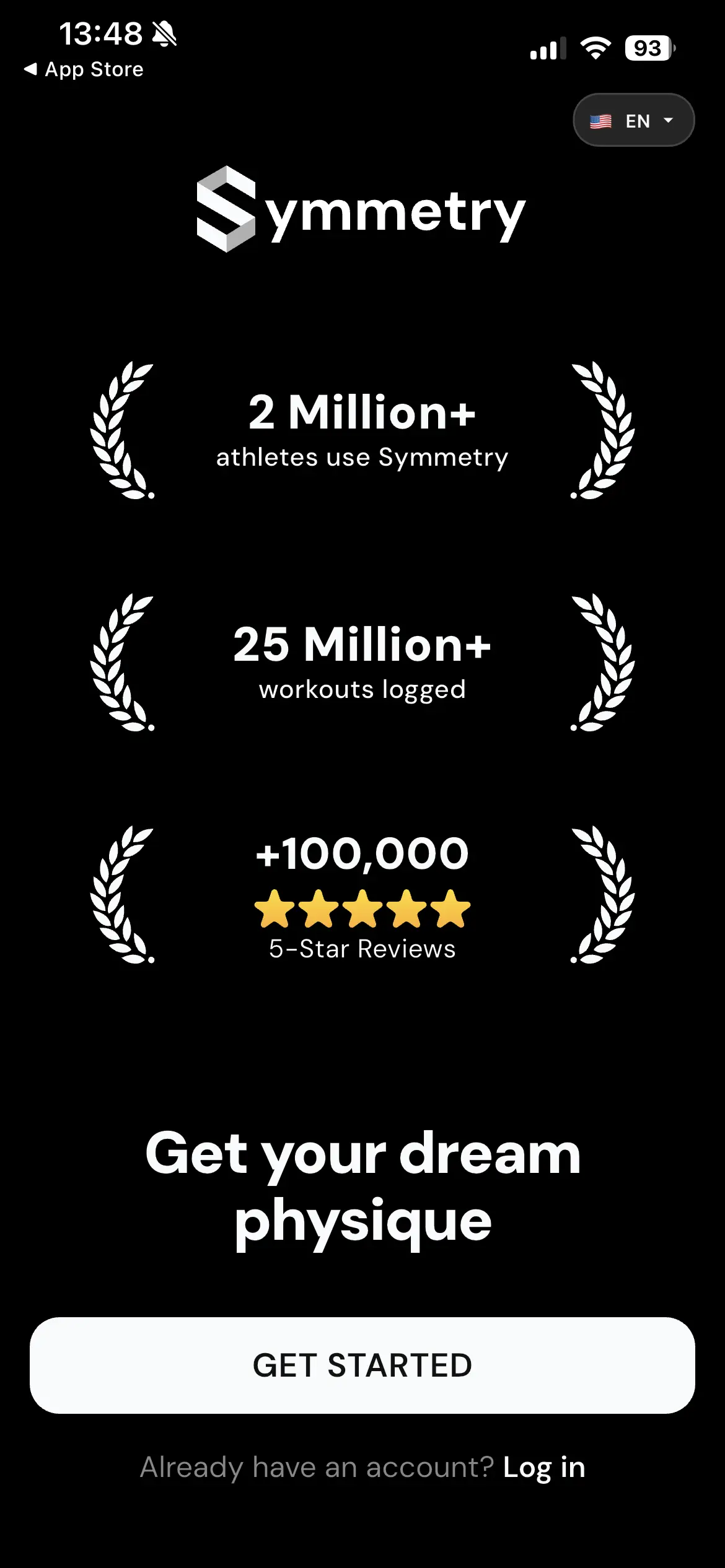
It is literally an app to stop watching porn, and its structure is very similar to Alex’s QUITTR, which I mentioned earlier. Even the tone and style are similar. Take a look and compare the onboarding screens. They are incredibly similar 👇️
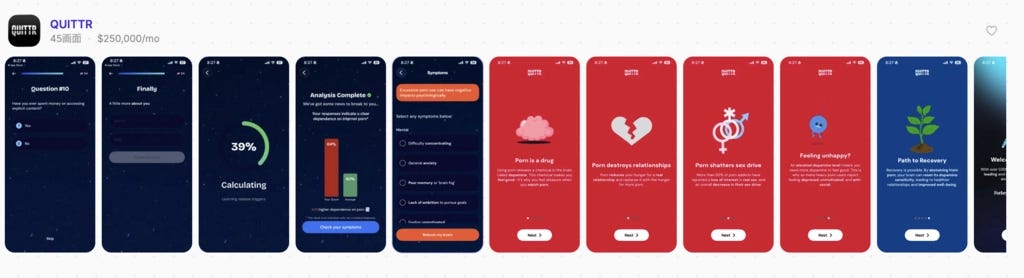
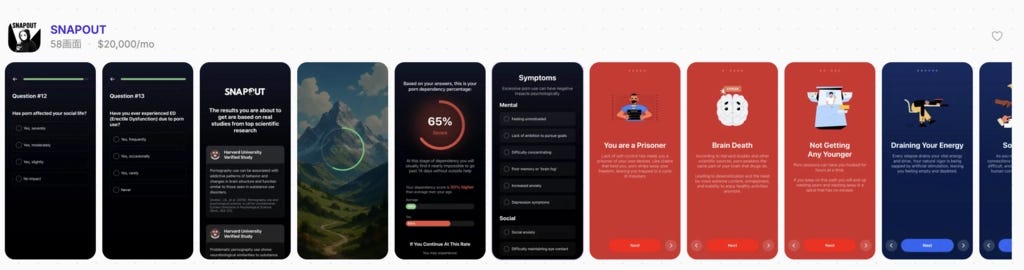
Well, apps are destined to be copied, so it can’t be helped, but even so, these feel a bit too similar. In any case, by quickly launching a product based on a successful app, he succeeded in generating $700 in revenue just 5 days after launch 👇️
 X (formerly Twitter)
Ernesto Lopez (@ErnestoSOFTWARE) on X
Just launched my App 5 days ago. Is this a good start?
X (formerly Twitter)
Ernesto Lopez (@ErnestoSOFTWARE) on X
Just launched my App 5 days ago. Is this a good start?
As a matter of fact, this was his very first tweet. Achieving this kind of result right from the start is insane. From here, he began putting serious effort into X, aggressively growing his X account alongside his app growth. Incredibly, about two weeks after launch, he would go on to make $9,300. Meanwhile, his X account gained over 1,000 followers in just 6 days. Truly insane. From here, I want to completely expose his approach. He scaled his app to this level using massive influencer marketing campaigns.
How exactly does he execute influencer marketing?
What specific videos are going viral, and to what extent?
How did he gather so much attention on X to reach 40,000 followers within a year?
We will look into these specifics. However, please don’t think that anyone can easily succeed just by reading this. When scaling his influencer marketing, he initially sent DMs to as many as 250 influencers a day. It is precisely by doing that kind of gritty, boots-on-the-ground sales work that results bear fruit. Furthermore, he is currently using AI agents to automate much of his operations. I will also cover that topic in the latter half. It would be a waste to just read his story and end with a “Wow, that’s amazing.” Please read carefully to the very end and connect it to your own actions. If a 21-year-old can do it, there is no way we can’t.
💥 Making $9,300 in Revenue Just 14 Days from Launch
Now, I want to look at his specific approach. In the following X thread, he shares that he achieved $9,300 in revenue 14 days after launching the app 👇️
 X (formerly Twitter)
Ernesto Lopez (@ErnestoSOFTWARE) on X
Alr vibe coders listen up⚠️👇🏼
My app makes $700 on a bad day.
And has generated $9300 in the first 14 days since launch.
For those of you asking for the hidden sauce, read along 👇🏼
X (formerly Twitter)
Ernesto Lopez (@ErnestoSOFTWARE) on X
Alr vibe coders listen up⚠️👇🏼
My app makes $700 on a bad day.
And has generated $9300 in the first 14 days since launch.
For those of you asking for the hidden sauce, read along 👇🏼
Based on this X thread, let’s look at how he marketed and rapidly grew his app. He says, “Take marketing more seriously!” In an era where anyone can develop rapidly with AI, differentiation ultimately has to come from marketing. So, what kind of marketing did he use to achieve these results?
Carpet Bombing with Influencer Marketing
As mentioned earlier, it is influencer marketing. The specific tactics are as follows:
Contact at least 250 influencers every day.
Get on a call with those who reply and negotiate terms.
Pay “$1 to $3 per 1,000 views.”
Do not pay upfront.
The key is not to falter during price negotiations. Since influencers are also looking to make money, they are highly likely to accept rational terms. Sending 250 DMs a day represents a completely different dimension of action—it’s insane. At first, he says you should just partner up aggressively and get posts out there. Naturally, performance varies by creator, but that is to be expected. You start broad, identify the high-performing creators, and then double down on them. You concentrate your investment on the creators who yield results. “You only need one viral hit. A single hit has the potential to instantly drive up your MRR,” he says. In fact, for his app, just two videos generated $20,000 in revenue.
Automation and Scaling
Once he started seeing consistent results, he automated the outreach by outsourcing the boots-on-the-ground sales work to virtual assistants. As shown in the post below, 13 days after launching the app, he hired two virtual assistants and handed over the outreach work to them 👇️
 X (formerly Twitter)
Ernesto Lopez (@ErnestoSOFTWARE) on X
Here’s how I will legally print money 💰
It’s day 13 of marketing.
Here’s my scaling strategy.
Just hired 2 VAs to start tommorow
They will Reach out to 250 influencers per day.
Hire 5 more influencers on a pay per view basis.
And Let the machine print money. 💰
X (formerly Twitter)
Ernesto Lopez (@ErnestoSOFTWARE) on X
Here’s how I will legally print money 💰
It’s day 13 of marketing.
Here’s my scaling strategy.
Just hired 2 VAs to start tommorow
They will Reach out to 250 influencers per day.
Hire 5 more influencers on a pay per view basis.
And Let the machine print money. 💰
You should definitely do it yourself at first. However, once you find a winning formula to some extent, you turn it into a manual so anyone can do it, and you automate it. At the same time, as mentioned earlier, you increase the compensation for high-performing influencers to strengthen relationships. You expand wide at first, and then focus your investment on the highest performers.
Organic Content Posting
While he accelerated growth all at once through influencer marketing, this approach requires a certain amount of initial capital. Furthermore, I don’t think it’s a good idea for someone who has never posted a short-form video and rarely watches them to suddenly jump into influencer marketing. Personally, I think it’s better to make a few videos yourself first to get the hang of it organically. As for Ernesto, he originally ran a social media agency and had that knowledge from the start, which is likely why he succeeded right off the bat. By the way, he says that if you are going to make content yourself and grow organically, you should:
Meticulously create content where the founder themselves shows their face.
Mass-produce faceless slideshow-style videos or videos with strong text hooks and post 3 to 5 times a day.
That makes total sense.
App Store Optimization
Additionally, App Store optimization is absolutely necessary. No matter how much you make a short video go viral, if the App Store listing isn’t compelling, conversion rates will be poor and inefficient. He highlights the bare minimum elements required for the App Store 👇️
A clear app name
A strong subtitle
3 to 5 screenshots
A simple description
Vague descriptions are a no-go. Phrases like “An AI-powered productivity experience” do not work. It makes it hard to understand what the app actually does. Descriptions that allow users to actually visualize the value, such as “Enhance focus and block distractions,” are crucial.
📲 Specific Accounts and Content
Now, let’s look at the accounts and content that drove the growth of his app, SNAPOUT. The main channels for his app are, unsurprisingly, TikTok and Instagram. Below are the official accounts for the app, and while each account has a decent number of followers and the videos get a fair amount of views:
However, with the view counts on these official accounts alone, he shouldn’t have been able to achieve such massive results. I did some digging, and it turns out posts like the ones below generated crazy viral traction.
This video got 40,000 likes. This video summarizes how to resist watching porn. In this video, he introduces 5 methods, and the 4th one is a direct introduction to SNAPOUT. Yet, it doesn’t feel like an ad; he casually mentions, “I’ve been using this and have resisted for 12 days.” The reason this video went so viral is that his manner of speaking and hand gestures invite a lot of remarks, making you inadvertently watch it or want to leave a comment. Furthermore, since he was already an influencer with a very large following to begin with, it took off. SNAPOUT likely reached out and paid for a sponsored promotion.
This piece of content also went massively viral 👇️
It gained 55,000 likes. The creator is an influencer who originally posted anime-style videos focused on Christian themes. While it is a blatant promotion for SNAPOUT, it doesn’t feel like an ad at all. It’s a surreal anime video that you can’t help but watch. It’s powerful. There is a movement among young people to “stop watching porn and reclaim your life,” making this kind of content highly prone to going viral.
💪 Launching a Challenge to Build 52 Products in 52 Weeks While Heavily Managing X By the way, while scaling aggressively through the short-form video × app combo, he also surpassed 1,000 followers on X within just 6 days of launching his account 👇️
His X management is monster-level, not just his short-form video operations and apps.
In this way, he accelerated both his short-form video × app growth and his X presence. He crossed 6,350 followers in just 41 days. Less than two months after launching his app, he was already pulling in $26,000 in revenue. And without losing this momentum, he embarked on a challenge to launch 52 products in 52 weeks 👇️
It seems he is not currently running this 52-product in 52-week challenge anymore, but declaring this kind of challenge is incredibly effective for gathering attention.
For context, the legendary indie hacker “Pieter Levels” challenged himself to build 12 products in 12 months, which ultimately captured massive attention and became the catalyst for his success.
In today’s AI era, launching one product a month isn’t much of a challenge, so proclaiming a challenge like Ernesto’s—about one product a week—might be the way to go.
He used this “challenge to launch 52 products in 52 weeks” as a hook to make his X posts go viral.
And he reliably kept launching products, consistently drawing in attention.
 X (formerly Twitter)
Ernesto Lopez (@ErnestoSOFTWARE) on X
2 months ago I had no apps
Now I have 1 app generating
$20,000/mo
3 more apps in the last 3 weeks
And 49 more on the way
Will be doing weekly updates at https://t.co/b9afomK58D
X (formerly Twitter)
Ernesto Lopez (@ErnestoSOFTWARE) on X
2 months ago I had no apps
Now I have 1 app generating
$20,000/mo
3 more apps in the last 3 weeks
And 49 more on the way
Will be doing weekly updates at https://t.co/b9afomK58D
First, he launched the app located on the far left of this post, called “Facecard.”
This app was born precisely out of competitor analysis.
He used “Umax” as a reference—an app created by Blake Anderson, the pioneer of genius young entrepreneurs who mass-produce apps with AI and scale them via short-form videos.
It’s an app where you upload your photo, and an AI analyzes it to give you various pieces of advice regarding your appearance.
In fact, when he sent out mass DMs to partner with influencers, 90% of the influencers replied that they had previously partnered with Umax.
And he scaled Facecard successfully as well.
 X (formerly Twitter)
Ernesto Lopez (@ErnestoSOFTWARE) on X
Took Facecard from
$2,000 ARR to $3.7k ARR
In 24 hours
→ 3 influencer videos
→ 88,000 views
→ Only $8 paid
It’s not black magic
I’m running 7 apps at once
Just apply the blueprint
→ 100 DMs a day
→ Gaslight your deals
→ Crush onboarding
X (formerly Twitter)
Ernesto Lopez (@ErnestoSOFTWARE) on X
Took Facecard from
$2,000 ARR to $3.7k ARR
In 24 hours
→ 3 influencer videos
→ 88,000 views
→ Only $8 paid
It’s not black magic
I’m running 7 apps at once
Just apply the blueprint
→ 100 DMs a day
→ Gaslight your deals
→ Crush onboarding
The approach was the same as before: sending out as many as 100 DMs a day to influencers to form partnerships.
💸 Acquiring TikTok Accounts to Drive Growth
Moving forward, he continued to launch and scale a massive number of apps, but along the way, he utilized a clever tactic that makes you think, “Ah, I didn’t think of that!”
He actually acquired a TikTok account 👇️
https://x.com/i/web/status/1938316427133653261
He bought the account for $1,250 and immediately acquired 20 new users within 7 days, adding $340 in MRR.
If there is a growing TikTok account with low personal branding dependency, looking into an acquisition could be a highly viable option.
🌀 Continuous Optimization of Product × Onboarding × Paywall
By the way, you might think he is purely a marketing guy, but that is not the case at all.
He states, “Continuously incorporating user feedback to refine the product is also indispensable.”
He thoroughly optimizes his paywalls as well, posting about it in a “Build in Public” fashion.
By presenting a one-time discount offer, his conversion rate (CVR) more than doubled 👇️
 X (formerly Twitter)
Ernesto Lopez (@ErnestoSOFTWARE) on X
This strategy doubled my app conversion ⚠️👇🏼
-> Have a discounted offer wall.
If a user backs out of
Paying on your main paywall
show the discount wall
and have a text saying
“ you will never see this offer again”
It creates urgency
Analytics of the last 7 days 👇🏼
X (formerly Twitter)
Ernesto Lopez (@ErnestoSOFTWARE) on X
This strategy doubled my app conversion ⚠️👇🏼
-> Have a discounted offer wall.
If a user backs out of
Paying on your main paywall
show the discount wall
and have a text saying
“ you will never see this offer again”
It creates urgency
Analytics of the last 7 days 👇🏼
This kind of steady, step-by-step product optimization directly impacts revenue.
By continuously refining his onboarding and paywalls day by day, he dramatically improved his CVR.
He says, “Onboarding determines 70% of success or failure.”
What matters in onboarding is:
Making users aware of their problem and reminding them why they downloaded the app.
Demonstrating that the app is the solution.
At the very end, you place an “unskippable, forced paywall.”
I believe this is an absolute must. Top-selling B2C apps almost always feature a combination of a long onboarding flow and a hard paywall.
Through these methods, he kept rapidly growing his apps.
The transition of his revenue is as follows 👇️
 X (formerly Twitter)
Ernesto Lopez (@ErnestoSOFTWARE) on X
my earnings over the last 21 months:
Never give up 👇🏼
dec 23: $2,000 (salary)
jan 24: $2,000 (salary)
feb 24: $0 (quit 9-5 job)
mar 24: $700 ( cleaning company )
apr 24: $920 ( cleaning company )
may 24: $0 ( failed )
jun 24: $900 ( freelancing )
aug 24: $1,244 ( started a marketing agency )
…
X (formerly Twitter)
Ernesto Lopez (@ErnestoSOFTWARE) on X
my earnings over the last 21 months:
Never give up 👇🏼
dec 23: $2,000 (salary)
jan 24: $2,000 (salary)
feb 24: $0 (quit 9-5 job)
mar 24: $700 ( cleaning company )
apr 24: $920 ( cleaning company )
may 24: $0 ( failed )
jun 24: $900 ( freelancing )
aug 24: $1,244 ( started a marketing agency )
…
You can clearly observe how, after becoming capable of earning through the agency, he gradually shifted his focus away from it to concentrate on apps.
Just 4 months after launching his first app in March, he pulled in a total of $48,000 a month from 7 apps by July, which is absolutely monstrous.
🚀 Investing as an Angel Investor to Scale Other Apps Together
From here, to grow his business even further, he adopted an approach where he angel-invests in other top-selling apps, acquires equity, and scales them together.
The first angel investment destination he chose was “prayer lock,” built by Mau, the Mexico-born developer.
While the exact timing of his involvement is unclear, it is highly likely Ernesto’s hand was involved around the time Mau’s app experienced explosive growth.
Furthermore, it is fascinating to note that they are currently using “OpenClaw” to automate their marketing.
A long-form X post titled “How our OpenClaw agent ‘Eddie’ helps us make $70k/mo with B2C Apps ( step by step )” went viral.
Their agent is named “Eddie,” and it reportedly automates a massive chunk of operations tied to app growth 👇️
Content marketing
Influencer outreach & management
Customer support responses
KPI management & reporting
Completely Automating Content Marketing
They are growing their apps by generating massive viral reach with slideshow-style videos, and this content creation is now almost entirely outsourced to and automated by an AI agent. If the content follows a fixed format, it is relatively easy to automate.
Automating Influencer Outreach
Even more interesting is the automation of influencer outreach.
Normally, influencer marketing requires the following tasks:
Finding influencers
Sending DMs or emails
Negotiating CPMs
Executing contracts
Communicating content direction
Following up on posting status
Incredibly, an AI agent now handles most of this process.
The agent automatically performs the following:
Finds creators matching the criteria on Instagram.
Scrapes email addresses from profiles.
Sends over 1,000 emails per day.
Sends over 100 DMs per day.
Previously, they hired virtual assistants for this task, but by replacing them with AI, they achieved cost reduction and a 10x improvement in results. Absolutely insane.
AI Handles Customer Support and KPI Management Too
Furthermore, AI handles customer support and KPI management tasks.
With over 100,000 users, support emails become overwhelming. It is far too demanding for humans to handle alone. Consequently, the AI agent handles the baseline responses. The AI reads the emails and automatically replies.
They have set up a system where it alerts a human only when it cannot handle the inquiry.
Additionally, the AI agent sends a KPI report every morning covering:
View counts of influencer videos
Organic vs. ad revenue
Revenue vs. ad spend comparison
High-performing content
To be honest, there are many parts here that could be automated without an AI agent, but this mindset is incredibly important.
For routine tasks or actions where a winning pattern has been established to some extent, let’s aggressively turn them into manuals and hand them off to AI or software!
📝 Summary
So, we have looked at Ernesto up to this point, and I find his sense of speed to be absolutely insane.
Of course, there is no doubt that his prior success running a social media agency served as the detonator for his app growth.
Inversion-wise, I think the current era is incredibly advantageous for people who possess the ability to hack marketing.
In his case, he analyzes top-selling competitor apps, uses AI coding tools to rapidly build apps with similar concepts, and uses his proven social media execution skills as a weapon to achieve explosive growth through marketing.
Personally, I still think prioritizing the improvement of a product’s CVR comes first. Then, polish the product to increase LTV.
Running influencer marketing when CVR and LTV are low yields a poor return on investment. Maximizing profitability per click is critical when running influencer marketing or running ads.
To achieve that, you must analyze successful apps and adopt their strategies!
Let’s aggressively analyze the competition!!
For competitor analysis, please use this newsletter or the recently built “Onbo Hub” as a reference!
Reference
https://www.youtube.com/@ErnestoSoftware/
https://medium.com/swlh/this-entrepreneur-tweets-his-struggles-makes-1-000-before-lunch-9b0cd44453d9