Meet Rafael Kramer: The Young Genius Marketing His Apps With AI Influencers
shipped 62 apps so far. At just 13, he caught a viral TikTok moment and turned it into a game that pulled in nearly $100,000 in a single month.
August 27, 2026

This time, I want to introduce you to someone special: Rafael Kramer.
This guy is a genuine genius.
I’ve featured a lot of talented young founders on this Blog, but even among them, Rafael’s track record is in a league of its own. He has shipped 62 apps so far. At just 13, he caught a viral TikTok moment and turned it into a game that pulled in nearly $100,000 in a single month. He kept cranking out apps off the back of viral memes, and lately he’s pivoted from games into consumer “looksmaxing” apps — and he’s printing money there too.
His latest app hit $54,000 in monthly revenue just over a month after launch. On some days it brought in $6,000 — in a single day. Absolutely wild.
And here’s the kicker: he markets this app using an influencer that is 100% AI-generated.
We have truly entered a strange new era. An AI-generated video goes viral, and that virality converts into explosive app downloads. This exact pattern is popping up everywhere you look.
In this Blog, I’m going to walk through Rafael’s life of serial virality and break down the marketing playbook behind his newest app. Let’s dig in!
🎮 The Kid Who Started Building Games at 13
Let’s start with his background.
Rafael is based in Switzerland.
He got into business at 13, bored out of his mind during the COVID lockdowns. With nothing to do, he typed “how to make money” into Google. A pretty kid-like place to start — but that search kicked off an absolutely abnormal career.
What he stumbled onto was Buildbox, a no-code tool for making games. No programming required — you build mobile games entirely by drag-and-drop.
Then, at 14, his big break arrived.
At the time, a meme of the rapper DaBaby with a car for a head was blowing up on TikTok. I know it makes no sense — but that’s exactly the kind of surreal, absurdist humor that was trending back then.
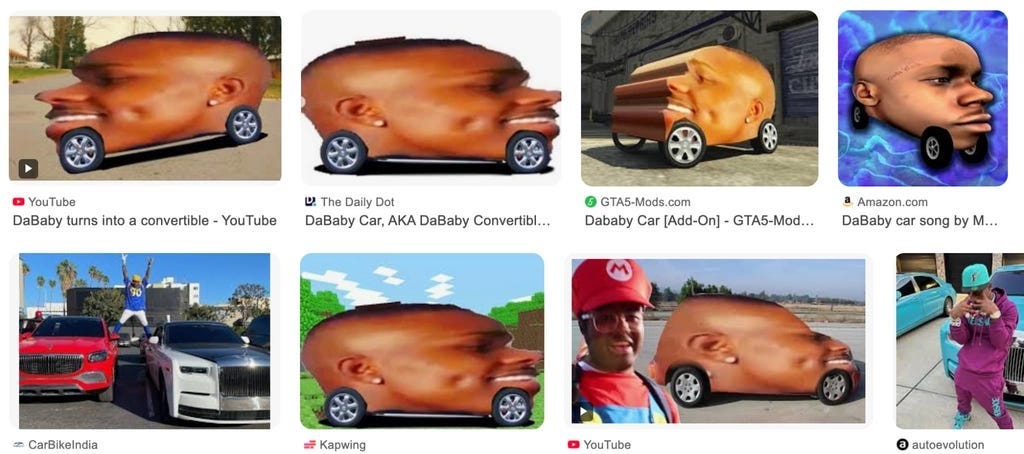
Rafael spotted the meme the same day it went viral, then pulled an all-nighter to build a game based on it from scratch.
He used Buildbox, of course, then posted a video of the game from his own account.
The result? That game racked up 2 million downloads in a single month, generating over $100,000 in revenue.
A 14-year-old made over $100K in a month from a no-code game he built overnight based on a meme. Insane.
If you ever needed proof of how much it pays to ride a trend, here it is.
💡 Turning “Meme → Game” Into a Repeatable Machine (50+ Times Over)
Here’s the part that makes Rafael special: he didn’t let that 14-year-old success be a one-hit wonder.
He turned it into a repeatable system.
In his own words: “Find something going viral as fast as possible, make a game, put it on the App Store, make a video about it, and pray it blows up. That’s it.”
He ran this “meme → game” formula over and over again. Instead of just consuming memes, he turned them into something you could actually play.
His monetization was dead simple too. No complicated in-app purchase systems — just “show an ad every time you die” and “watch a 30-second video ad if you want to respawn.” That’s the whole thing.
He says he only earned about 10 cents per user — but with 2 million downloads, that still adds up to real money.
He admits, looking back, that “if I had monetized properly, I could have made way more.” But at the time, he prioritized speed over squeezing every dollar.
Don’t overbuild. Don’t overthink monetization. Spot a viral meme, and spin up a simple game off the back of it. No coding — just whip it up with no-code tools. You only start polishing once the money starts coming in.
Using this same approach, he built over 50 apps and racked up more than 10 million downloads in total.
🤝 Scaling Through Revenue-Share Deals With Influencers
While churning out meme games, Rafael leveled up to the next stage.
He launched InfluencerApps, a company that “partners with creators to launch games together.”
And here’s where he diverges sharply from a typical marketer.
He didn’t pay influencers a flat fee for posts. Instead, he offered them a 50/50 revenue share.
In other words, he made each influencer feel like “this is your game too.” Weekly meetings, creative input, a hand in shaping character updates — the whole works.
As he puts it: “You have to make them genuinely feel like it’s their own game.”
The biggest win from this approach came when he teamed up with the creator behind Skibidi Toilet.
I’d never heard of Skibidi Toilet myself, but apparently it’s a worldwide phenomenon. The videos feature bizarre monsters — disembodied heads popping out of toilets — scheming to invade Earth, while camera-headed creatures fight back. It looks like pure nonsense at first, but the strange world it builds genuinely sucks you in. My honest first reaction was “what on earth is this?” — and then I caught myself completely hooked.
The channel has nearly 50 million subscribers. A giant.
And get this — the creator behind it lives in Georgia (the country I live in)!
Rafael reached out back when the channel had only around 5 million subscribers and launched a game with them. A single YouTube Shorts video got over 50 million views and drove millions of downloads.
This approach is a seriously smart move for developers who can build but don’t have the bandwidth for marketing.
Even though AI has made it ridiculously easy to build products, surprisingly few people actually build, deploy, and ship something live themselves. So if you’re a developer, finding an influencer who has reach but no product of their own and saying “let’s build this together!” on a rev-share basis can be a genuinely great play.
Seeing the potential here, Rafael went on to launch a string of apps with creators on revenue-share deals.
But he also learned a crucial lesson along the way: follower count doesn’t equal results.
In fact, he completely flopped with another influencer who also had 5 million followers — simply because the audience and the game were a bad match.
So what should you look at? His answer: the comments section.
“Are people genuinely engaging? Or are they just dropping emojis?”
I run TikTok and Instagram myself to grow my own apps, so I know exactly what he means. There are tons of users who leave an emoji on every video — but those users rarely turn into paying customers. Sure, even an emoji is an action and I’m grateful for it, but when you’re partnering with a creator, you need to check whether their followers are leaving genuinely high-intent comments.
🧠 From Meme Games to Consumer Apps
So that’s how he built games for years — but in 2025, he took on a new challenge: shifting his target from the games market to consumer apps.
Why? Because meme games may be explosive, but they’re extremely short-lived, and since they basically monetize through ads, it’s hard to generate sustained revenue. As a business, it just isn’t sustainable.
He also felt that making meme games is fine while you’re young, but it’s not a great look once you grow up.
So from here, I’ll break down the consumer app he built and exactly how he grew its revenue to $54,000/month in just over a month.
On paper, you might think that’s impossible. But once you see his approach, you’ll start thinking, “you know what, maybe I could pull this off too.”
First, to find themes with viral potential, it’s essential to study the market by regularly scrolling through TikTok and Instagram short-video feeds. For Rafael, it all started with an account he ran into while scrolling TikTok in bed.
Second, use AI everywhere you possibly can.
Right now there’s still a big literacy gap between people who can wield AI and people who are merely on the receiving end of it. And periods when that gap exists are exactly when opportunity is lying around for the taking. That gap is closing fast — and the people who act now are the ones who get to cash in.
Honestly, if you simply localize Rafael’s case for your own market, just about anyone could capture a decent chunk of revenue. That said, only a tiny fraction of people actually take action. Whether you’re in that fraction or not — that’s up to you.
Alright, let’s take a closer look at his success story!
So the first thing to do is research which themes and apps are going viral. Doing exactly that, Rafael discovered that “looks-improvement” apps were blowing up.
So he built Debloat AI, a looksmaxing app built around the angle of facial “debloating” — reducing facial puffiness.

The app ended up getting 40,000 downloads and was eventually acquired.
The exact final revenue and acquisition price weren’t disclosed, but it likely fetched a respectable sum.
This “looksmaxing” theme has been trending overseas for a while now, and it taps into one of the most primal human desires: the urge to look better.
Having tasted success with Debloat AI, Rafael felt firsthand just how explosive the looksmaxing theme could be. The catch: to make things go viral, he had to hire a bunch of creators, which was a grind.
So while hunting for a different idea, he stumbled one day onto a wildly viral looksmaxing account — and what he found left him stunned.
📱 A Fateful Encounter With an Influencer Who Doesn’t Exist
One day, scrolling TikTok, Rafael landed on an account called Logan Reed — a looksmaxing account posting clips of someone’s looks visibly improving over time.
This video alone has racked up over 14 million views.
At first, his only thought was, “yep, looksmaxing is really trending, and wow this is blowing up.”
But then came the jaw-dropping revelation.
That “Logan Reed” account was completely AI-generated.
A fictional human created entirely by AI — and utterly indistinguishable from a real person.
Watch the videos and you can tell how meticulously they’re crafted. Given how fast image- and video-generation AI is advancing, it’s becoming genuinely impossible to tell AI-generated content apart from the real thing. Especially with this kind of non-speaking short clip or photo-slideshow format, you can produce content that’s virtually indistinguishable from reality.
When Rafael built Debloat AI, his approach was to get a real creator to make content, go viral, and grow the app off the back of it. That worked well enough — but it still came with management overhead and revenue costs, which made it a fair amount of work.
But if AI can do that job? The whole equation changes. You can scale at almost zero cost, and the revenue ceiling is sky-high.
So he moved immediately.
He could have built his own AI influencer from scratch, but instead he went with the same rev-share playbook he’d used for his games. He reached out to the account’s creator right away and pitched: “let’s build an app together!”
That speed. His operating principle hasn’t changed one millimeter since he was 14, spotting a viral meme and building a game overnight. Speed is everything.
✨ Enter “FaceKit,” the Looks-Improvement App
Working hand in hand with the AI influencer’s operator, they built FaceKit.
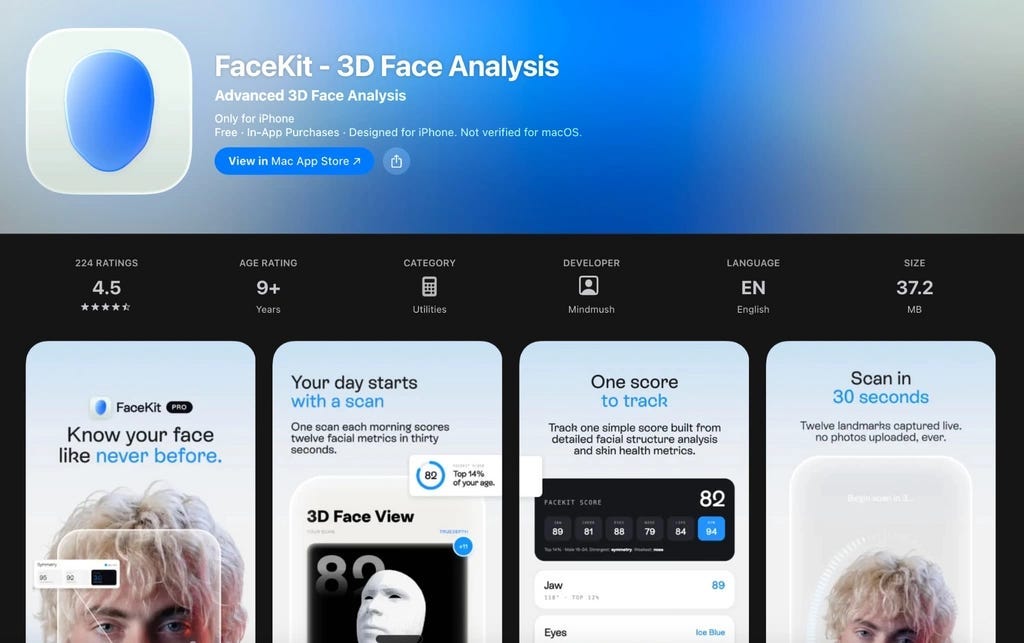
FaceKit uses your iPhone camera to 3D-scan your face and quantify things like the distance between your eyes and your facial symmetry, then gives you advice on skincare, hydration, and working out.
The 3D scanning sets it apart from your run-of-the-mill camera app, and it’s clear they cared deeply about the app’s quality.
In every success story I’ve covered, I keep harping on how great the onboarding is — but FaceKit’s onboarding is on another level entirely. Seriously fantastic onboarding. Let’s break it down.
First, the very start of onboarding shows a demo of the app — and the demo clip of taking a 3D face photo is slick. 👇
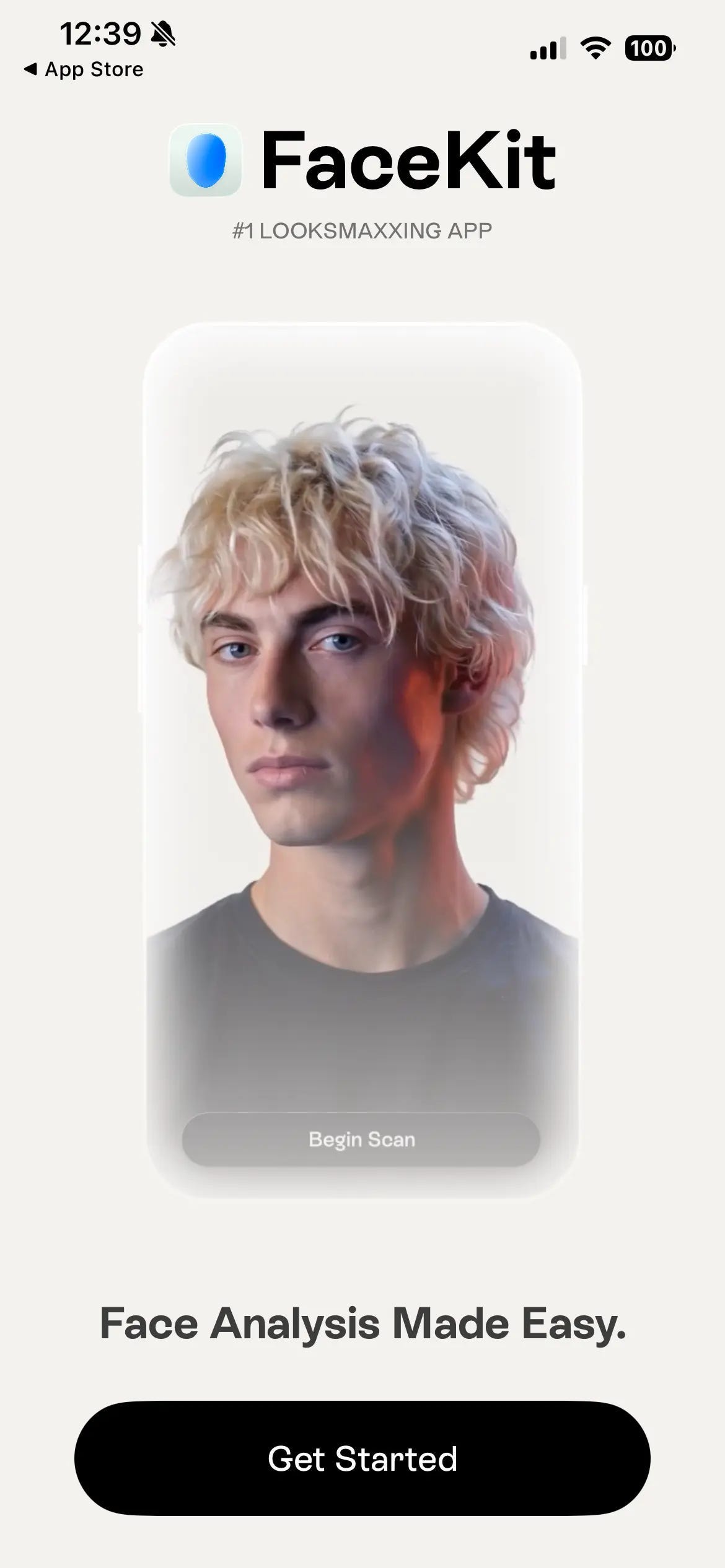
It really pulls you in and makes you want to use it.
Then come the classic questionnaire screens — and the UI here is a chat-style format that works incredibly well. 👇

When questionnaires get long, some drop-off is unavoidable — but framing it as a chat-style UI seems to keep that in check. A really clever idea.
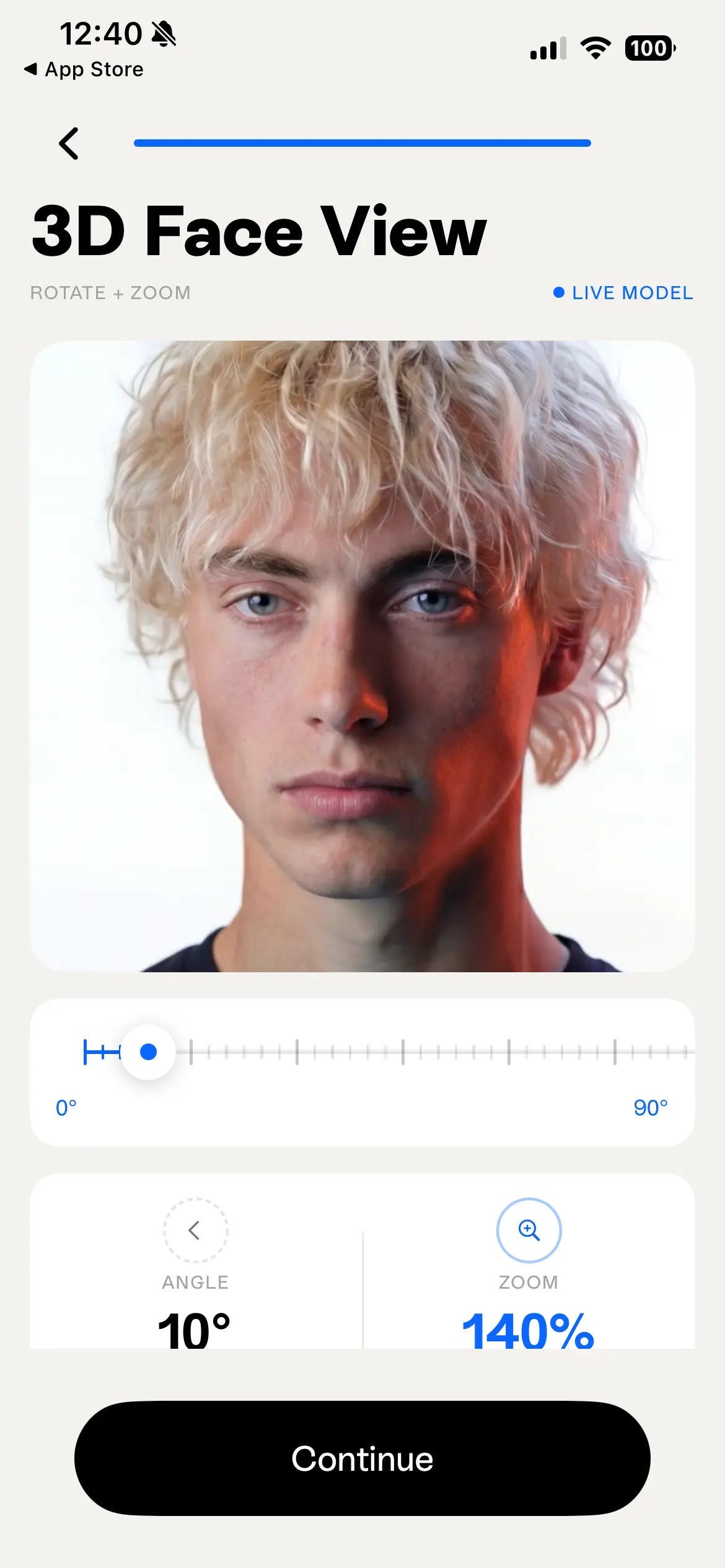
On top of that, the onboarding flow drops in several screens where the user interacts directly. For example, in the screen below you can change the angle of the face by dragging a slider. 👇
And finally, you upload your own photo to get analyzed. 👇

Before the results appear, a screen slides in where the user has to swipe. 👇 This is where they extract a small commitment from the user. These little commitment-extracting screens are present in every app that sells well.

Next, the results page. 👇
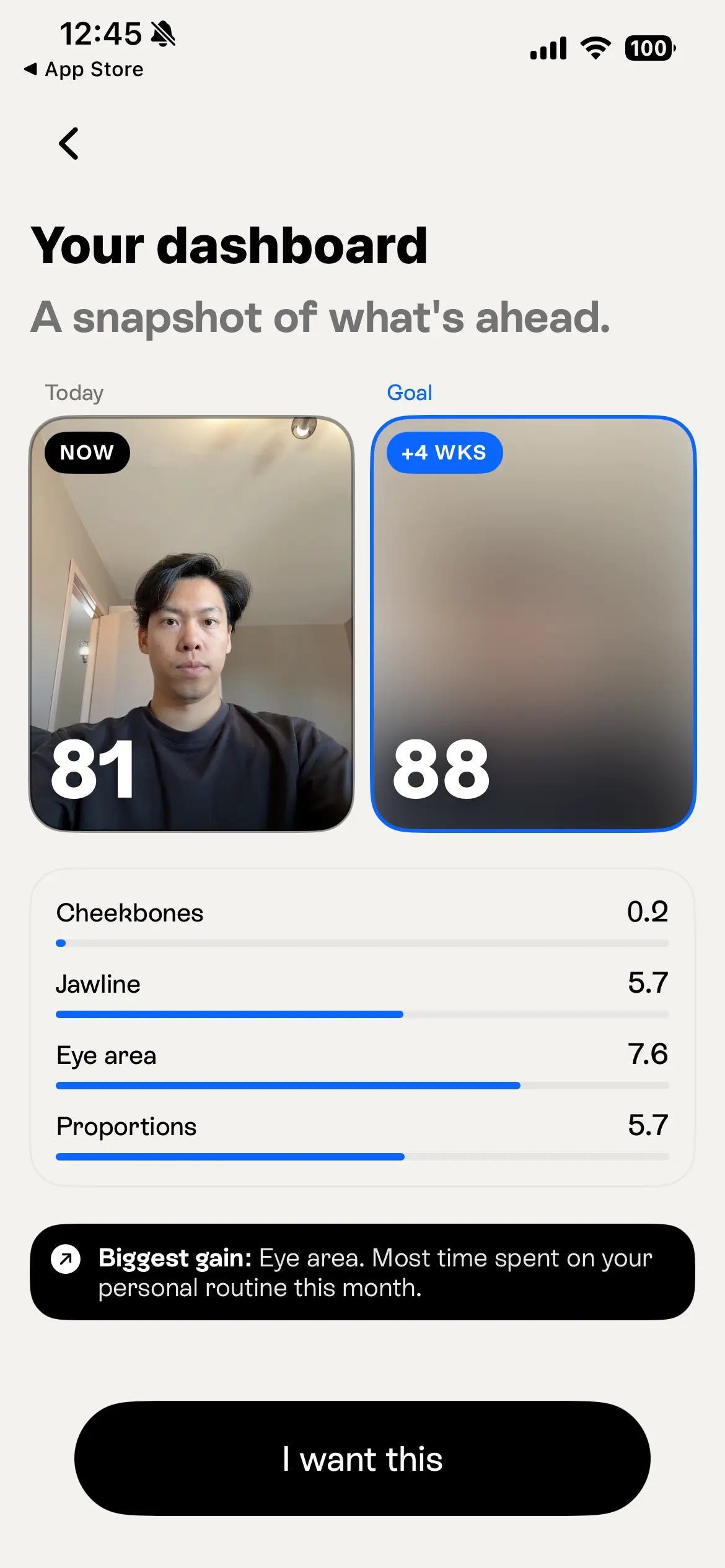
It shows your current state and your goal state (the goal is blurred out, which cranks up the incentive to pay).
And then the paywall. 👇

The weekly plan is $9.99 and the annual plan is $24.99 (prices vary by country, but the pattern is roughly the same everywhere).
They push the annual plan hard. Of course this lifts conversion — the whole onboarding extracts commitment from the user and places the exact screen they most want to see right behind the paywall. Since the user has already taken actions like uploading their photo, sunk cost kicks in.
🎯 Short-Video Marketing Powered by AI-Generated Clips
Now let’s get into his marketing approach.
It started with promotion on the AI-generated influencer account he’d reached out to. For example, the video below got 2.5 million views. 👇
Partway through, the FaceKit app icon fades into the frame, and the FaceKit pitch kicks in from there. It doesn’t feel salesy, and it’s designed so you watch all the way to the end. Honestly, watch this and you can’t help but get curious about the app — the conversion rate has to be high.
And they didn’t stop at this one account. They spun up tons of “looks-improvement” accounts with generative AI and promoted like crazy. Apparently they’re running around 40 accounts. Insane.
It’s true — once you know the playbook, you can generate these accounts endlessly. And this theme really does pack the strongest set of ingredients possible:
It’s a powerful theme rooted in a primal human desire — the wish to look better.
The visuals change in a Before/After way, which is naturally viral-friendly for short video.
It’s not even that hard to produce with generative AI — you just combine voiceless photos and short clips.
It’s genuinely an unbeatable theme.
He’s also gone viral with AI-generated videos in formats beyond the Before/After hook. Like this one: 👇
It’s a clip of a teacher in a classroom saying something like “with FaceKit, I can rate your looks.” It went viral with 1.9 million views. This genre — videos shot at an angle like you’re secretly filming a class, with the teacher getting angry or saying something bizarre — tends to blow up.
By cranking out viral videos like these with generative AI, he grew revenue explosively in a single month. He launched in January, and by February revenue had hit $54,000/month.
⚡ Finding Ideas “While Lounging in Bed”
His product-development philosophy is full of lessons.
First, even when he has an idea, he never builds the full product right away. He builds only the onboarding flow and the paywall — nothing else.
There’s just one question he wants to validate: “Will someone watch a TikTok, download the app, finish a 2–3 minute onboarding, and then actually pay?” If the idea fails anywhere in this loop, he scraps it on the spot.
This is a hugely important mindset. Most people build out a product’s features first and then go “okay, time to sell it” — but that’s backwards. Build only the path to the moment of payment first, and test whether the transaction actually happens. You can build the guts of the product after that. It won’t be too late.
And most of his money-making ideas, he says, came from lounging in bed scrolling TikTok and drawing inspiration from the For You page. FaceKit, too, traces back to a viral video he happened upon in his TikTok feed.
Every successful young founder I’ve ever covered checks short-video platforms like TikTok and Instagram every single day. A massive trove of business ideas is sitting there, waiting.
So scroll those TikTok and Instagram feeds and do your market research! Just one warning: if you scroll mindlessly, the algorithm will fill your feed with videos you personally like, with nothing to do with your app’s theme — so stay intentional.
💰 How to Put This Success Story to Work
So we’ve now traced the story of Rafael, the young genius who’s built a mountain of viral games and apps.
I genuinely believe the “looks-improvement” theme from this case study could absolutely work if you localize it for your own market.
At the end of the day, the primal human desire to “look better!” isn’t going anywhere. And if there’s an app that uses AI to guide you there nicely, people will use it. It’s also a space that’s relatively easy to make go viral on short video.
This era really drives home how unbelievably powerful the ability to go viral — and to ride virality — has become. I’d argue the bigger impact isn’t that AI made product development easy, but that the dominance of the short-video format means anyone can capture massive attention overnight. It’s the democratization of marketing.
That said, it has a downside: the growth tends to be temporary. Products that grow by riding a viral wave often burn out fast. In fact, Rafael’s FaceKit was at one point making $6,000 a day, but it now hovers in the range of around $1,000 a day (which is still impressive).
And Rafael’s passion seems to have already moved on to his next business. Rather than settling for a temporary viral spike, he’s now focused on building a business that grows continuously. Maybe that’s why FaceKit itself is already listed for sale on the startup marketplace TrustMRR.
By the way, TrustMRR is the product that the genius solo developer Marc Lou is pouring the most energy into right now — a platform where you can verify the revenue of various indie products and even buy and sell them.
Still, if you’re growing an app from zero, the ability to go viral is non-negotiable. I wrestle with virality myself, every single day.
Let’s go chase that virality together!