"Pingo AI": The Monster Language Learning App Created by Two Students, Generating Over $500k in Monthly Revenue in Just One Year
After extensive research for my own Japanese learning app, I discovered "Pingo AI"—a viral sensation launched by two students that hit $500k MRR in just over a year. Simply insane.
August 31, 2026
Have you heard of “Pingo AI,” a language learning app?
It is an app that is absolutely buzzing on TikTok and Instagram. Despite being launched only a little over a year ago, it has racked up an astonishing total of over 1 billion views. Furthermore, its revenue recently surpassed $500,000 per month. It is an app growing at a tremendous pace. The creators of this powerhouse app, “Pingo AI,” are these two young men, Michael and Morrie, who are just around 20 years old.
https://www.linkedin.com/in/michael-xing-04216821a/

https://www.linkedin.com/in/morrie-schonfeld-1628002b1/
Please take a look at the staggering numbers below 👇️
January 2025: Launch
March 2025: 50,000 users, $25k MRR → Accepted into YC program
July 2025: 300,000 users, $200k MRR
April 2026: Over 3 million users, $500k MRR
$500k MRR per month just 14 months after launch. It’s seriously insane. They started as solo developers, breaking 50,000 users and $25k MRR within two months of launch. Although they are no longer strictly “solo developers” because they were accepted into the YC program and raised funding, I wanted to feature them because this serves as an incredible case study for product development success in this era. To be honest, for the past year, I have come across “Pingo AI” short videos almost every single day. I run a Japanese learning AI flashcard app myself, so I regularly research short videos in the language learning space. Furthermore, having learned multiple languages—English, Georgian, and Spanish—I have a very strong interest in the language learning field. And time and time again, “Pingo AI” showed up in my feed. Every time I watched them, I thought: “Wow, this format is genuinely genius.” “It’s amazing how they are buzzing with a language app. It’s frustrating (with envy).”
I was hooked in the first two seconds, and before I knew it, I had watched until the end. Moreover, it hardly felt like an advertisement. This is, hands down, the most powerful short-video marketing in the modern era. I conducted thorough research into the behind-the-scenes of this, and found a mountain of lessons that are incredibly valuable. This is a must-read for anyone who wants to grow an app using short videos. Please make sure to read until the end.
🏫 The “Chinese Study Group” in a College Dorm was the Origin
Their meeting occurred in 2023. The two met as roommates in an American college dormitory. Michael is Chinese-American, and his parents are Chinese. On the other hand, Morrie is American but is a genuine language nerd who had been teaching himself Chinese for a long time. Once they became roommates, they hit it off and started practicing Chinese together almost every week. Michael, being a native speaker, was just speaking “naturally.” But for Morrie, it was a super powerful learning experience. Morrie says this:
“I’ve been studying Chinese for eight years, but at the end of the day, if you don’t have someone to talk to, you won’t become fluent. Textbooks can get you to a certain level, but to cross that certain line, you have no choice but to have conversations.”
Indeed, the wall you hit in language learning is the lack of conversational experience with native speakers. Without a place to speak, you won’t improve, and it’s hard to stay motivated. I am currently in Georgia and have the opportunity to work in English, so I am motivated to learn Georgian and English, but the moment I return to Japan, my motivation drops instantly. When I was traveling around South America, I studied Spanish every day, but I quit after leaving.
As you can see, conversational experience is essential for language learning, but it is hard to find an environment that makes that a reality. However, a tool that easily solves this has appeared in modern times: AI. In this day and age, you can create a language conversation environment relatively easily using AI. I also have daily conversational “wall-bouncing” practice with ChatGPT in English. So, is conversation with existing AI like this enough? Not necessarily. AI like ChatGPT is convenient for chatting when you have already reached a certain level of fluency, but it is tricky to use during the process of getting there. Also, if you don’t get creative with your input, you end up having the same conversations every time. That is where the value of building a dedicated application comes in. Of course, there are many apps in the “Language Conversation × AI” space that think along the same lines, but by arranging the underlying content and educational scenarios, differentiation is possible, and there is significant potential. Thus, “Pingo AI” is the product that Michael and Morrie built from that intense original experience.
🗣️ How good is “Pingo AI” as a product!?
“Pingo AI” was launched in January 2025.
It is quite new, a latecomer in this type of app category. So, how is the product quality? I actually downloaded and used it, and it is incredibly easy to use. I think the high resolution (clarity) coming from their original experience has led to such a high-quality product. Let’s briefly look at the onboarding and features of “Pingo AI.” First, it asks for the language you want to learn and your proficiency level 👇️
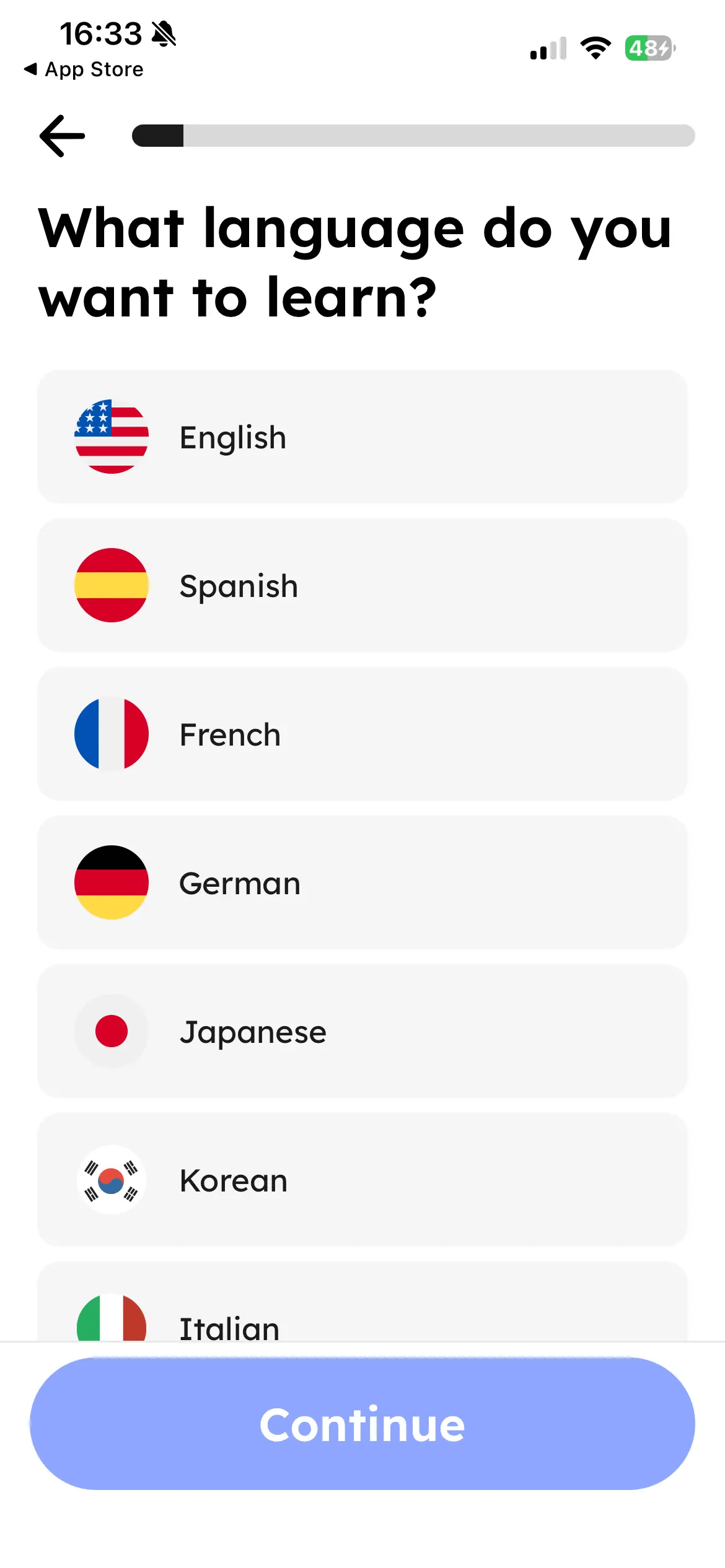
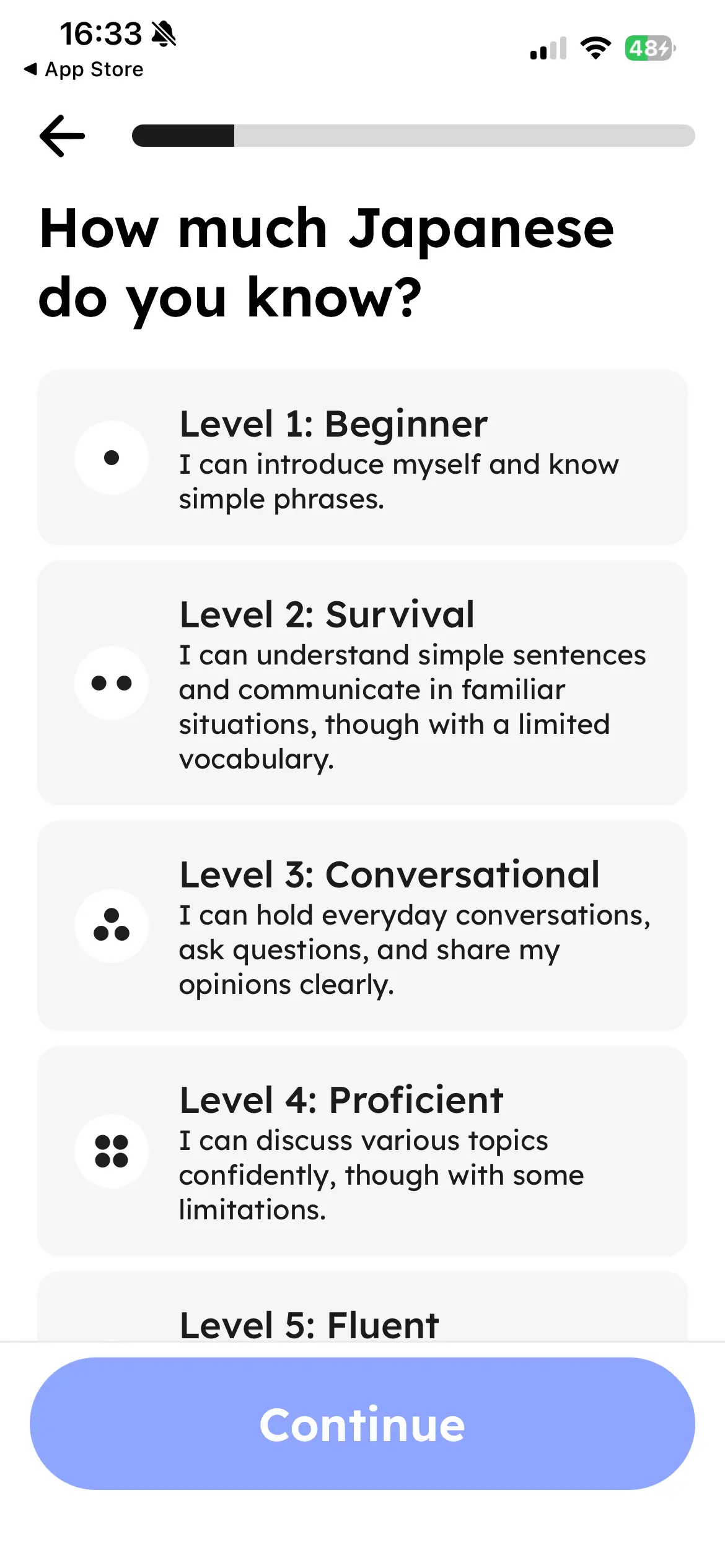
Depending on the language and level chosen, a curriculum is set. Then, a graph follows showing the difference in language learning between using “Pingo AI” and the standard method 👇️
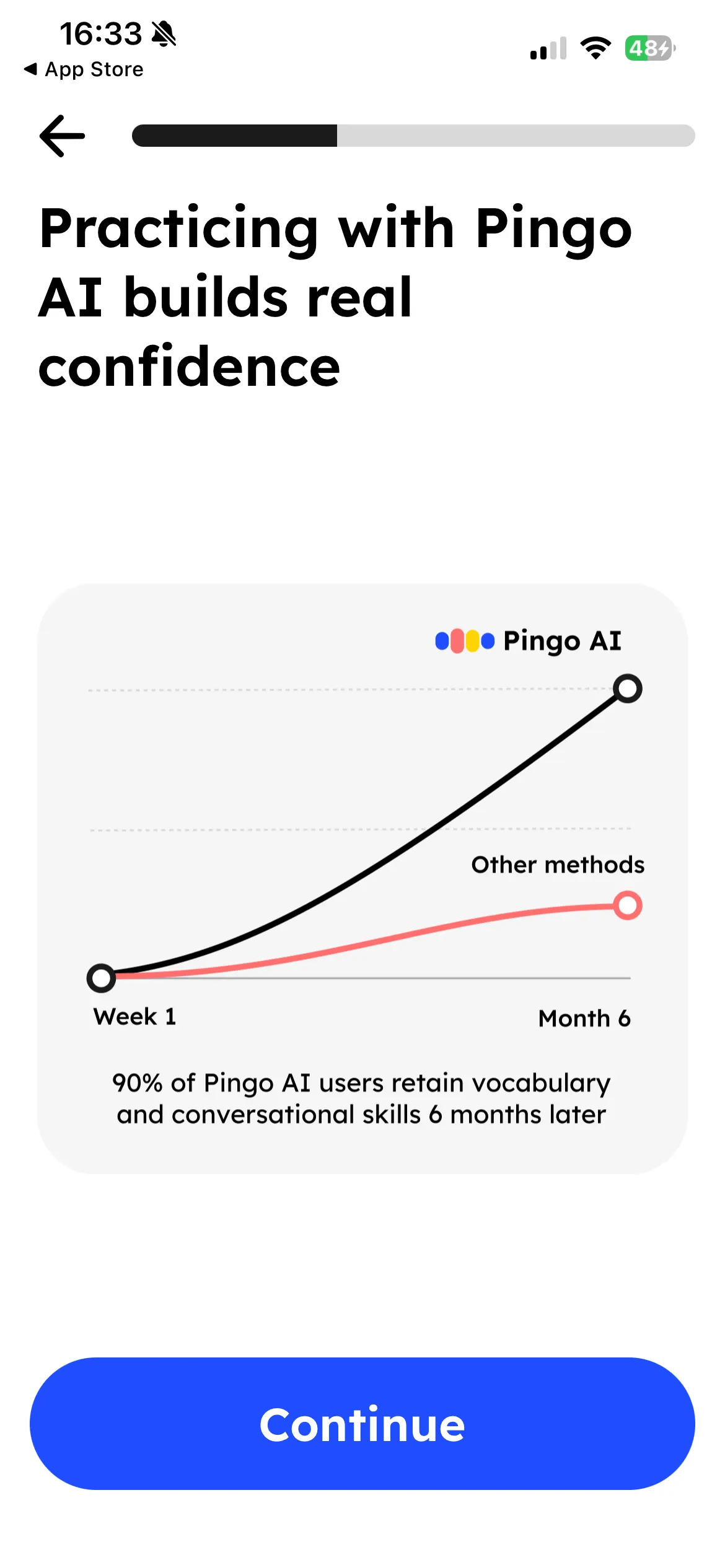
This is a classic staple. Most “bestselling app on-boarding” flows I have introduced in this newsletter have graphs like this. If you are developing an app right now and your onboarding doesn’t have a graph like this, you should introduce one immediately. There are almost no apps selling millions or tens of millions a month that don’t have this. I, too, have included such a graph in the onboarding of the Japanese learning app I am currently growing. It is better to show visually “how your life will change by using this app.” “Pingo AI” goes further by adding graphs like the one below midway to emphasize the value of “Pingo AI” 👇️
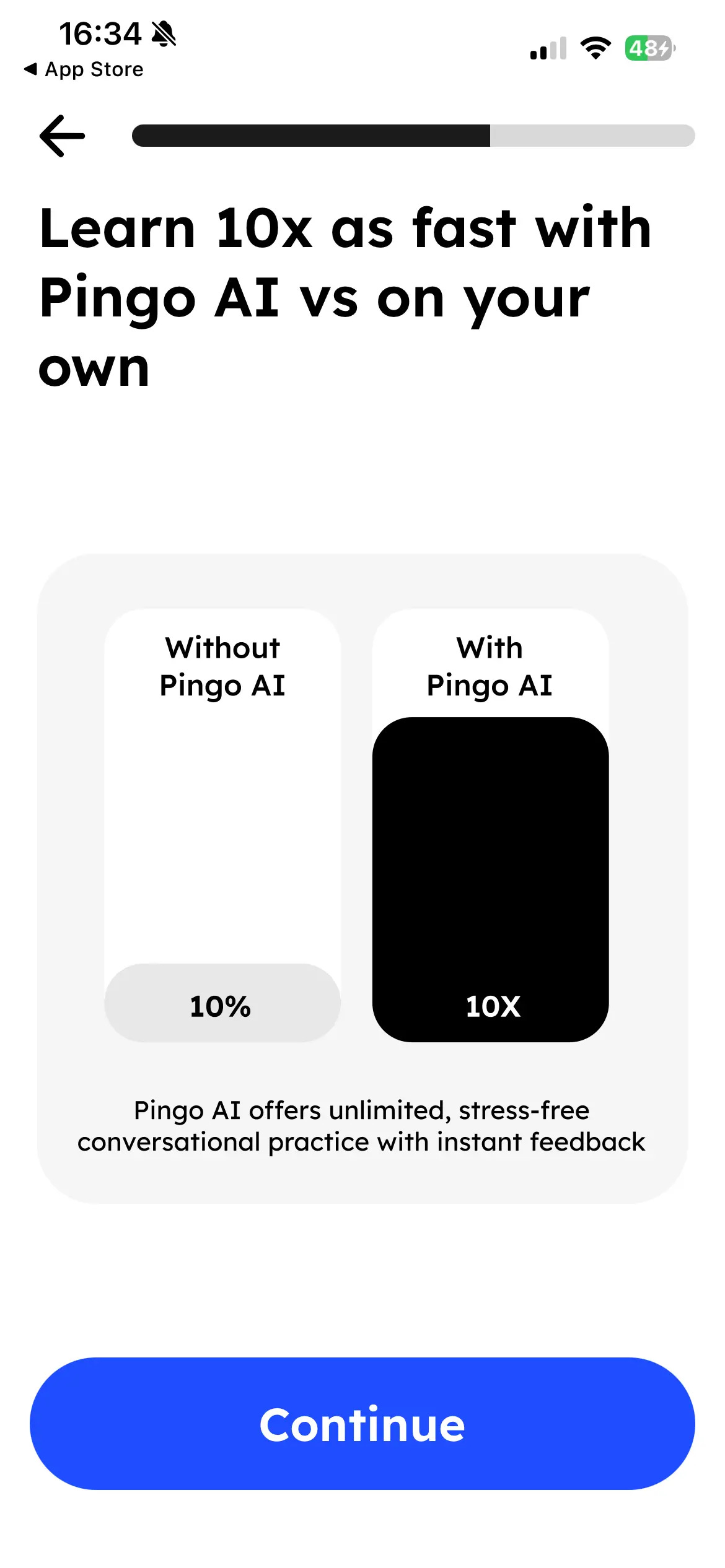
After that, a percentage screen appears showing that it is personalizing the experience 👇️
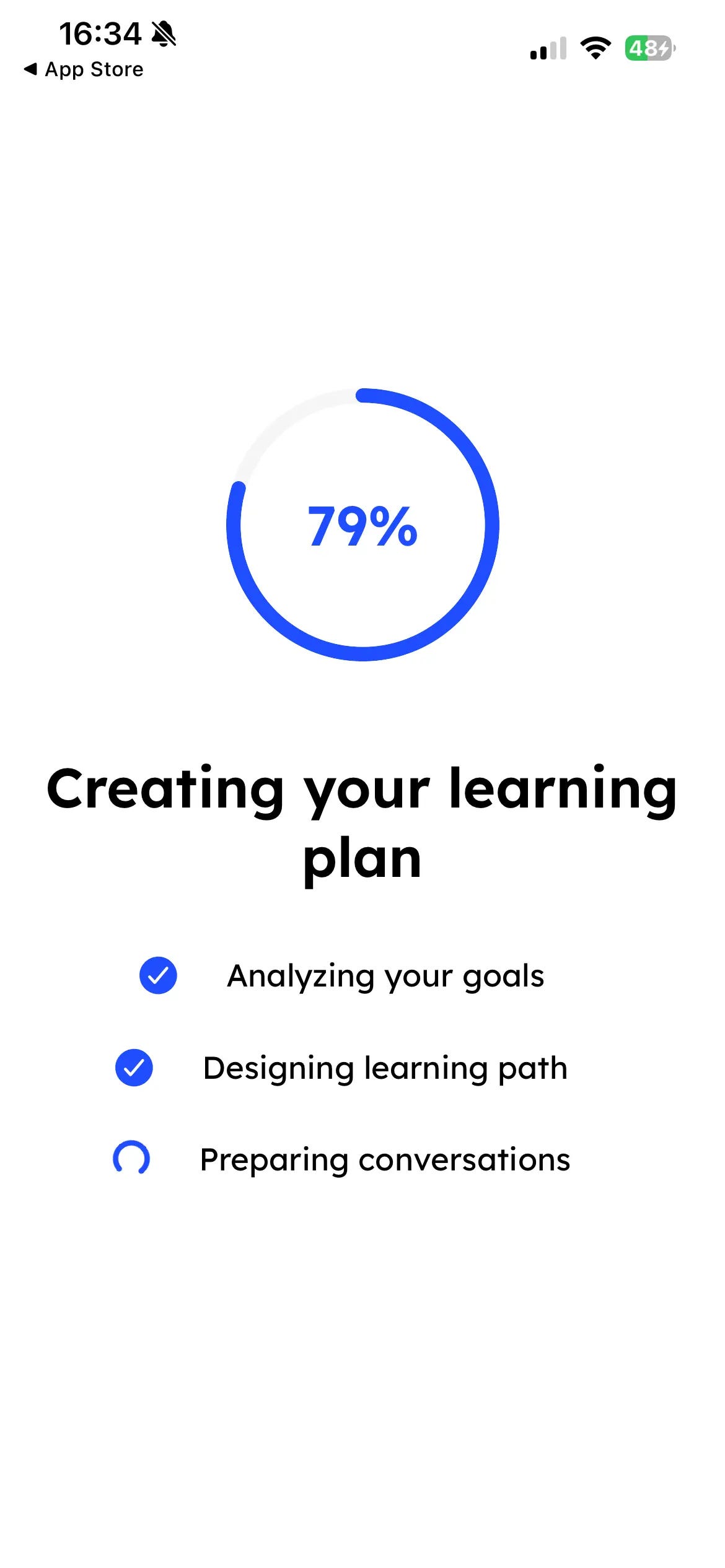
Then, a screen displaying user reviews 👇️
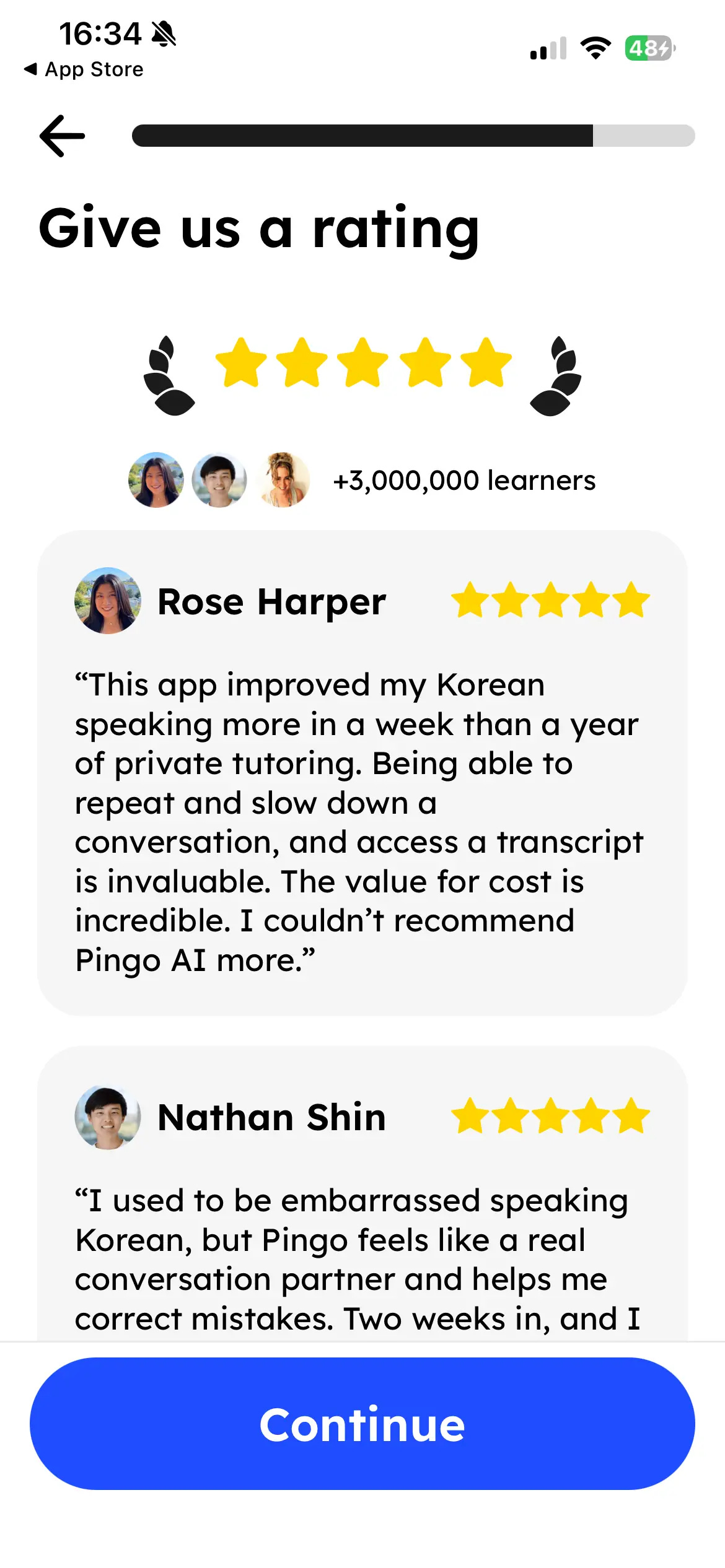
This flow is implemented in most apps, so you should definitely analyze it and implement it. Sorry for the constant self-promotion, but I stock the onboarding screens of popular apps on a platform called “Onbo Hub,” so please use it as a reference 👇️
I’ve recently started stocking videos as well, so you can now quickly check onboarding flows at several times the speed.
Now, let’s get back to talking about “Pingo AI.” After finishing onboarding, you transition to an account creation screen, and then you can take one lesson 👇️
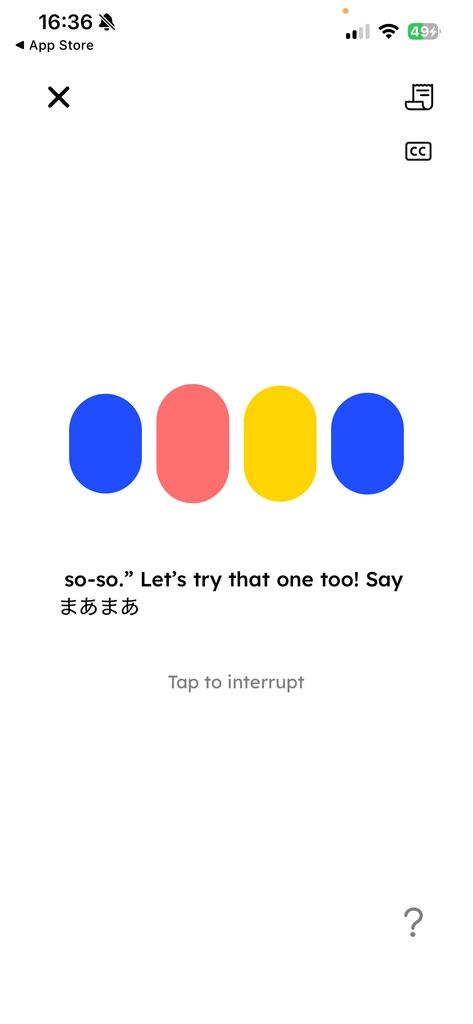
It is not a completely hard paywall; it is designed so you can do one lesson for free. The lesson itself involves speaking various practical phrases after the AI’s audio. If your pronunciation is off, it corrects you. By the way, the AI in “Pingo AI” is made of four lines in blue, pink, and yellow. These four lines move smoothly in sync with the audio. They said they didn’t want to use the format where an avatar talks, like conventional language learning apps. They are thinking about how to create rich expressiveness with just these four lines. Interesting. Honestly, I thought this UI was quite good. It feels like the app itself is more sophisticated than using an avatar. Anyway, if you try to take another lesson after finishing the first one, you need to pay. This is where the paywall first appears 👇️
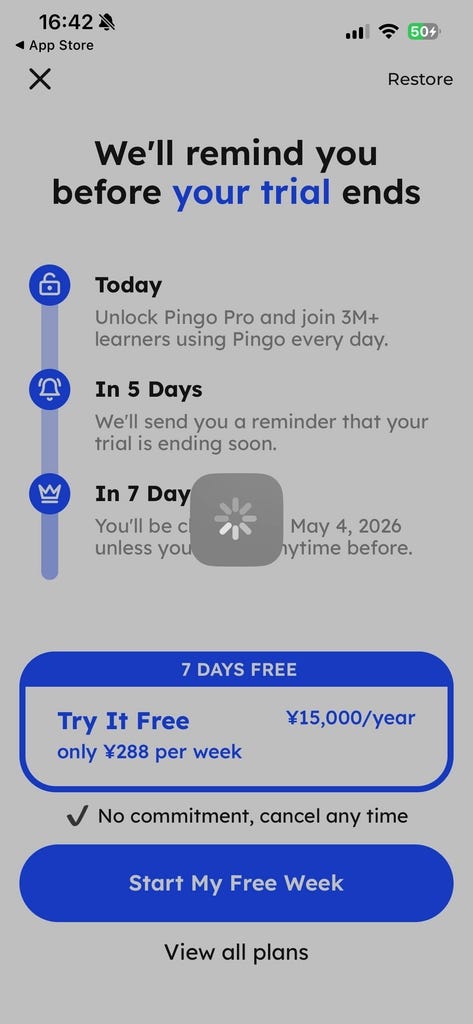
The price is 15,000 JPY per year in Japan, including a one-week trial. Currently, it allows one free lesson and a one-week trial, but looking at the reviews, it seems it was originally a completely hard paywall. Perhaps they softened the paywall considering further scaling at the time they were accepted into the YC program and raised funding. A hard paywall strategy is appropriate for solo development. A freemium strategy is appropriate if you have raised funds and are aiming for a unicorn-level valuation. Personally, I think the approach they took—”aiming for a certain level of growth with self-funding × hard paywall at first, and then shifting to funding × freemium at the timing of hitting the accelerator”—is quite viable.
🚀 Topping $25k MRR in 2 Months After Launch
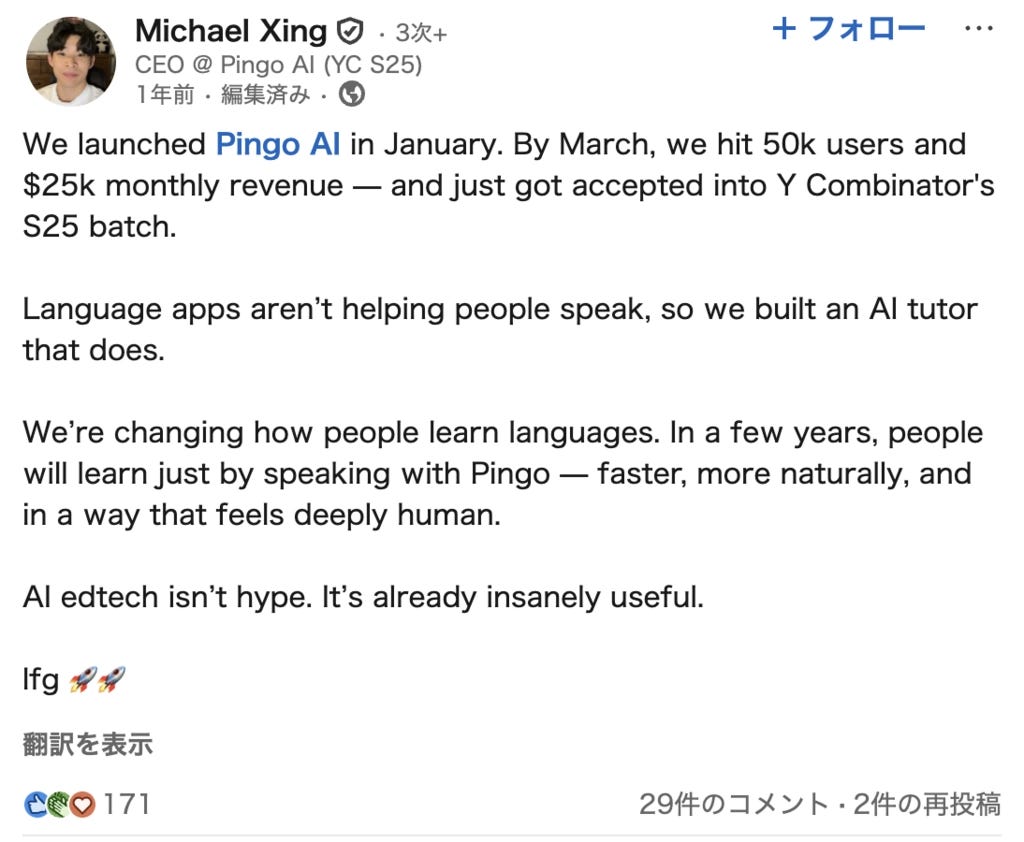
So, what were the results after launch? Results started appearing immediately. As of March 2025, two months after launch, the number of users reached 50,000, and MRR reached $25,000. And they won their acceptance into YC 👇️
From there, they achieved even further growth, reaching about $500,000 per month and over 3 million cumulative users by April 2026. Doing this in just over a year since launch is abnormal. So, how were they able to grow the app so rapidly? Along with the quality of the product, the insane customer acquisition power through short videos is a powerful engine. Michael says:
“In this day and age, virality is by far the best growth lever. Therefore, there is no point in building a consumer-facing app with no prospect of going viral.”
Actually, Michael originally built a food-related app. However, it was difficult to generate virality and it failed. Based on that experience, they built the app from the start thinking about how to generate virality. This idea of “designing for virality from the start when building a product” is incredibly important in this day and age. So, from here, we will take a thorough look at their viral strategy. I’ll be honest. I have been doing short-video marketing for my own Japanese learning app for over a year. Researching every day, posting every day, and even commissioning creators. Even so, I spent days worrying that “the product isn’t growing much.” Meanwhile, having thoroughly investigated “Pingo AI” this time, one thing became clear. “Oh, I was fundamentally doing it wrong.” What I am revealing from here on is the full picture of “Pingo AI’s” viral strategy to overturn all those “mistakes.” Specifically, I will explain these six points 👇️
The difference between the “Winning Format” they found in the early stages of launch and the “Losing Format” they discarded.
Criteria and methods for recruiting creators.
The full picture of creator management based on “VC Portfolio Theory.”
The story behind the creation of the legendary “Toxic AI” format that is buzzing everywhere, and the “Essence of Creator Management” that can be learned from it.
Concrete measures to dramatically increase CVR found through paywall AB testing.
Is a 3-day or 7-day free trial optimal?
Honestly, if I could have started my solo development with all of this knowledge, my current situation would be completely different. Conversely, those who will compete in solo development from here on out can start with this knowledge from the beginning. That alone should be a massive advantage. A must-read for all developers who want to grow apps with short videos.
🎯 Testing Various Conversation Formats to Find Winning Patterns
They immediately started creating short videos in various formats. Of course, the conversation via “Pingo AI” is the hook for the video, but there are various patterns within that. Through trial and error, the first video to go viral was the following.
This hit over 100,000 views. As a result, it turned out that the format that goes viral the most is “a format where you talk using ‘Pingo AI’ on an iPad,” just like this video. Also, they don’t include unnecessary introductions at the beginning and start the video from the point where “Pingo AI” is talking. The first two seconds are incredibly important for short videos. The key is whether you can retain the user for the first two seconds. In that respect, it is quickest to show a hook where the AI is talking in the language immediately. Furthermore, with this format, you can naturally show the product, so it leads quite a bit to conversion (CV).
They also tried the “slideshow format with several still images,” which is quite popular right now, but they stopped it because the CVR was quite bad. The slideshow format basically promotes the product on the final screenshot, so there is a high possibility that the user will drop off before the promotion. Also, the “feeling of an advertisement” is unavoidable. In that respect, the format of talking with “Pingo AI” has a thin feeling of advertisement, and since you can show a demo of the product from the beginning, you can imagine that the CVR is quite high. I honestly think this format is powerful. While testing this format more and more, the following video went viral and exceeded 1 million views 👇️
This was content created by jumping on the wave when the world was buzzing about the fact that TikTok might be banned in the US. By aligning the content of the conversation with social trends, you can make the video go viral nicely. Powerful. Having found a winning format in Chinese, they expanded to other languages as well. There are accounts for Korean (@pingoai.korean), French (@pingoai.French), and Spanish (@pingoai.spanish). Thus, in just two months since launch, MRR exceeded $25,000. However, there is a limit to just continuing to upload short videos themselves. So, the strategy they adopted to aim for further scaling was involving creators. Next, let’s look at that creator strategy.
🙋 Recruiting Creators
To aim for further scaling, they started recruiting creators. They said they target “people who are learning a specific language, have 5,000 to 10,000 followers, and have experienced going viral even once in the past.” It is not necessary to have many followers, but it is desirable to have a certain amount of content creation experience and to have a knack for viral videos. Hence the condition “people who are learning a language, have 5,000 to 10,000 followers, and have experienced going viral even once.” And language learners are more desirable than native speakers. Because they can understand the user’s pain and create better content.
In the Japanese learning app I am growing, I had only used videos by Japanese creators until now. This is a complete mistake. If you are going to create content to promote a Japanese learning app, it is obvious that it is better to use foreigners who are learning Japanese as the subject. I must do it. They say recruitment is basically done via Instagram or TikTok DM. And if there is a response, detailed communication moves to email.
🧑🤝🧑 Starting Creator Management with a VC-like Mindset
While they took a “push” approach to recruitment like this in the beginning, they say they are currently using a “pull” approach. That is the creator program called “Pingo Creators” (it’s intense that they even acquired the domain pingocreators.com to operate it).
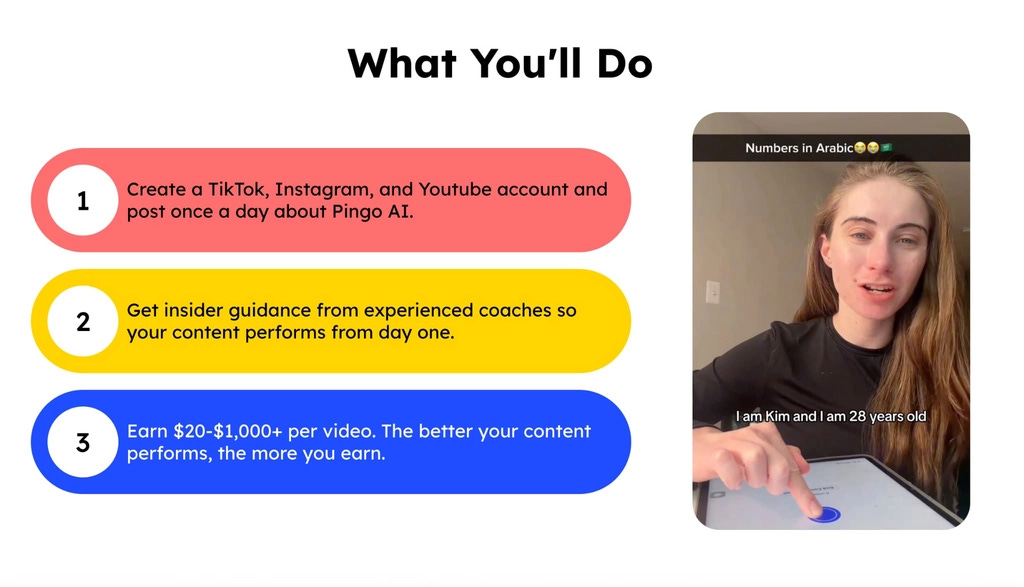
If you apply to this program and pass, you can act as an official Pingo creator. And you set up your own TikTok, Instagram, and YouTube accounts and post videos about Pingo. Because they have many creators and the awareness of “Pingo AI” has risen, they have become able to do this pull-style recruitment. By the way, the compensation consists of both “fixed compensation per video” and “bonuses based on views.”
This allows creators to continue making videos with high motivation. By the way, they also say they have a mechanism to receive feedback from coach creators who have already succeeded. Incidentally, it seems there are creators earning over $10,000 a month. Powerful. And it seems they operate this group of creators thinking of it like a “VC portfolio.” Just as a VC invests in 100 startups, they “invest” in 100 creators.
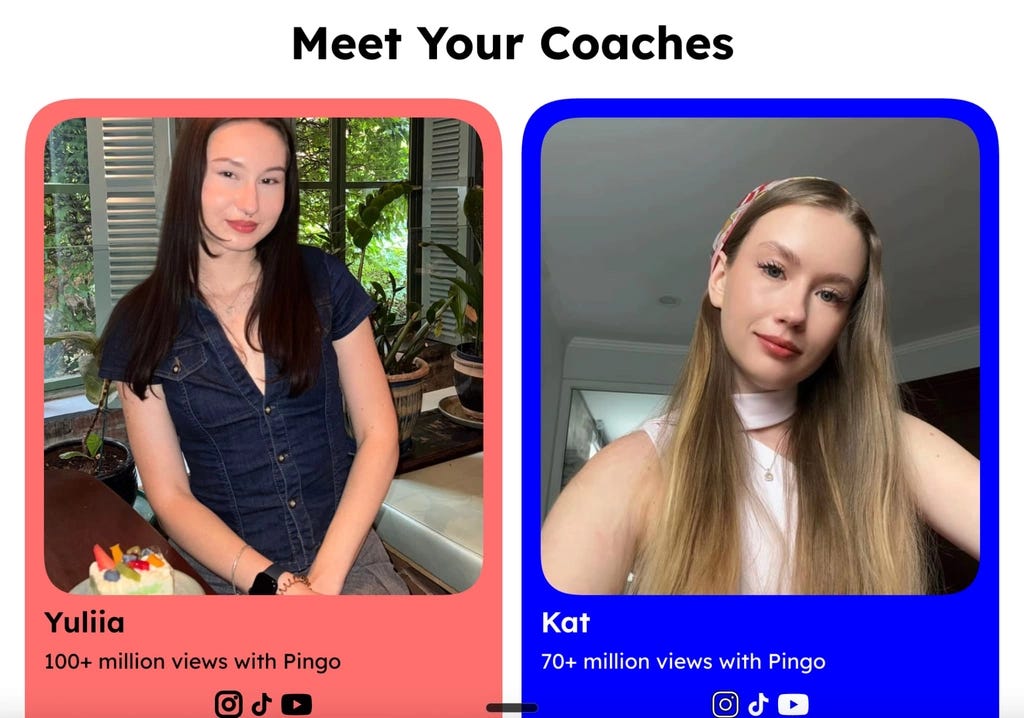
They contract with them one by one, invest coaching time, pay compensation, and align the direction of the content. And as is the case with a VC portfolio, most creators end up with mediocre results. Some creators don’t grow at all. But among them, a few “homerun-level” creators always appear. For example, members like Yuliia (over 100 million views on Pingo alone) and Kat (over 70 million views on Pingo alone), who currently serve as coaches, were geniuses who created homerun-level hits as creators from the start 👇️
A few of these top creators generate the majority of the views for the entire portfolio. And creators who don’t show results are either coached and corrected, or eventually removed from the portfolio. The approach of teaming up with a large number of creators to ensure numbers, finding viral formats and expanding them horizontally, and then narrowing down to talented creators is incredibly smart. Honestly, I think I have to do this too... this is no time to be struggling, wondering why it’s not working by asking one creator half-heartedly. The approach is to converge the expected value of short video virality by asking multiple creators while testing various formats myself. I’m going to do it!
📲 Pingo’s “Top 3 Viral Video Formats”
So, what kind of videos are Pingo’s UGC creators specifically making? According to the official Pingo Creators page, there are three main content formats they recommend 👇️
Conversation Content
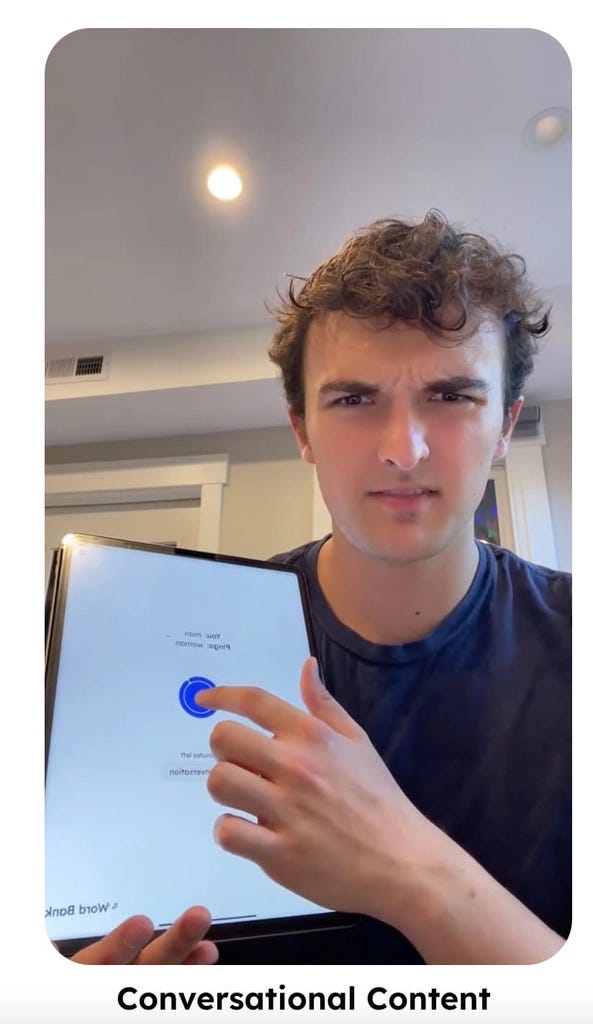
A pattern where you film the creator actually talking to Pingo’s AI. By showing “a scene of practicing using Pingo,” it makes the viewer think, “Oh, I want to try this too.” This is the royal road content that the two founders were originally doing.
Reaction Content
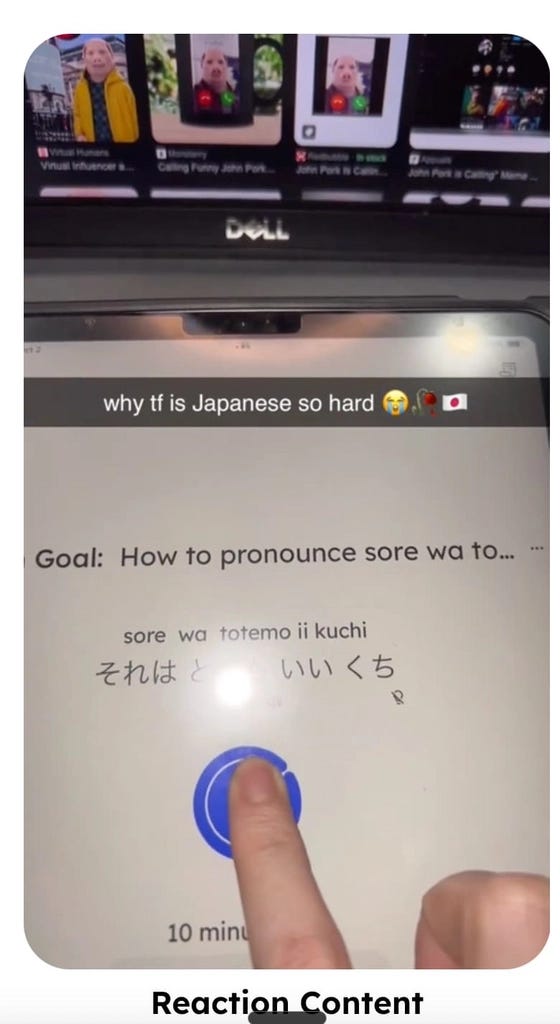
A pattern where the creator reacts exaggeratedly to what Pingo’s AI said. It cuts out the moment when the AI unexpectedly returns a sharp comment, is a little toxic, or says something funny, and makes it look dramatic. As I will dig deeper later, this is the star content that is generating massive buzz.
StudyTok Content
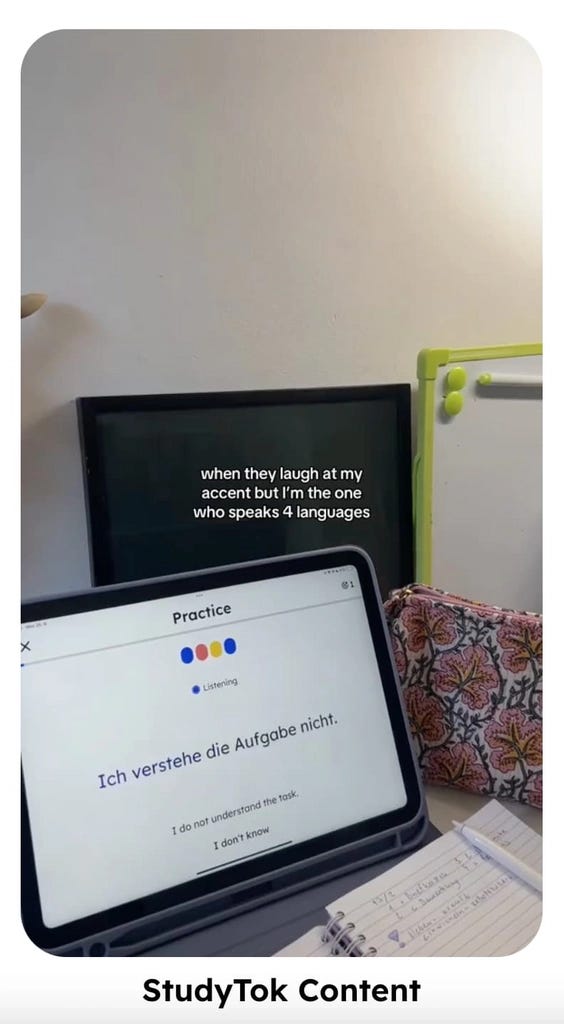
Videos following the “StudyTok” format, which has become a major genre on TikTok. Inserting scenes where you are using Pingo in tandem with the state of studying at a desk.
These three are all designed to show the Pingo experience “naturally.” The important thing is to erase the “commercial feel of Pingo.” They thoroughly ensure that Pingo appears naturally within “the creator’s real personal language learning life.” By doing so, it doesn’t just go viral, it leads to CV. Even if it goes viral, it is meaningless if it doesn’t lead to CV.
😈 The Biggest Buzz is the “Pingo Mocks the User” Format
Well, well, let’s look at the formats that actually went viral within this management policy! The video format that has gone viral the most so far among “Pingo AI’s” viral formats is, as expected, the #2 Reaction Content. And among them, the format where “Pingo AI roasts (disses) the user” is going massively viral. For example, a video like this 👇️
This video recorded 200,000 likes. Maybe there are people who have seen it? The user makes a mistake in Japanese pronunciation. Then, “Pingo AI” digs in with a sharp tongue, saying something like, “Hahaha, what are you saying? That’s totally wrong.” This was incredibly well-received. Most conventional AIs were things that returned harmless and supportive responses. However, a video where an AI returns an obvious answer like “Well done” is boring. The sense of discomfort—”Eh, why is the AI taking that attitude?”—is a powerful hook. Furthermore, content that reveals natural emotions such as the user’s surprised face or crying face attracts interest. As a result, this “Toxic AI” × “Crying User” content became a staple format. I think this format can be applied to any app.
🕺 Discovering Viral Video Formats Starting from Creators
And what is shocking is that this was not a feature created for the purpose of going viral from the beginning. Originally, “Pingo AI” had a feature called “Custom Scenarios,” where users could freely create scenarios or instruct the AI to speak in a certain tone. Then one day, one creator used a custom scenario and posted a video making “Pingo AI” mock them. The founders didn’t instruct them. But it went massively viral. Since then, they switched their policy. From the policy of “we design the content ourselves” to the policy of “let creators freely test and error, and horizontally expand what hits to the entire portfolio.” The “winning formats” found by top-tier creators and coaches are shared as a textbook to the entire portfolio. Then, new creators can also generate buzz with a certain hit rate.
💰 Dramatically Improving CVR by Displaying the Free Trial Timeline
They say they strive to increase CVR by AB testing the paywall every day. And they say the one that has been most effective so far is “displaying the timeline of the free trial.” Indeed, their paywall clearly states the schedule from free trial to billing as follows 👇️
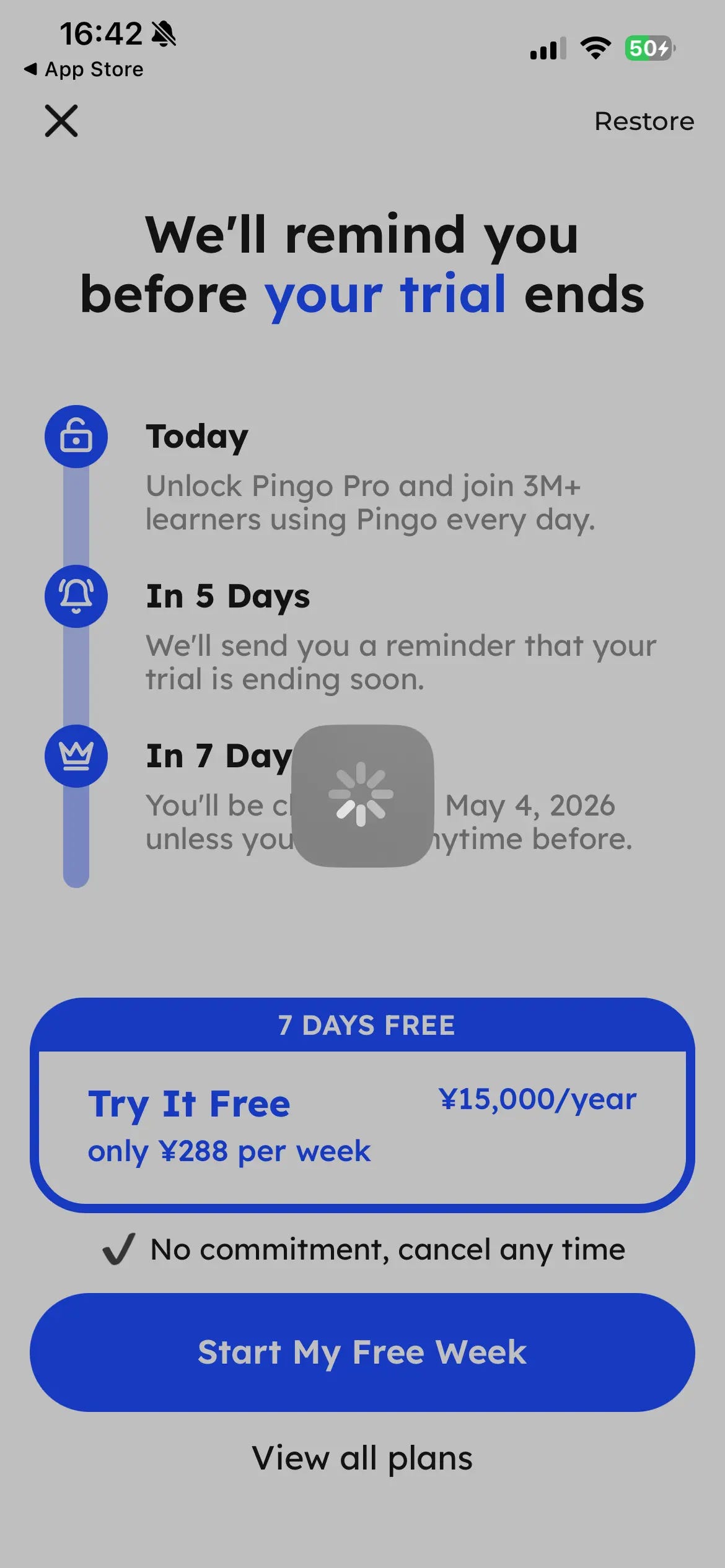
When people see a free trial, they think, “I’ll forget to cancel, so I won’t do it.” That is exactly why they thoroughly emphasized, “We will definitely notify you 2 days before,” “You can cancel anytime,” and “Even if you press the trial start button, you won’t be charged immediately,” eliminating the user’s risk. They said this was more effective than persuading the value of the product. Interesting.
💸 Which is better, 3 days or 7 days for the free trial period?
Also, they have been AB testing which is better, 3 days or 7 days for the free trial period. As a result, the 3-day trial tended to have a 5–7% higher churn rate, and the 7-day trial resulted in a conversion rate that was about 2% higher. Therefore, they are currently adopting 7 days.
However, since the optimal solution may always change, they say they are still doing trial and error even now. It seems they are also testing a layered structure to offer a 7-day trial as a churn prevention measure to users who refused the 3-day trial. Morrie says: “The optimal paywall is worth testing 100 times more than you imagine.” Paywall testing is seriously important. I have done it quite a bit on the Web, but I haven’t done it properly on iOS, so I think I need to do it. Let’s analyze onboarding and paywalls and optimize the app’s CVR!
📝 Summary
Well, I have looked at a big product called “Pingo AI” at great length so far, but the important thing is, after all, “build an app in a field where you have problems.”
The reason “Pingo AI” became such an explosive hit is because the two founders were stakeholders who were troubled by the “lack of Chinese practice partners” themselves. It is almost impossible to create content with a real air of authenticity in a field where you don’t have problems.
So first, let’s build an app for yourself in a field where you are seriously troubled. This is a principle common to over 100 developers I have introduced in the past. Build a product starting from your own issues!! And “overwhelming UGC creator portfolio operation” is also one of the big success factors.
You can go up to a certain point with the conventional “style of posting on TikTok yourself every day,” but that eventually makes “your own time” the bottleneck. The trigger for “Pingo AI” to scale explosively was the model of “operating creators like a VC by investing in them.” If you do this, there is room left to scale even if you use up all your own time. However, you should do it yourself at first. Don’t leave it entirely to creators from the beginning.
I myself have been doing short-video marketing for over a year, but I haven’t done operations where I ask creators in earnest, so I think I should do it soon. The idea itself is not that great. There are many apps that let you learn a language while talking with AI, and anyone can think of it. What is important is whether you can go through with it in earnest. As for me, I have been practicing English for 30 minutes every day without fail for 5 years, and since I started living in Georgia, I have been practicing Georgian for 30 minutes every day without fail, and I was doing Spanish every day when I was traveling in Central and South America.
Honestly, the language learning field exists quite a bit as a primary experience for me too. Language learning is fun and is rooted in the fundamental human desire for communication. So, while making a Japanese learning app, I think I want to make a multi-language learning app for myself. I still think there are many possibilities rolling around in this field. Language learning is diverse. I have no choice but to do it!
reference
https://www.ycombinator.com/companies/pingo-ai
https://www.ycombinator.com/launches/O6R-pingo-ai-ai-companion-that-helps-you-learn-languages
https://techcrunch.com/2025/09/15/the-9-most-sought-after-startups-from-yc-demo-day/
https://getlatka.com/companies/mypingoai.com