This 20-Year-Old Grew a Height-Prediction App to $147,000 a Month in 8 Months
He found the idea on a marketplace, validated it in a TikTok comment section, and built a video format so simple that can shoot one in 15 minutes. Here's the entire playbook.
August 27, 2026

This Substack breaks down real-world cases of people making serious money with apps in the AI era.
Today’s subject: Michael Que.
The app he built is, and I want you to sit with this for a second, an app for getting taller.
You enter your parents’ heights, your current height, your age, and where you are in puberty. It predicts how tall you’ll be as an adult. Then it hands you a sleep, nutrition, and stretching plan designed to get you as close to the top of that range as your biology permits.
You can make money from that? was my first reaction too.
But the app is currently pulling in over $100,000 a month. At its peak it did $147,787 in a single month.
Zero to there in eight months.
And he’s a 21-year-old college student. He was 20 when he launched it — and at the time, he was getting rejected from every single internship he applied to.
Today we’re going through exactly how he landed on this idea, why the idea was structurally positioned to win, and the specific mechanics he used to scale it.
💼 Rejected Everywhere, and Furious That Interviewers Got to Decide His Life
Michael was studying finance at NYU. His classmates were all grinding toward investment banking and private equity internships. He was doing the same thing.
And he lost, over and over.
Here’s how he put it on X:
“When I really wanted to get a job, I couldn’t get an offer from any dogsh*t company. Now I’m in a position where I have to turn offers down.”
And then:
“To everyone who’s been rejected over and over: don’t let a handful of recruiters and people who just happen to work at a company decide what everything you’ve built is worth. The reason I love consumer apps is that my fate isn’t decided by whether an interviewer likes the way I talk — it’s decided by millions of consumers.”
Turned down by finance firm after finance firm, sitting in that particular kind of despair, he went all-in on building apps instead. And it worked spectacularly.
He made that decision in the summer of 2025.
🔎 He Found the Idea on acquire.com, a Marketplace for Buying and Selling Businesses
So once he’d committed to apps, how did he arrive at a height app of all things?
Here’s the thing: he didn’t come up with it from scratch.
The tool he used to find ideas was acquire.com — an online marketplace for buying and selling internet businesses. Indie developers list their SaaS products and apps for sale there every day.
And there it was: a height prediction app, listed at around $20,000.
The fact that it’s listed on acquire.com is itself proof that demand exists. Somebody built it, somebody was willing to pay for it.
Going hunting for an already-validated idea is overwhelmingly faster than squeezing one out of your own head.
And he had a second reason to bet on this one.
When he was 13, he was insecure about being short, and he’d typed things like “height prediction” into Google himself.
Products built out of your own lived experience are strong. At minimum you’re a plausible customer, and your resolution on the user’s pain is far sharper than it would otherwise be.
Some people argue you shouldn’t lean too hard on personal experience — that it loads your product with your own subjective bias. Fair enough in general. But for solo builders specifically, I think a product that grows out of something you actually lived is a very good starting position.
In his case, he’d cleared two bars at once: proven market demand, and personal experience of the problem. That’s a strong hand.
📱 TikTok Comment Sections Are the World’s Best Demand Sensor
What sealed it was the TikTok comment section.
Scrolling through videos about height, he noticed teenagers writing the same thing over and over in the comments:
“14M, currently 5’6”. Dad is 5’11”, mom is 5’4”. How tall will I get?”
Seeing that, Michael became certain the demand was real.
An enormous number of teenagers care deeply about how tall they’re going to get, and what they can do to get taller.
And honestly, thinking back to my own middle school and high school years — I was pretty preoccupied with how tall I’d end up too.
I also suspect that if I’d taken the right actions back then, I could have gotten a bit more out of it. So yeah, this could really land with a lot of young people, I thought.
That’s three factors stacked:
A market with demand already validated
A problem he’d personally struggled with
Genuine potential to go viral on TikTok
When those three line up, I’d put the odds of success pretty high.
🙋 Launching “GoTall,” an App for Getting Taller
And so he launched GoTall.
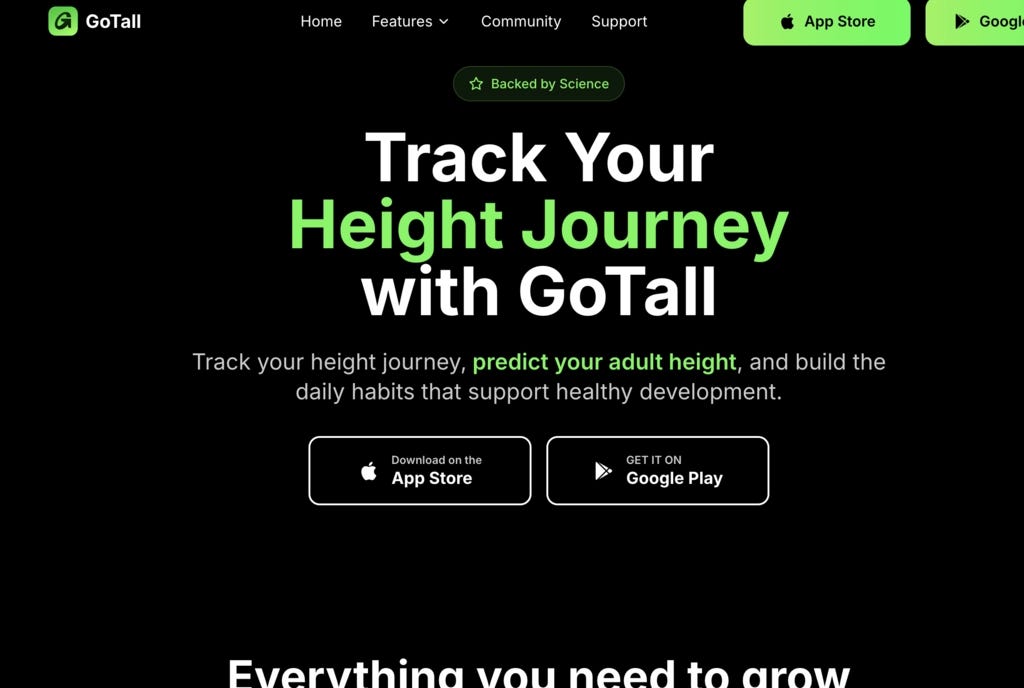
You enter your parents’ heights and the changes happening in your body, it predicts your future height, and it supports you with exercise and nutrition guidance aimed at maximizing it.
That “I want to lose weight” demand exists is obvious to everyone. But once you’re an adult, you stop noticing that kids in their growth years have a burning “I want to be taller” demand.
For a kid, though, “I want to get as tall as possible” is almost certainly a bigger want than “I want to lose weight.”
He caught that demand cleanly and it became a hit. It’s an idea only a young person notices. And an idea only a young person is willing to bet on.
Now, as always, this app’s onboarding is enormously long. From download to paywall there are 47 screens.
The app asks a whole range of questions in order to predict your height.
Current height, shoe size, parents’ heights, what sports you play, how often you lift — you’ll hit questions that make you think wait, you’re asking that too?
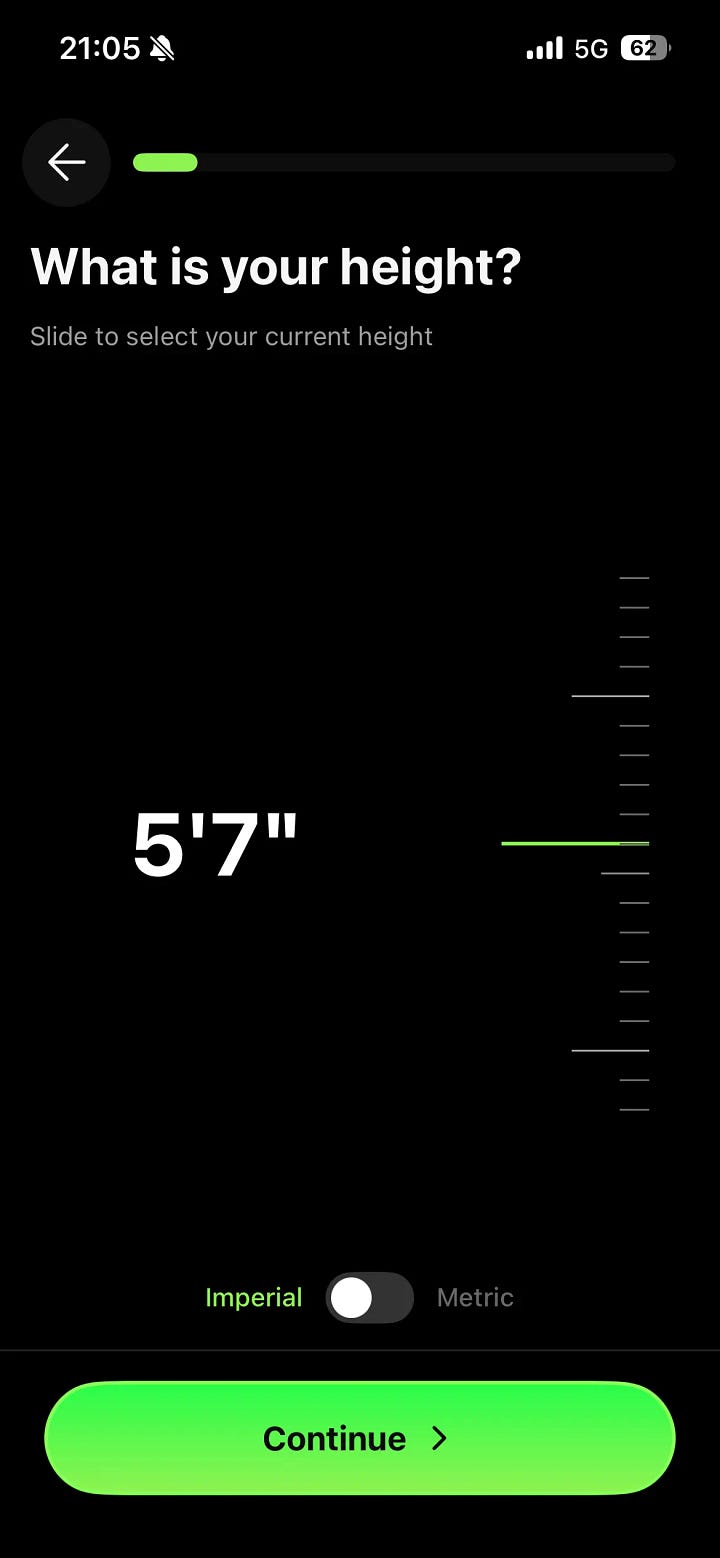
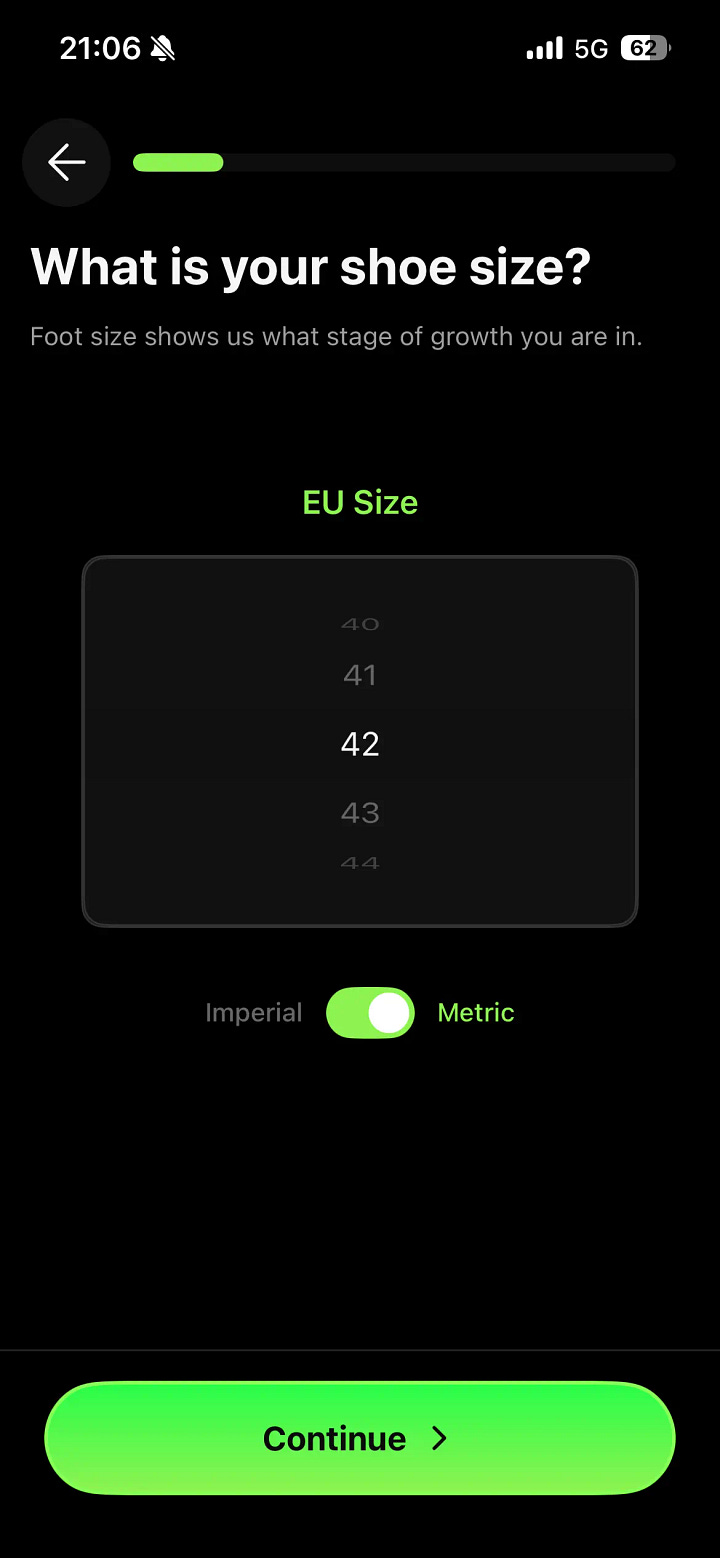
Every one of them genuinely matters for predicting height accurately.
And from the user’s side, the more questions there are, the more trust builds: this app is seriously analyzing me. Then sunk cost kicks in — I’ve invested this much time, I need to see the result.
The result: a 91% paywall reach rate.
That is, frankly, absurdly high.
And the design is built so that if you want to see your final height prediction, you have to pay.
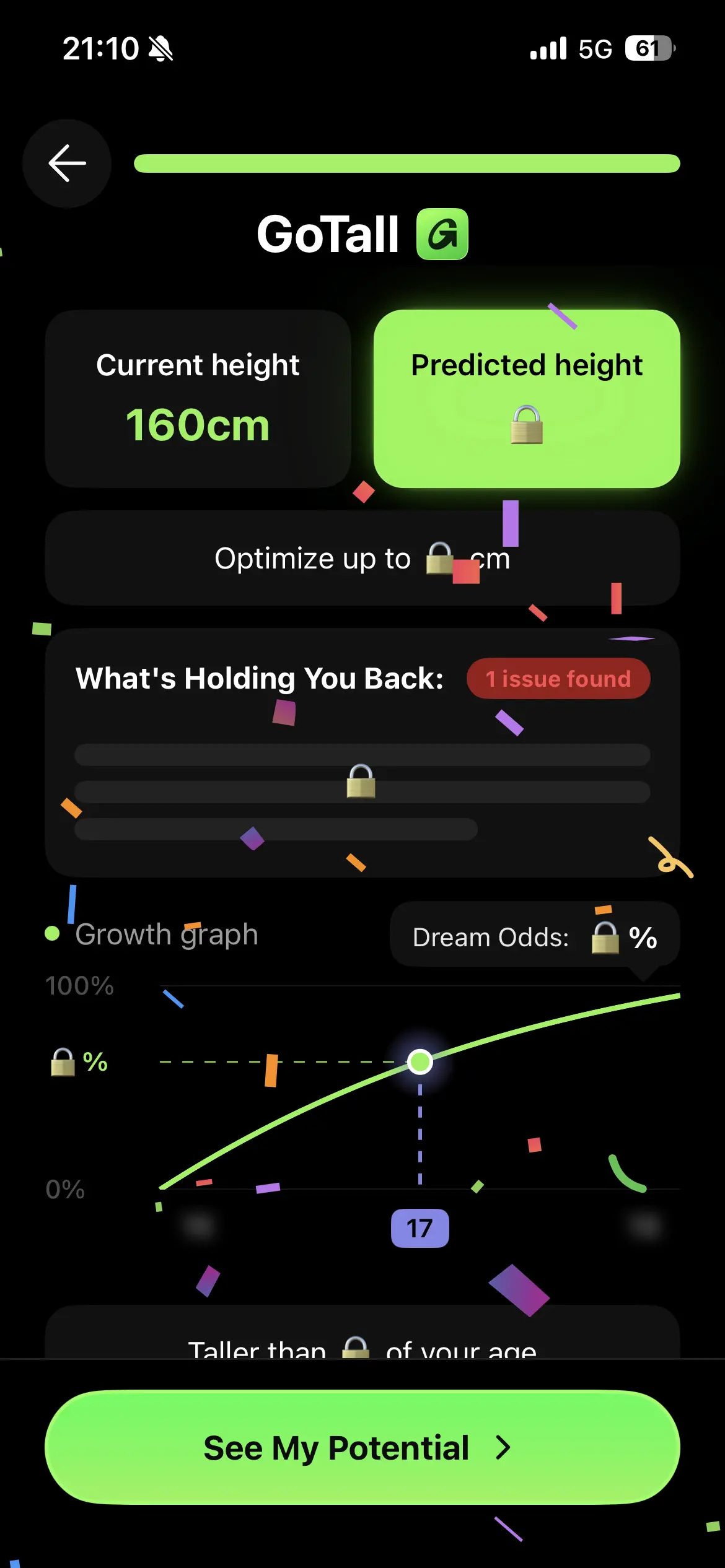
Well, yeah — that’s going to convert.
You can dismiss the paywall, incidentally, and a portion of the app is usable as freemium after that.
But if you want the thing you came for — the height prediction — you’re paying.

The genuinely interesting part of the height prediction is that it doesn’t resolve once and end.
Every time the user logs sleep, meals, and stretching, the predicted number updates.
In other words, it isn’t a bait feature you look at once and abandon. A reason for continued use is engineered directly into the core mechanic.
GoTall’s onboarding is genuinely worth studying, so I’d encourage you to go through it.
Of course, GoTall is already registered on Onbo Hub, the site I run. You can check every single screen here:
🚀 First Conversion Two Days After Launch
So what actually happened when he launched?
He got his first paying conversion two days in.
With barely any downloads to speak of, someone appeared who was willing to pay — and his confidence hardened into conviction.
Zero conversions and one conversion are completely different worlds. Even at one, if there’s a user willing to hand over money, that’s an unambiguous sign the demand is real.
From there it’s a matter of improving onboarding and the product while boosting acquisition.
So he started posting 10 TikToks a day. Brutal.
People who actually get results operate at a completely different order of magnitude in raw volume.
Posting a handful of TikToks and then lamenting that nothing’s working is not a serious attempt.
Every success story I’ve covered in this Substack was posting at least once a day — the heavy hitters, 10 or more.
📉 Two and a Half Weeks In, $167. He Nearly Quit.
Reading this far, you might assume it climbed smoothly from here. Reality was nothing that kind.
Two and a half weeks after launch: 500 downloads, $167.
Which is still impressive in absolute terms — but compared to the success cases I’ve covered here, it lacks momentum.
And in fact, he’s said that watching the numbers refuse to move despite how hard he was working, he was half ready to give up.
At that point, nobody could have imagined this would become a product doing over $147,000 a month.
Then, in the middle of that, he finally found his viral TikTok format — and made $161 in a single day:
“Woke up this morning to our biggest spike ever. 2,600 downloads and $161 in revenue in one day. This is happening because we recently created our own organic video format. It takes 15 minutes to make and yesterday the videos did 500,000 views combined.”
From here, the app accelerates.
September 29, 2025: first day over $1,000
November 2025: $30,000 a month
January 2026: $147,787 a month
...Ridiculous.
So let’s break down the growth trajectory from that point in detail.
I went back through his personal TikTok account, the official app account, and the accounts of the UGC creators he hired — starting from their earliest posts — and analyzed when and why each one broke out.
Strong formats always have a reason. Understanding that reason matters enormously for growing your own app.
Let’s get into it.
🕺 Running Format Experiments on His Own TikTok Account
First, he created his own TikTok account plus an official app account, and ran his experiments there.
His account: https://www.tiktok.com/@kevinliutalks
Official app account: https://www.tiktok.com/@gotallapp
Early on he wasn’t promoting the app at all — he was just making videos with tips for getting taller:
Then his first break came from an interview-style post:
That one did 43,000 views.
The concept: walk around campus, ask students how tall they are, then say “really??” and actually measure them with a tape measure.
GoTall’s UI shows up casually inside the video, which does the promotional work.
It’s a format with obvious viral potential — but interview content needs an on-camera presenter and someone shooting, and it takes real effort to produce.
The cost-to-output ratio was bad, and he couldn’t sustain it. He kept testing other formats, looking for a bigger vein.
And then he found the format that would break everything open.
This one:
It’s a video that quotes a comment from another video and answers it.
The comment being: “My dad is X and my mom is Y and I’m currently Z — predict how tall I’ll be.”
In the video, he reads the comment aloud and says, “I got this comment — let’s predict his height with GoTall!” — sliding the app in naturally.
Then he shows the final prediction. The structure makes you want the answer, so watch-through retention stays high.
And here’s the powerful bit: he prompts action by saying “comment on this video and I’ll do your height prediction in the next one.”
That buried his videos in comments, and the algorithm started rewarding him.
The first video did around 5,000 views. The fourth one he posted in the format broke 370,000:
After that he was consistently doing tens of thousands of views, with good ones clearing several hundred thousand:
And the other enormous advantage of this video: the effort required to make one is close to zero.
The source material is the comment section, so there’s nothing to think up.
And the editing isn’t complicated.
He’s said a single video takes him about 15 minutes from start to finish.
Finding a format that is:
low-effort to produce
impossible to run out of ideas for
structurally prone to going viral
...is the whole game in short-form video.
🌀 Scaling the Format Horizontally Across Creators
Convinced the format worked, he first made a separate account to test whether it would grow there too.
Predictably, the new account grew as well.
Then he had his girlfriend post in the format. That grew too.
Now he knew for certain it was replicable.
All that remained was gathering creators to post it.
So he started sending roughly 50 DMs a day. Again — the sheer volume is brutal.
And note that he wasn’t selling. The offer was: “I’ll teach you my viral format — want to try it?”
The result was a small squad of creators. And sure enough, the videos those recruited creators posted took off too:
That post did 2.4 million views. Insane.
At the time, he was paying that creator $5 per video. And by his math, he was earning about $0.50 per 1,000 views.
By US UGC creator standards, that’s on the cheap end. But the model worked — because the format was so simple.
His winning format is “reply to a comment and predict someone’s height.” A creator who has never once touched the app can shoot one in minutes by following the template.
They don’t need to understand the product. They just follow the template.
That’s why it scaled.
With a stable of creators mass-producing the winning pattern, he kept testing new formats on the side.
Some of the creators:
The official account stayed quiet for a while, but from around January 2026 he’s been growing it aggressively. This one’s growing with a new format:
Five months after launch, he crossed $30,000 a month.
📲 Michael Is a Skeptic on AI UGC
He scaled by hiring real, existing creators — but there are plenty of cases out there of people growing apps with AI-generated videos designed to look like real humans.
That kind of content is called “AI UGC.”
And on AI UGC, Michael has been consistently negative:
“Gen Z is unbelievably good at detecting AI on TikTok (images included). Right now, hiring real creators and paying a $1 CPM might be both more effective and cheaper.”
Mass-producing video with AI to cut costs looks rational on the surface.
But the instant that AI smell gets detected, engagement falls off a cliff.
That said, as humans get better at detecting AI, AI keeps getting better at hiding — so it’s hard to deny this is turning into a cat-and-mouse game.
Personally, I’m not especially enthusiastic about growing apps with AI-generated UGC, and I don’t feel like I could handle it well right now.
But there are real cases of apps growing explosively on AI UGC.
FaceKit, is the clearest example:
My guess is that if the video is just a reaction shot — a surprised face, no speaking — or a sequence of stills, AI can produce something pretty decent.
But making genuinely spoken content with AI and fully eliminating the AI smell strikes me as quite hard.
I suspect it also depends heavily on how well AI fits your app’s theme.
🚀 Explosive Scale via Paid Ads
So: hiring UGC creators grew his revenue to $30,000 a month.
But how did he get from there to $150,000 a month?
The answer is ads.
Here’s how he described the road to $150,000 a month:
Revenue that was $30,000 a month in November 2025 had grown to $150,000 a month by January 2026.
What drove him was setting a goal that looked impossible.
His target for the end of 2025 was $100,000 a month. In November, he was at $30,000.
Trying to find any way over that wall, he apparently went as far as visiting Blake Anderson’s office to ask for advice.
Blake, of course, is the wildly successful app founder who’s appeared in this Substack many times — the person a huge number of young app founders are inspired by.
And even Blake reportedly told him that clearing $100,000 in that timeframe wasn’t possible.
Michael didn’t give up.
He took the best-performing videos out of the organic UGC library he’d accumulated, pushed them into paid ads, and went in accepting the risk.
At first, he says, none of it worked.
But he kept cutting the underperforming ads and tuning as he ran, and after a certain period of grinding, ad performance suddenly took off all at once.
The result: January 2026 ROAS (return on ad spend) landed at 2–3x, and January revenue came in at roughly $150,000 for the month (whether he actually hit $100,000 in December is unclear).
🔥 What to Watch For When Setting Up UGC Creator Accounts
He’s also written up the account setup work you need to do first when hiring UGC creators and scaling.
It’s extremely useful, so let me walk through it.
If you post a video promoting a product straight out of the gate on a brand-new TikTok account, TikTok can flag it as spam and cap your views at around 100.
Michael lays out his method for avoiding that here:
The procedure:
【Step 1】Prepare a large batch of warm-up scripts
First, write a big pile of scripts for videos that have nothing to do with the brand — purely engagement-farming content. In the height niche, that’s stuff like “things only tall people understand.” Just entertainment.
【Step 2】Reply to every single comment
Have the creator reply to every comment on those videos. The point is to get the algorithm to read the account as a normal user.
【Step 3】Pay a $20 bonus once a video clears 1,000 views
This is the genius part.
“Once one of a creator’s warm-up videos passes 1,000 views, I pay a warm-up bonus ($20). That gives them an actual incentive to scroll.”
Normally, warm-up work is tedious busywork. Creators will absolutely cut corners.
So he attached a small reward to it. Twenty dollars is a rounding error to him, but to the creator it’s a reason to actually do the job properly.
The incentive design here is excellent.
【Step 4】No branded content whatsoever until they can clear 1,000 views
And this is enforced strictly.
Until a creator’s videos can reliably break 1,000 views, zero branded content.
Just completing this initial warm-up before starting promotional UGC videos, he says, changes the growth curve completely.
If you’re serious about social media marketing, this is a mindset worth copying outright.
💵 Asking for Reviews During Onboarding
He’s also said this about collecting reviews:
“It doesn’t matter how sh*tty your app is. Every new app should be able to get close to a 5-star rating. Put a ‘write a review’ popup inside your onboarding. You’ll get a flood of 5-star reviews naturally.”
On this one I’m honestly on the fence. I think there are legitimate arguments both ways.
Plenty of apps do include a review request screen inside onboarding — but these days there’s a real chance Apple rejects you for it, and a real chance users leave you a bad review instead.
That said: early on, when I was getting essentially no reviews at all, simply adding one of these review-request screens got reviews flowing in substantially.
If reviews just aren’t accumulating for you, it’s worth testing.
📝 Wrapping Up
So — that’s Michael Que and GoTall.
The part I found most useful was how he found the initial app idea. Hunting through what’s listed for sale on acquire.com is a genuinely new angle to me.
Looking at existing apps that are already selling well is fine, but then you have to fight something that’s already selling, already marketing hard, already growing.
Whereas apps listed on marketplaces like acquire.com might be hiding a vein of gold: demand that’s confirmed, but that nobody has marketed and grown.
And looking at his winning TikTok format, it reinforced how much it matters to find content that drives high engagement, never runs out of source material, and costs almost nothing to produce.
Find a format like that, and scaling becomes comparatively easy.
Personally, though, what landed hardest was that setting a big goal — $100,000 a month by year-end — was itself a cause of his app’s enormous growth.
Without a target like that, you probably don’t take the risk of dumping money into ads.
I’m growing several apps myself, and I’ve been going around saying things like “I want to hit $7,000 a month by year-end!” — which, in hindsight, might be far too soft.
Maybe I should be aiming for $100,000 a month. If you’re aiming at $100,000, $7,000 becomes something you blow past without noticing.
Set your goals as big as you possibly can.
So — that was a deep dive on Michael Que.
Thanks for reading all the way through! If anything caught your attention or you have questions, just hit reply to this email — I read everything.
And if you post your thoughts on X and mention me, it makes my day. I always respond.
See you next time.
References
https://x.com/michaelque22
https://www.gotall.app/
https://apps.apple.com/us/app/gotall-height-predictor/id6747467975
https://www.youtube.com/watch?v=EQfZCe3MkTU
https://x.com/michaelque22/status/2025792559029596631
https://x.com/michaelque22/status/2075760015290274274
https://x.com/michaelque22/status/2083790273734455319
https://x.com/michaelque22/status/1947819204947620136
https://x.com/michaelque22/status/1948225085132698021
https://x.com/michaelque22/status/1965205674444341297
https://x.com/michaelque22/status/2006441522951237757
https://growlabsllc.com/