Two AI Apps, $0 → $400K MRR: Inside the Playbook Behind Glam Up & Sprout
How a small team built two AI apps to $400K MRR — with no ads, no VC, and the same playbook twice
August 31, 2026
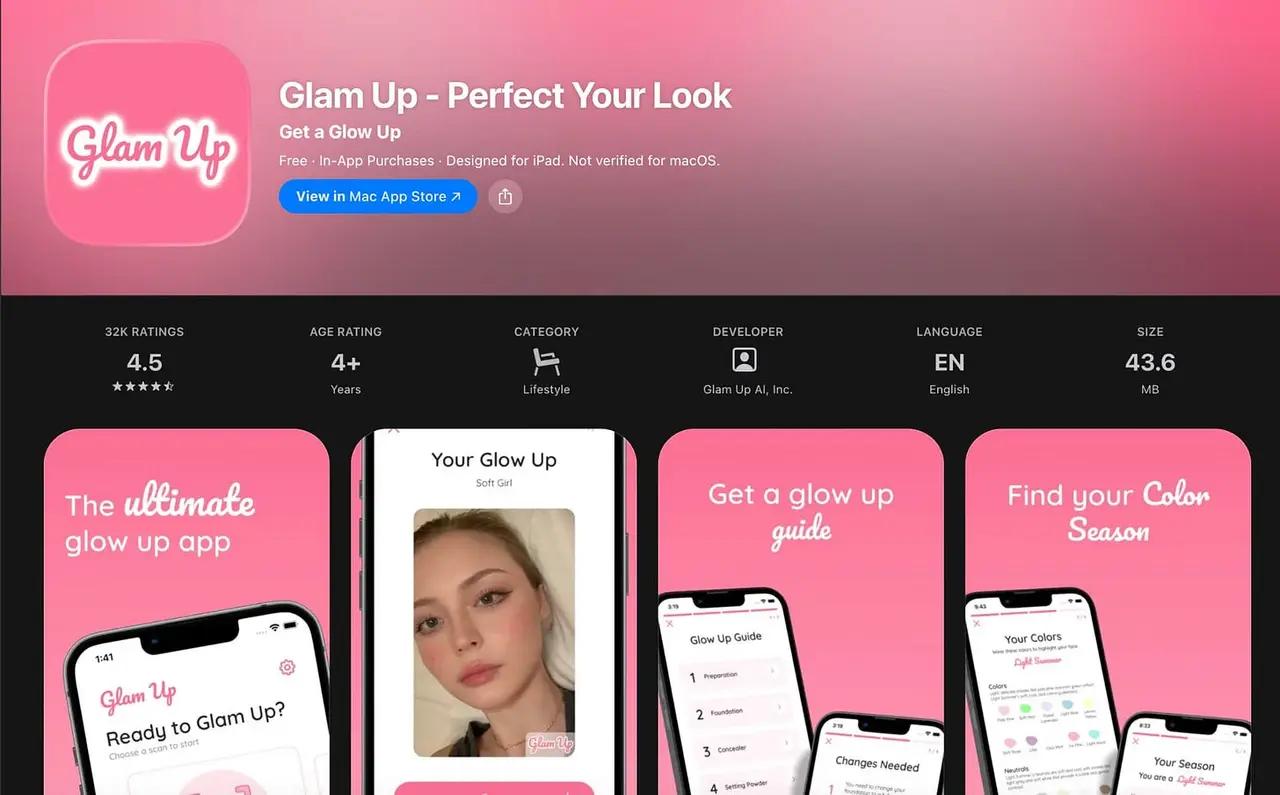
A 6-month-old AI beauty app hit $150K MRR. Eight months later, a sister app in a completely different category hit $250K MRR. The crazy part? The same small team built both — and they keep using the same playbook.
The team behind the apps
Before we get into the apps, a quick note on attribution — because in earlier write-ups (including the Japanese version this newsletter was based on), the story sometimes gets told as if one person did it all. That’s not accurate, and it matters.
Glam Up and Sprout were built by a small founding team, with two co-founders at the core:
Aaron Paul — co-founder, engineering. A Y Combinator-affiliated engineer who was embedded in the Hacker Fellow Zone (HFZ), the same toC app builder community that produced Blake Anderson (Cal AI, Umax) and many of the consumer AI breakouts of the past two years.
Nicole Cheung — co-founder, design and growth. Came in with a viral TikTok background (10K followers in 10 days while backpacking through Europe), and ran design, content, paywall, and marketing.
Aaron shipped the product, Nicole shipped the growth engine, and other team members contributed across both apps. Most of the public-facing storytelling has come from Nicole’s side (her CMC senior thesis, podcast appearances), which is why the growth playbook is so well-documented — but that documentation describes a team’s work, not a solo act.
With that out of the way, let’s get into what actually made these apps work.
App #1: Glam Up — the AI beauty app that hit $150K MRR in 6 months
What it does
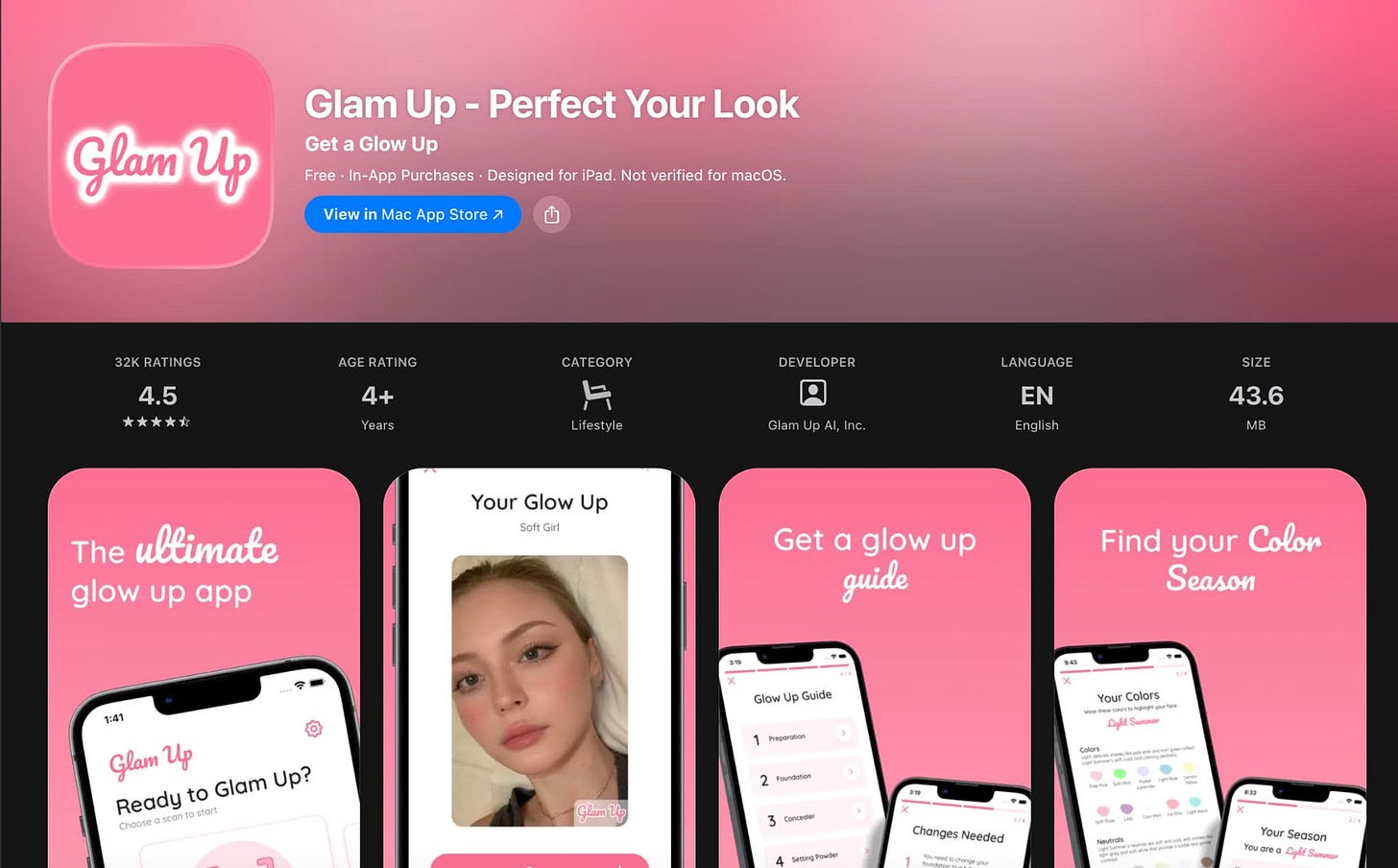
Upload a selfie. The app scans face shape, eye shape, and skin tone, then delivers personalized color analysis, face-shape analysis, and product recommendations. The wedge: “what makeup actually suits me?” — a question every young woman has Googled at some point.
The origin
The whole thing started with a 10-minute phone call. Aaron, watching Blake Anderson’s Umax (”look-maxxing for men”) climb to $500K MRR from inside HFZ, suggested a women’s version. Nicole agreed on the call. App launched a month later. It was barely functional at launch — but it was out.
The funnel: hard paywall, long onboarding
Glam Up uses what’s now the standard consumer AI app structure:
Long, personalized onboarding — skin condition questions, lifestyle questions, all feeding into a “personalized” result
Rating prompt mid-flow — and this is the clever bit: the CTA is “Leave a rating.” Tap it, and instead of advancing, the screen now shows “I rated.” Tapping “I rated” without actually rating feels socially awkward, so a meaningful slice of users actually leaves the rating before continuing. Ethically questionable. Empirically effective.
Photo upload — user uploads their face
Hard paywall — to see the AI makeup result, you pay
You can check all screenshots and video of Glam Up below.
Pricing: weekly only. No monthly, no annual. Why? Because AI makeup is an impulse-driven, one-time-curiosity purchase, not a habit. Annual plans would be a tougher sell and probably hurt conversion. Match the plan to the use case.
The growth engine: referral codes as a TikTok hack
This is the most replicable part of the playbook, and it’s worth understanding precisely.
At the paywall, users get a choice: pay, or share a referral code and get 3 friends to install the app. Most apps build referral programs where both sides get a reward. Glam Up deliberately gave the invited side nothing.
Counterintuitive — but here’s what happened:
Because the invited side gets no benefit, asking close friends privately feels awkward. (”Hey, use my code so I get free access” is a weird text to send a friend.)
So users dump their codes into the comments of viral TikToks instead, hoping strangers will use them.
The app generates a pre-written copy template: “Download Glam Up and use code [XYZ]” — so the app name gets dropped into every comment, for free.
TikTok’s algorithm sees a video with hundreds of comments and boosts it as high-engagement.
The video goes more viral. More users hit the paywall. More codes get dropped. Loop.
And because most invited strangers don’t actually use the codes (no incentive), the original user eventually has to just pay anyway.
The team essentially built a system where the bug is the feature — by deliberately not rewarding the invitee, they got viral distribution and paid conversion from the same mechanic.
What got copied — and how Glam Up benefited
A competitor launched a near-identical app called Glam AI (later renamed Glow Up). Same category, suspiciously similar name. Normally a nightmare.
Instead, Glam Up benefited. Because of App Store Optimization, when users searched for “Glam AI” after seeing competitor TikToks, Glam Up — older and more established in search — often surfaced first. Louis’s viral content essentially fed traffic to the original.
The team then doubled back and copied the competitor’s viral format — bare face → AI makeup transformation slideshows — generating their own 11.7M-view post off the same template. Lesson: in the consumer AI app world right now, the product isn’t the moat and the creative isn’t the moat. Speed of replication is the moat.
Content production: do it yourself first, then scale
The team did not start by hiring creators. Nicole and Aaron each ran 3 TikTok accounts personally — 6 accounts between them, all manual, all experimenting. Content pipeline:
Pull beautiful faces from Pinterest
Use another tool to digitally strip the makeup
Run that “bare face” image through Glam Up to generate the “after”
Post the before/after as a TikTok slideshow
Infinite content from a near-infinite source. After dozens of experiments, the pattern emerged:
Hook text: “Never saw myself with the right makeup routine 😭” — small font, offset to the side
Caption: always “I will be unstoppable 😮💨” + the same hashtag set
Audio: a rotation of ~10 specific tracks. Others didn’t work.
Once the formula was locked, they scaled — but didn’t fully outsource. They built an internal manual and onboarded UGC creators against it. Even with creators, they kept directing the content. Hands-off scaling didn’t work for anyone, including them.
The result
Launch: April 2024
6 months later: 1M+ users, $150K MRR, #3 on the App Store
No paid ads. No VC funding.
App #2: Sprout — the AI job-application app that hit $250K MRR in 8 months
What it does
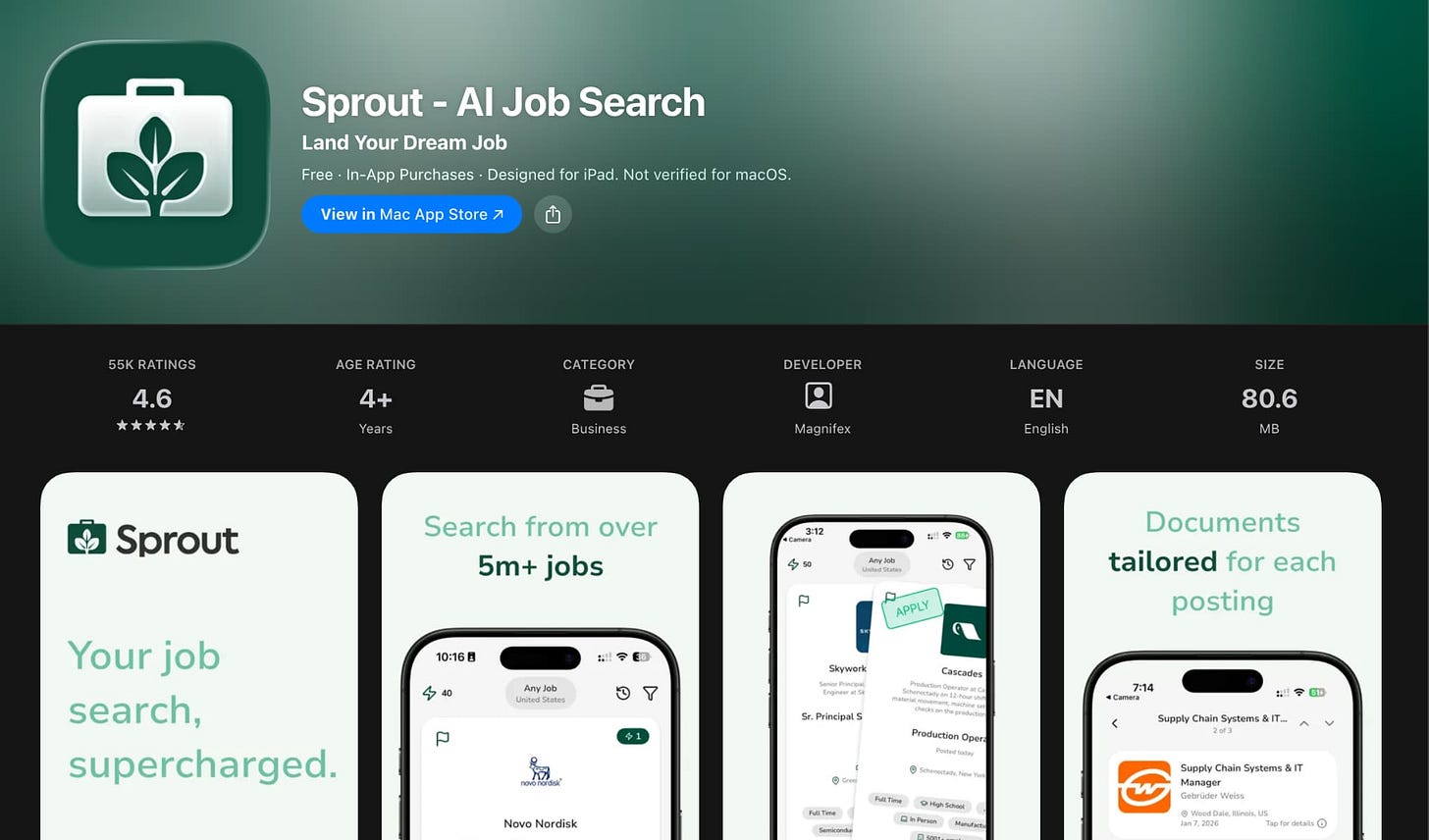
Tinder for job applications. Swipe right on a job, and the app’s AI auto-tailors your resume and cover letter and submits the application for you. Bundled in: AI interview prep.
The market wedge: American Gen Z grads are completely burned out on the 100+ applications it now takes to land an offer. Sprout doesn’t just save time — it makes a soul-crushing process feel like a swipe game.
The playbook port
The reason Sprout is interesting isn’t that it was a new idea. It’s that the team ported the exact same growth playbook from Glam Up — beauty/female/TikTok → job hunting/Gen Z/TikTok — and it worked again.
This is the actual lesson. The team didn’t build “a viral hit.” They built a repeatable growth engine and pointed it at a different category.
Pricing: monthly only this time
Sprout: monthly plan only. No weekly, no annual.
The logic: job hunting is a multi-week-to-multi-month process, not a one-shot impulse like a makeup filter. But it also ends — once you have an offer, you cancel. So monthly fits the natural usage window. Match the plan to the use case (again).
The Sprout Creator Program — UGC at industrial scale
For Sprout, the team went further than for Glam Up. They built a full creator school:
Open application process for aspiring TikTok creators
Interview screening — only accepted creators get to officially promote Sprout for paid contracts
Inside the program: video lessons, text modules, and quizzes to verify learning — codifying everything they’d learned from Glam Up
Each creator gets a unique 15%-off coupon code, which functions as their attribution link
One graduate, Maddy C, produced a 13.4M-view video using a “fake coworker Zoom call” format that pulls viewers through with story beats.
Plenty of other graduates hit similar numbers using related formats.
The team reports roughly 50% of graduates go viral within two weeks — because they’re not telling creators to “be creative.” They’re handing them a tested, optimized template and quizzing them on execution.
Obsessive format optimization
One example of the level of detail: for a single faceless-video format that hit 1.6M views, the team tested video lengths at 5s, 6s, 7s and landed on 6.7 seconds as optimal. They tested camera tilt angles. They tested how many seconds in to trigger the zoom.
This is the part that’s hardest to copy and the easiest to underestimate. AI made it easy to ship a product. It did not make it easy to find the 6.7-second answer. That still takes hundreds of experiments.
Pricing tests
Two months after Glam Up launched, the team raised the weekly price from $2.99 → $8.99. Conventional wisdom says conversion should drop. Instead, conversion went from 3.5% → 5.5%.
The hypothesis: a price too low signals low value. Especially for AI features, where users have no internal pricing anchor, a higher number reads as “this must actually do something.” There’s a ceiling, obviously — but most indie consumer AI apps are priced under it, not over it.
The result
8 months from launch: $250K MRR
Combined with Glam Up: ~$400K MRR from two apps, built by a small team
What actually generalizes from this
A lot of the article-versions of this story make it sound like there’s a single trick — the referral hack, or the hard paywall, or the price increase. There isn’t. The teachable parts are slower and less fun:
1. Build a growth engine, not a viral hit. The point of Glam Up wasn’t Glam Up. It was proving a system that could be ported to Sprout. The system is the asset.
2. Match the pricing plan to the use case. Impulse curiosity → weekly. Multi-week project → monthly. Habit-forming → annual. Default-annual is bad advice for a lot of categories.
3. Don’t outsource content until you can write the manual. The founders ran accounts manually for months before bringing in creators. The reason their Creator Program works is they’re handing creators a tested formula, not asking them to invent one.
4. Test at a granularity that feels insane. 5s vs 6s vs 7s vs 6.7s. Hook position. Audio rotation of exactly ~10 tracks. The reason competitors can’t easily out-execute them isn’t intelligence — it’s that competitors stop testing five rounds earlier.
5. Speed of replication > originality. The competitor’s slideshow format got cloned within a day. The team’s own formats get cloned constantly. Nobody’s mad about it, because everyone’s doing it. Whoever moves first and tests fastest wins the week.
A note on what we don’t know
Public coverage of Glam Up and Sprout has come almost entirely from the marketing/growth side of the team. That gives us a great picture of the funnel, the content engine, and the pricing experiments — but the engineering choices (AI model selection, infra cost structure, latency tradeoffs, retention engineering on the product side) are mostly unreported. For builders trying to replicate this, that gap is worth keeping in mind: a great paywall on a bad product still churns. Every part of the team mattered, even if only one part has been telling the story publicly.
Reference
https://adapty.io/case-studies/glam-ai/
https://scholarship.claremont.edu/cmc_theses/3882/
https://www.cmc.edu/news/nicole-cheung-25-co-founds-ai-beauty-app-achieves-milestone
https://www.launchx.com/command-post/articles/dont-be-scared---just-start