 ChillFitStory
Who Owns ChillFit? Foyatech, the Faceless Company Behind the Chair Yoga App
ChillFit is made by Foyatech, a Singapore company with no public faces. The chair yoga app earns most of its money outside the U.S., from women aged 55 to 64.
ChillFit lets you do yoga and tai chi without getting out of your chair. About a year after launch, the app analytics firm Sensor Tower estimated its revenue for the previous month at somewhere between $100,000 and $500,000.
Yet on the U.S. App Store it has only about 3,000 ratings, and it isn't in the top 100 grossing Health & Fitness apps. There's no viral TikTok video, and the people behind it don't show their faces. ChillFit is made by Foyatech, a company in Singapore. So where does the money come from, and who is paying?
A company with no faces
Public records show Foyatech Pte. Ltd. was incorporated in Singapore in 2023. Its website is a single page describing a newly established technology company starting with health and utility apps. It names no one, and the directors' names don't appear anywhere you can check for free.
On the App Store, the developer goes by Core AI. In a year it has released seven apps, from workouts and calorie tracking to sports card grading. ChillFit is the one that grew.
Built on what people were already searching for
Before ChillFit, Americans had discovered wall pilates, workouts with your feet against a wall. U.S. searches took off in January 2023 and peaked in January 2024. Chair yoga searches jumped every January, in 2024 and 2025, right when people set New Year's goals.
The related searches tell the story: 28-day chair yoga challenge, free chair yoga for seniors, and the name of an app, BetterMe. BetterMe started in Ukraine as a Facebook page, and its founder said in 2022 that it averaged $5 million in revenue a month. Many people seem to have seen these workouts in ads, then searched for them.
ChillFit launched in October 2025, when wall pilates searches had fallen below a tenth of their peak. It packed in nearly every term anyway: chair yoga, wall pilates, tai chi, workouts on the sofa or in bed, and the 28-day challenge. According to mwm.ai, it passed 1 million downloads in its first year. It didn't invent a workout. It answered what people were already searching for, in one app.
The U.S. is only a fifth
Counting App Store ratings across 64 countries gives about 14,000. The U.S. accounts for only about a fifth. Europe is nearly half, and the second-largest country is Brazil.
On top-grossing Health & Fitness charts, it ranked 23rd in Colombia and Egypt and 34th in Brazil. It supports 17 languages, and its ads run in Portuguese, Spanish, Dutch, English and more, about 860 of them in Meta's Ad Library. Look only at the U.S. and you would never see how big it is.
Women aged 55 to 64
The ads also show who the users are. One Portuguese ad says, in effect, I'm 65 and I do this workout every day. Meta publishes reach data for ads shown in Europe: this one reached about 10,000 people. Its gender targeting was set to all, yet 95% were women, and the largest group was women aged 55 to 64.
The reviews agree: people who are 75, just retired, or recovering from knee surgery. And this audience isn't on TikTok. In Pew Research Center's 2026 survey, only 11% of Americans 65 and older use TikTok, while 59% use Facebook.
Onboarding: questions about knees and stairs
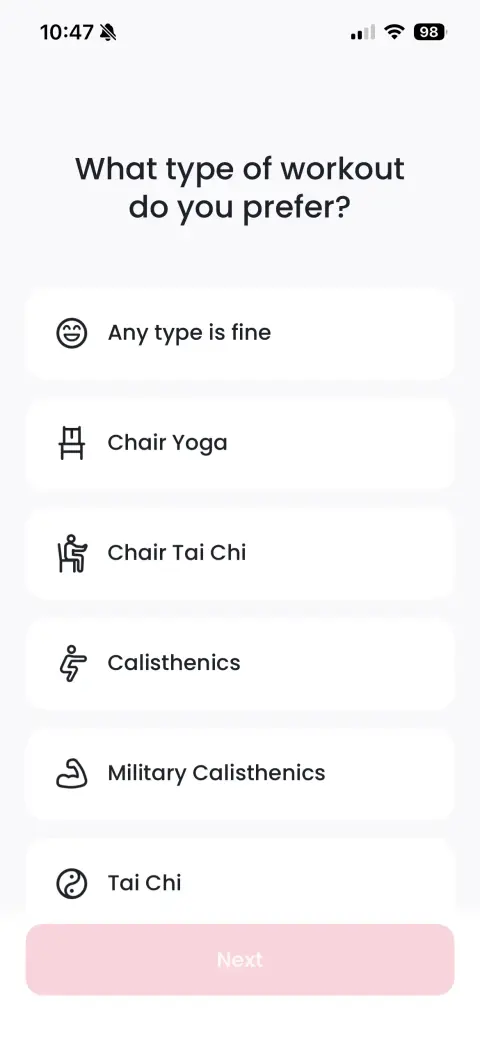
People arriving from an ad meet about 39 screens, split into three parts. The first question is "What type of workout do you prefer?", with chair yoga and chair tai chi near the top, followed by your main goal.
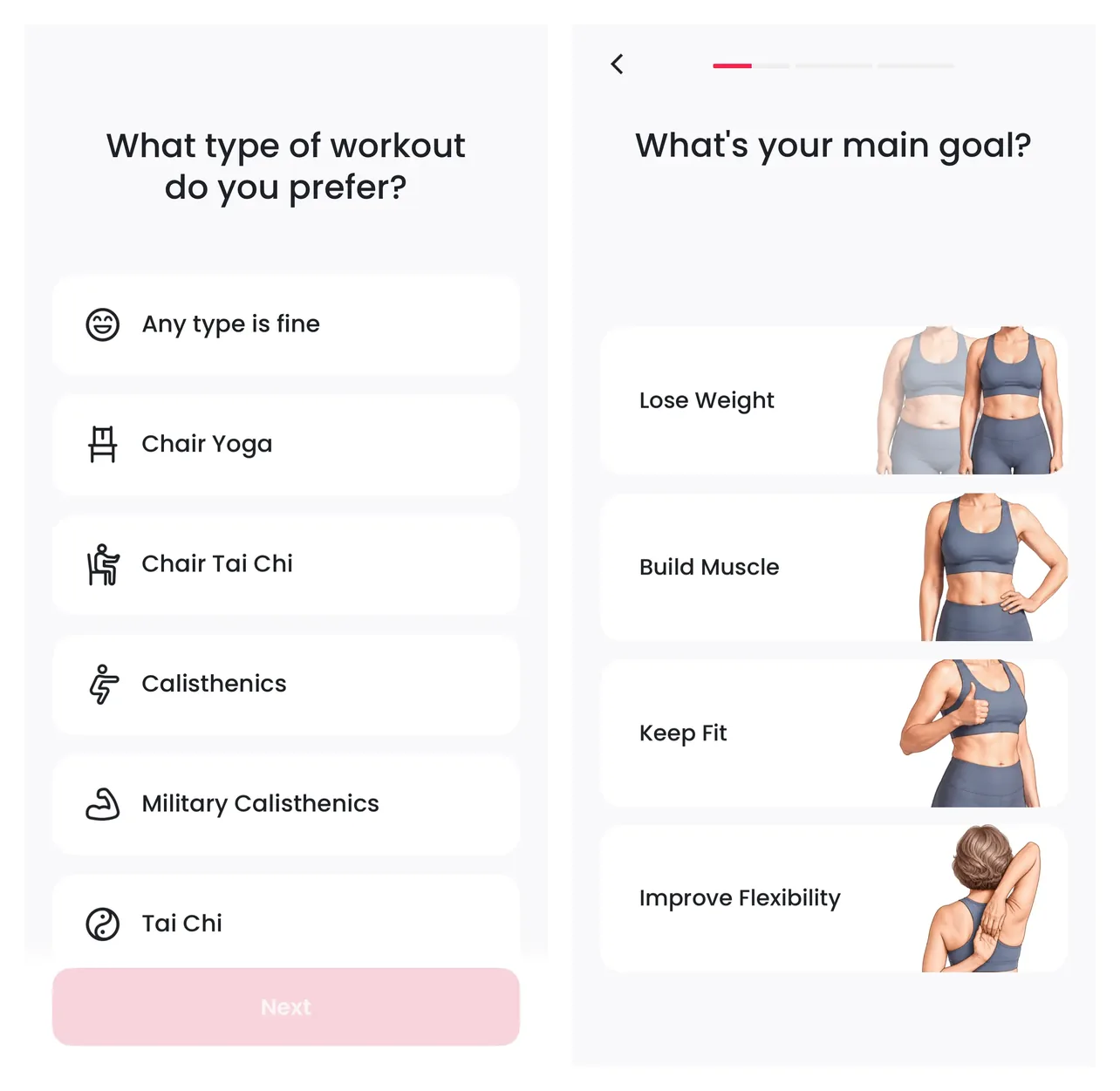
Later it asks "Have these areas ever been injured?", "Can you touch the floor without bending your knees?" and "How do you feel after climbing some stairs?" Answer that you get a little tired, and it reassures you that plenty of users are in the same group. The women in the photos look like they're in their 50s and 60s. Each weight entry is followed by a chart predicting the date you'll reach your goal.
Paywall: a free trial, chosen for you
The paywall offers a 7-day free trial or a discounted first month, with the free trial selected by default and an optional reminder before it ends. In our recording, leaving it brought up a sheet for setting workout reminders, and the home screen then showed a banner offering the free premium trial.
Who came for "free"
Not every review is kind. The star rating is 4.9 out of 5, but the reviews with written comments average 3.3. Many one- and two-star reviews say users thought it was free and it wasn't, or that they were charged after canceling. Some say a Google search told them it was free. These were people searching for free chair yoga. The company replies to low ratings in each country's language.
Getting people who came looking for free to pay is the hardest part of this app. But it shows that after a trend fades, people are still searching, and they may not live where you do or speak your language.
Note: ChillFit doesn't disclose its revenue. "$100K–$500K last month" is Sensor Tower's worldwide estimate as of October 30, 2026; Onbo Hub's own estimate is $452,000 a month. Ratings are from the App Store in the U.S. and 63 other countries on October 30, 2026, and chart positions from iTunes Top Grossing (Health & Fitness, top 100) the same day. Downloads and the 3.3 average are from mwm.ai. The founding year is from Singapore company registry aggregators, search interest from Google Trends (U.S.), and BetterMe's revenue from an interview with its founder (Partnerkin, 2022). The ad count is what the Meta Ad Library showed on October 30, 2026, and the age and gender breakdown is EU transparency data for one ad. User counts shown in the app (such as "258,900+") are the app's own claims. Reviews are paraphrased, some translated.
Ideas worth copying
See ChillFit's full onboarding
This story only shows a few of the screens. Onbo Hub has all 39, from the first screen to the last.
View the onboarding

Newsletter
Founder stories and growth teardowns of apps that are actually making money.
Sources
- Foyatech (website)foyatech.ltd
- RecordOwl, Foyatech Pte. Ltd. company recordrecordowl.com
- Sensor Tower, ChillFit overviewapp.sensortower.com
- MWM, "ChillFit: Home Workout Planner"mwm.ai
- Google Trends, chair yoga and wall pilates (U.S.)trends.google.com
- Partnerkin, "Interview with the Founder of BetterMe"partnerkin.com
- Meta Ad Library (ChillFit)facebook.com
- Meta Ad Library ("TENHO 65 ANOS" ad)facebook.com
- Pew Research Center, "Americans' Use of Social Media in 2026"pewresearch.org
- ChillFit (App Store)apps.apple.com
 Lyfta
 Liftoff
 AbMaxx