 MeAgainStory
How Martyn Strydom's MeAgain Overtook an Earlier GLP-1 Tracker App
Martyn Strydom, a former BCG consultant, launched MeAgain 11 months after its rival and passed it in U.S. ratings. Here is how the GLP-1 tracker caught up.
In the U.S., one in eight adults is taking a GLP-1 drug, the class of medicines sold as Ozempic, Wegovy, Mounjaro and Zepbound. Many of them got a prescription, but nobody told them what to do the day after a shot.
MeAgain is a tracker built for that gap. It launched almost a year after its main rival, yet today it has more ratings on the U.S. App Store. MeAgain was founded by Martyn Strydom. He runs it as CEO, with a co-founder and a small team in New York. Here's how the latecomer pulled ahead. (This is a story about an app, not medical advice.)
The day after the shot
In a KFF poll from November 2025, 12% of U.S. adults said they were currently taking a GLP-1. According to RAND, women aged 50 to 64 are the most likely to have used one.
People on these drugs face problems only they really see. For Wegovy, drug levels peak one to three days after an injection, and in its clinical trials, 44% of people reported nausea (16% on placebo). In May 2025, four U.S. medical societies noted in a joint advisory that many people prescribed GLP-1s get no meaningful nutrition or lifestyle guidance. The days between shots were on the patient.
The founder: from South Africa to BCG
Strydom was born and raised in South Africa, studied in Hong Kong and economics at Columbia, worked on Wall Street, then spent three years at Boston Consulting Group, mostly on pharma, health tech and consumer projects.
In 2024 he and a partner started a consumer health company built on the idea that health apps should be fun and gamified while staying rooted in science. In April 2025 they launched MeAgain, just for people on GLP-1s. Its mascot is a capybara named Capy who lives on your home screen: hit your protein and water goals and he's happy, fall short and he looks sad.
Starting 11 months behind Shotsy
There was already a leader. Shotsy, built by Aja Beckett to track her own shots, launched in May 2024, passed 100,000 downloads by February 2025 and raised $2.25 million.
MeAgain started 11 months later. As of October 30, 2026, it leads in U.S. App Store ratings, about 39,000 to 34,000, and on the Health & Fitness top-grossing chart, 44th to 72nd.
Ads about the struggle, not the drug
Since 2024, TikTok has banned content that promotes weight loss drugs. So MeAgain put people's daily struggles front and center instead. According to Social Growth Engineers, it set up more than 35 TikTok accounts and kept posting.
The Meta Ad Library showed about 610 active ads. Among the 92 most-seen, about half run under the names of creators who take GLP-1s themselves. A typical one opens with a creator two months into treatment admitting she couldn't answer basic questions about her own week, because nobody had handed her a plan. One such ad shown in Europe reached women aged 45 to 54 the most.
Selling drugs, then stopping
Then came a detour. In spring 2026, MeAgain's website began offering compounded and brand-name medications. Soon after, its App Store listing was renamed and described as for tracking and education only. By October, the medications were gone from the site. The company hasn't said why. It was in June that new ratings jumped from about 1,000 a month to about 4,000.
Onboarding: your medication, dose and side effects
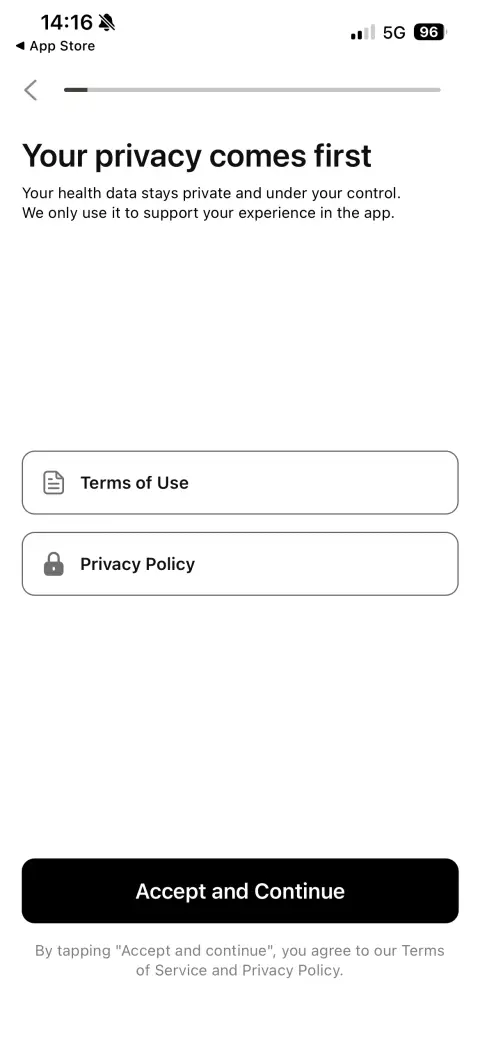
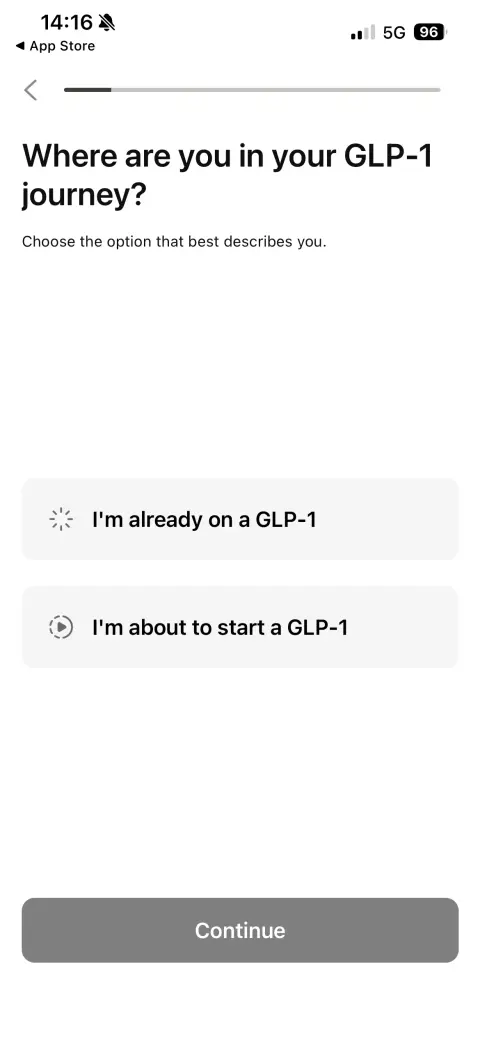
After the welcome screen, the first thing you see isn't a question but "Your privacy comes first." For a health app, reassurance comes before anything is asked. Then it asks where you are in your journey and which medication you take, from brand names to pills and compounded drugs, followed by your dose.
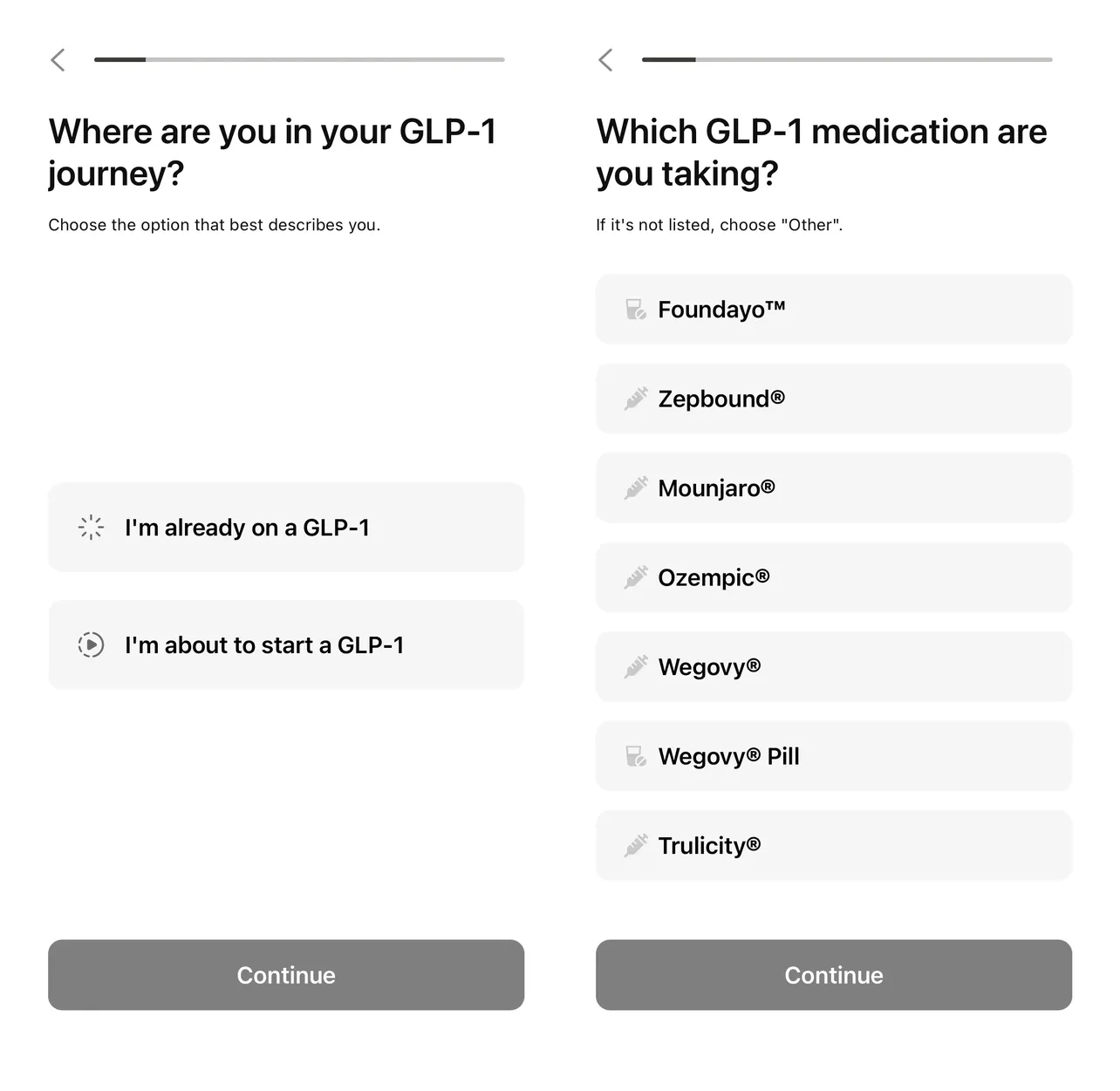
Next: "What side effects are giving you the most trouble?", with options like nausea, fatigue, hair loss and constipation. The loading screen then shows the plan responding to those answers, such as hydration goals for nausea and protein goals for muscle.
Paywall: an annual plan, no free trial
The paywall, headed "Stay on Track with Every GLP-1 Dose," opens with "#1 GLP-1 Companion App" and "370K+ Users" badges and a review. It offers a yearly plan marked most popular and 75% off, and a monthly plan. There's no free trial. By then, after so many questions, the plan feels built for you.
An emotional support animal
The most common theme in reviews is emotional support. Users call Capy their companion through treatment; one says even her son asks whether her capybara is happy.
The complaints are about money: the price only appears after every question, and there's no trial. Today, part of the app is free to use.
In the end, MeAgain chose not to be in the business of selling the drug, but to stay with people through the days between shots.
Note: This story is not medical advice; GLP-1s are prescription drugs, so talk to a doctor about them. Usage figures are from KFF and RAND (2025), side-effect data from the Wegovy prescribing information. Ratings and chart positions are from the U.S. App Store and iTunes Top Grossing (Health & Fitness) on October 30, 2026; the ratings history, drug sales and name change are from Wayback Machine archives. Shotsy's numbers are from Silicon Florist (February 2025). The TikTok account count is from Social Growth Engineers; the ad count is what the Meta Ad Library showed on October 30, 2026, and the creator-ad share among the top 92 is our own count. "#1 GLP-1 Companion App" and "370K+ Users" are claims shown in the app. The company doesn't disclose revenue. Reviews are paraphrased.
Ideas worth copying
See MeAgain's full onboarding
This story only shows a few of the screens. Onbo Hub has all 27, from the first screen to the last.
View the onboarding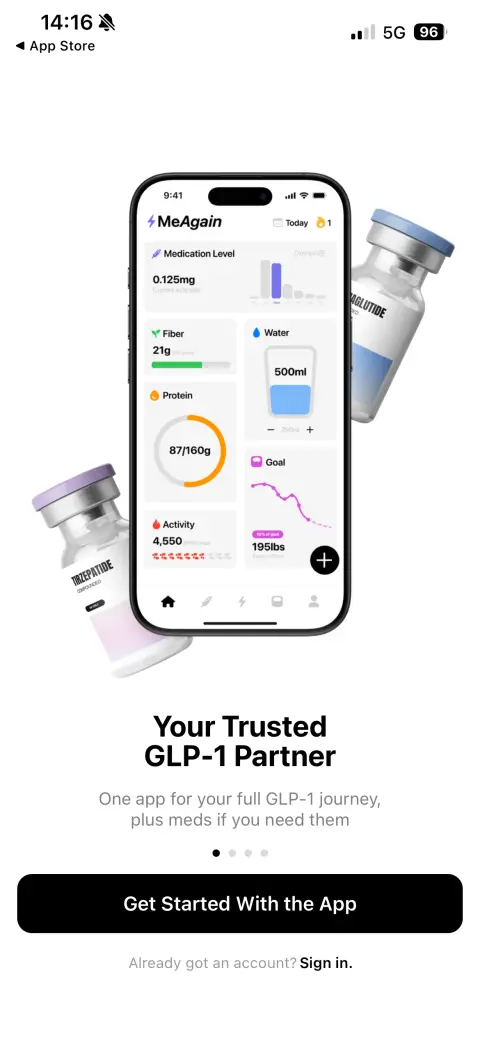
Newsletter
Founder stories and growth teardowns of apps that are actually making money.
Sources
- Martyn Strydom (personal site)martynstrydom.com
- SF Examiner, "Martyn Strydom: The Beauty of a Non-Linear Path of Exploration"sfexaminer.com
- KFF, "Poll: 1 in 8 Adults Say They Are Currently Taking a GLP-1 Drug"kff.org
- RAND via EurekAlert!, GLP-1 use among U.S. adultseurekalert.org
- DailyMed, Wegovy prescribing informationdailymed.nlm.nih.gov
- Joint advisory of four U.S. medical societies, "Nutritional Priorities to Support GLP-1 Therapy for Obesity"pmc.ncbi.nlm.nih.gov
- Silicon Florist, "Shotsy lands $2 million for weight loss shot tracking app"siliconflorist.com
- Shotsy (App Store)apps.apple.com
- Rolling Stone, "Ozempic Defined a TikTok Era. Now the App Wants It Gone"ca.rollingstone.com
- Social Growth Engineers, "MeAgain: Ozempic's TikTok Gold Rush"socialgrowthengineers.com
- Meta Ad Library (MeAgain)facebook.com
- Meta Ad Library (creator ad)facebook.com
- Wayback Machine, meagain.com (April 2026)web.archive.org
- MeAgain (website)meagain.com
- MeAgain (App Store)apps.apple.com
 Lyfta
 Liftoff
 AbMaxx