 MioStory
How Avi Khemani and Angelo Ramos Grew Mio to $30K and a $100K Shipaton Win
Avi Khemani and Angelo Ramos turned feedback on their app DAWG into Mio, a pixel-art habit app that made $30K in six weeks and won Shipaton 2026.
Out of 3,985 apps entered in RevenueCat's Shipaton 2026, the Grand Prize went to one that had been out for only about two months. Mio is a habit app where you build daily routines with a pixel-art companion by your side, and about six weeks after launch it had 6,200 installs and $30,000 in revenue. The strange part: we couldn't find a single viral TikTok or Meta ad for it.
Mio was founded by Avi Khemani and Angelo Ramos. Here's how they built and grew it, with the real screens.
The founders: two Stanford friends who have shipped apps since school
Mio comes from DWG Labs, a small company the two run together. Both started studying computer science at Stanford in 2017. While still in college, Khemani worked at Apple, and in the winter of his senior year he released his own app, Stress Ball, to help ease anxiety. It still has more than 2,000 ratings. Ramos worked as an engineer at Instagram and Meta, then co-founded a travel AI startup as its CTO. They say they've used RevenueCat for subscriptions ever since they started building apps in high school and college.
DAWG, and the users it wasn't built for
In 2025, the two launched DAWG, a discipline and self-improvement app built mainly for men. It now has more than 7,000 ratings on the US App Store.
One request kept coming back. Female users liked the idea behind DAWG, but wanted goals and a tone that felt more like theirs, and a space to improve alongside other like-minded women. That became the starting point for Mio.
In 2026, Khemani left his job at Scale AI, just as Shipaton, a two-month contest about how much newly launched apps could grow, kicked off.
"Earn coins in real life"
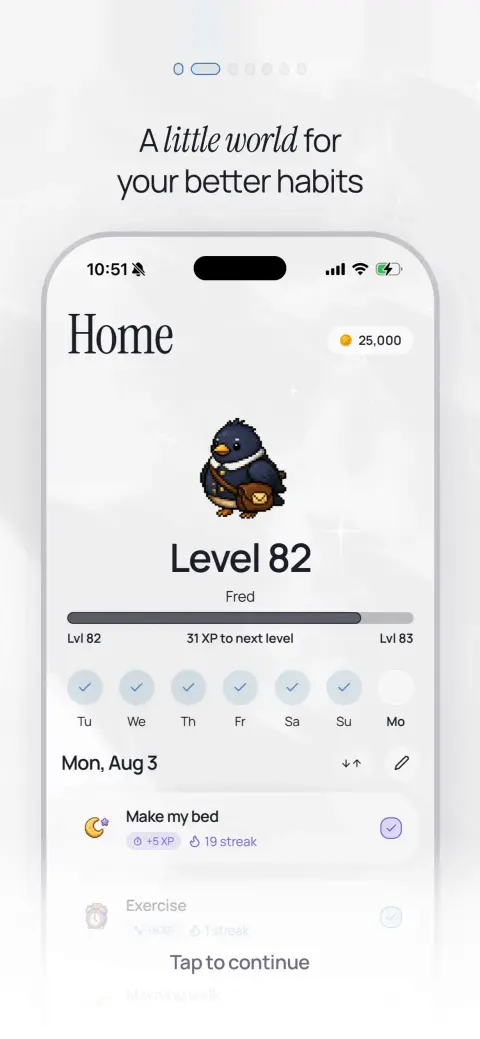
The idea was simple: what if doing your tasks in real life earned you coins and leveled up a character? The founders wrote that they didn't want Mio to be "another checklist with XP pasted on top." Instead, they looked to cozy games like Stardew Valley and Fields of Mistria.
Complete a habit and you earn XP and coins, leveling up both yourself and your companion. Coins unlock new companions, outfits and backgrounds. Mio launched in August 2026. About six weeks later it had 800 subscriptions on top of those 6,200 installs, with more than 12% of users paying.
Where did 6,200 installs come from?
The official TikTok account had three followers, and its eight posts got at most about a thousand views each. The Instagram account had 181 followers but zero posts. Meta's Ad Library showed zero ads.
The answer was in the founders' own Shipaton submission: "We've been testing paid creative on Meta pretty aggressively, iterating on hooks, video concepts, and positioning based on performance." The Instagram account with no posts was most likely there to run those ads, since Meta ads can run under an Instagram account's name.
So why was the Ad Library empty? Ads that aren't about politics or social issues can only be searched there while they're running; only ads shown in the EU stay visible for a year after they stop. Mio had 62 ratings in the US, and just one each in Canada and India. Our guess is that the ads ran only in the US and had stopped by the time we looked. An empty Ad Library doesn't mean an app isn't advertising.
Discipline beats fitness
Mio could be pitched as a fitness app, a habit app or even a skincare app, and at first the founders didn't know which message would land. In their words, "messaging around discipline, routines, and getting your life together has consistently performed better than more fitness-specific angles."
They weren't only looking at what grabbed attention, but at "what actually brings in users who subscribe and stick around."
Onboarding: the first few minutes after the ad
The onboarding runs about 34 screens. Before asking anything, it shows six screens of the app itself.
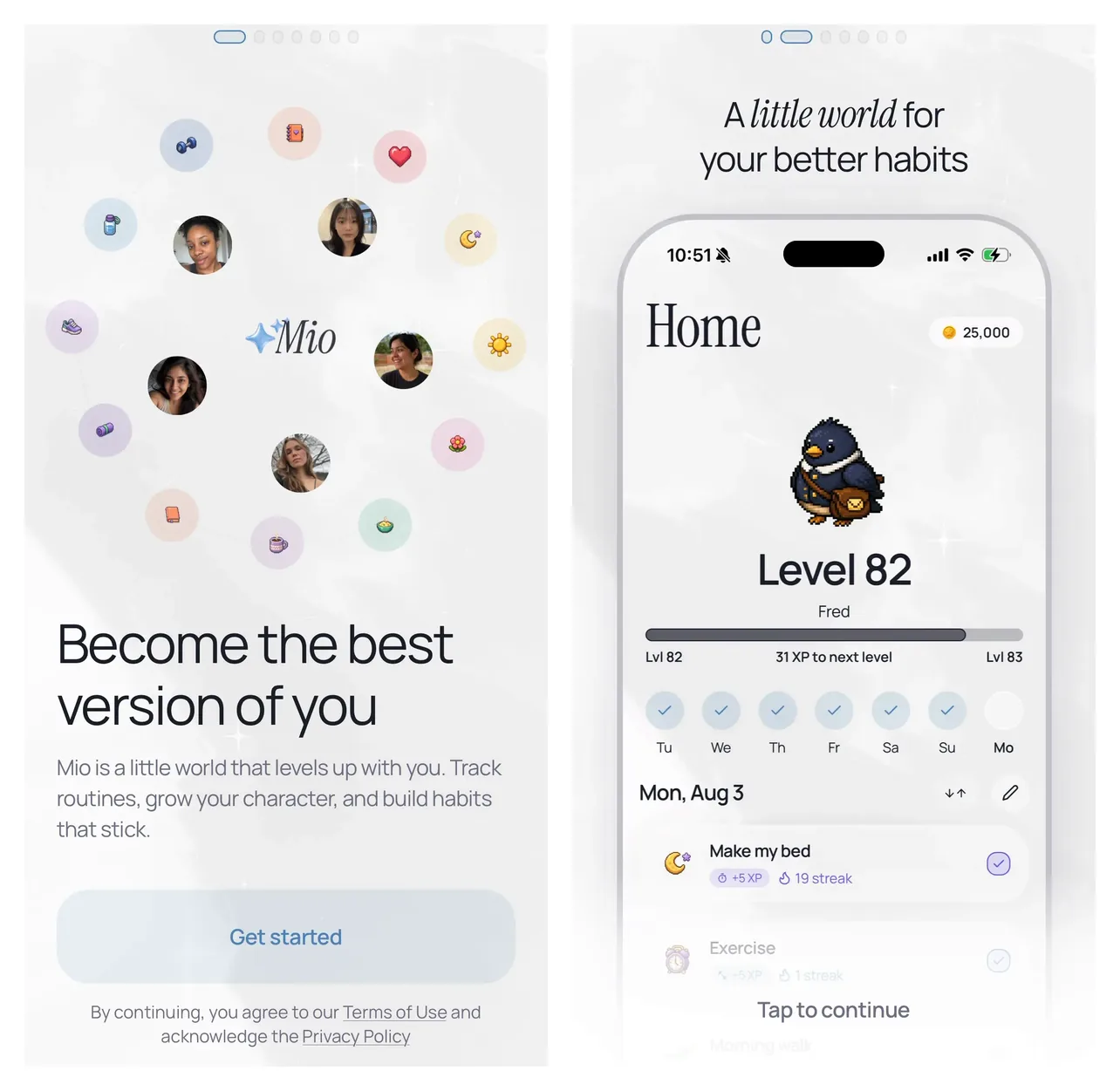
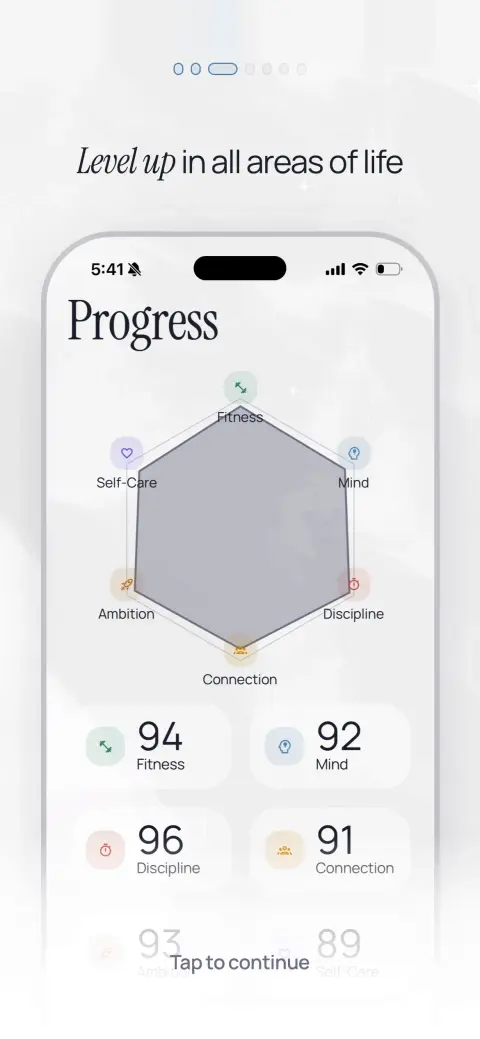
Then the questions begin. When you enter your daily screen time, it turns the answer into a lifetime number: at that pace, about 116,800 hours spent doomscrolling. Halfway through, you pick your first companion and unlock it with coins. At the end, a radar chart of your skills shows a score of 12 today, rising to 40 in one week and 69 in 30 days. Only after showing people who they could become does it ask them to pay.
Number one out of 3,985
At the end of September, the two submitted Mio. Of the 3,985 submissions, almost 3,000 apps made it onto the stores, and the Grand Prize went to Mio. RevenueCat wrote: "When we looked at the revenue and growth across all the apps submitted to Shipaton, Mio was a clear winner." The prize was $100,000, along with an award ceremony in New York and a spot on a billboard in Times Square.
Paywall: pay first
The paywall offers a monthly and a yearly plan, with the yearly plan selected by default and labeled as saving 83%. Pro features are listed as a checklist, with a reminder that you can cancel anytime. There's no free trial.
That's the trade-off. More than 12% of people who install Mio pay, but some App Store reviewers complain that they had to pay before they could even try it, or wish there were a free version.
Note: The 6,200 installs, 800 subscriptions, $30,000 in revenue and 12%+ conversion to paid come from the founders' Shipaton submission on Devpost (submitted September 29, 2026) and their submission video; RevenueCat's announcement on X (October 21, 2026) also cites 6,000+ downloads, 800+ active subscriptions and nearly $30k in revenue. These figures have not been independently verified. The 3,985 submissions, the roughly 3,000 apps that reached the stores and the Grand Prize are from RevenueCat's blog (October 20, 2026); the $100,000 prize is from the Shipaton 2026 page on Devpost. Career details come from the founders' public LinkedIn profiles. Ratings for DAWG, Stress Ball and Mio are from the US App Store, and ratings by country from App Store records, as of October 29, 2026. The TikTok, Instagram and Ad Library figures were checked on the same day. The Ad Library explanation is based on Meta's documentation. Whether Mio is still running ads, and how much it spends, hasn't been made public; that the ads ran only in the US and had stopped is our estimate. Quotes from the Devpost submission are shortened, and App Store reviews are paraphrased.
Ideas worth copying
See Mio's full onboarding
This story only shows a few of the screens. Onbo Hub has all 33, from the first screen to the last.
View the onboarding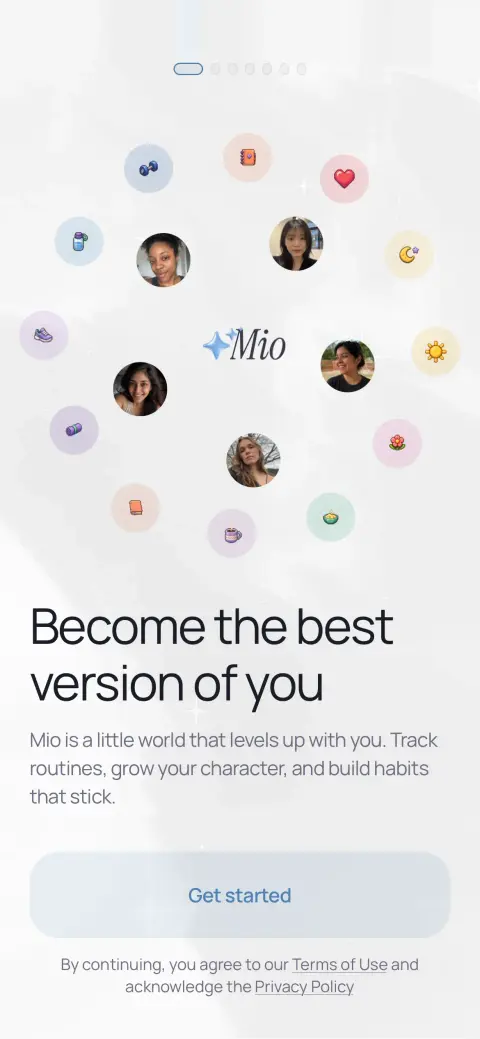
Newsletter
Founder stories and growth teardowns of apps that are actually making money.
Sources
- Devpost, "Mio" (Shipaton 2026 submission)devpost.com
- Avi Khemani, "Mio" Shipaton 2026 submission video (YouTube)youtube.com
- RevenueCat, "Shipaton 2026 winners" (October 20, 2026)revenuecat.com
- RevenueCat on X (October 21, 2026)x.com
- RevenueCat Shipaton 2026 (Devpost)revenuecat-shipaton-2026.devpost.com
- Shipaton Showcase, "Mio"apps.shipaton.com
- App Growth Annual, "The Shippies"appgrowthannual.com
- DWG Labsdwglabs.co
- DAWG (App Store)apps.apple.com
- Stress Ball (App Store)apps.apple.com
- Meta Ad Library (Mio)facebook.com
- Meta, "Ad Library tools"transparency.meta.com
- Mio on TikTok (@mio.app2)tiktok.com
- Mio on Instagram (@mio_habits)instagram.com
- Mio (App Store)apps.apple.com
 Wayk

 Purpose
 Lightly