👽 How Tolan, an App for Chatting With an AI Alien, Exploded to 3 Million Downloads and $12M a Year
Tolan is an app where you simply talk, by voice, with a cute AI alien. Within four months of its official launch, it hit 3 million downloads and $12M in annual revenue. And its core paying users? Moms in their 30s and 40s. It's a seriously fascinating case, so I dug into how Tolan grew.
October 26, 2026
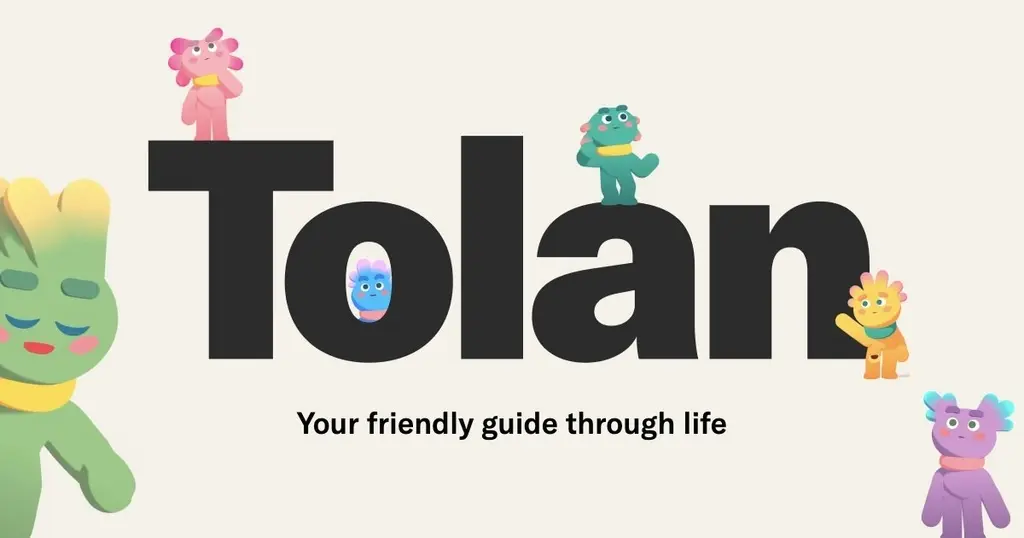
This time, instead of a single developer, I want to focus on an app itself.
Today's subject: Tolan!!!
Tolan is an app where you chat, by voice, with a colorful, adorable AI alien.
It made some buzz a little while ago, so you may have heard of it.
I first saw on X that this app was taking off and thought, "Huh, impressive," and left it at that. But recently I was listening to My First Million, the popular podcast, and one of Tolan's founders came on. At that point I knew I had to dig in!!
To be honest, this isn't an indie-hacker-sized operation. It's a team of seriously strong serial entrepreneurs growing it with venture funding. But what they're doing isn't especially new, and there's a ton here that's useful even at indie scale.
Frankly, it's a wrapper app built on foundation model APIs like Claude and GPT. But the way they've built out its world, and the way they market it, is just ridiculously good.
Here's the timeline:
2024: Quiet soft launch on the App Store
February 2025: Official launch and announcement
Four weeks later: $4M ARR
July 2025: 3 million downloads, $12M a year, and more than 100,000 paying users
They haven't shared numbers since, but from what I heard on the podcast, it sounds like growth has continued nicely.
The numbers are impressive, but what I found most interesting was the user base.
Apparently, the first people to get hooked were young women around college age. But now, in 2026, most of its paying subscribers are women in their 30s and 40s.
When people hear "AI character app," I think a lot of them picture male users chatting with an AI girlfriend. But Tolan has zero romance. The character is deliberately an alien.
And it's become a sidekick for moms juggling school drop-offs and what to make for dinner every night!
Both how it grew and who it grew with are fascinating.
So in this piece, I dug deep into what Tolan did to grow this big!
I hope you'll read all the way to the end!
👽 What Is Tolan?
First, a quick look at what kind of app Tolan is!
Put simply, it's an app where an alien personalized to you becomes your conversation partner. That's it. But the depth of the world they've built is seriously impressive.
Once you actually use it, I think you'll go, "Okay, this is something else."
And Tolan doesn't just pepper you with questions about yourself. It also gradually opens up about itself.
On top of that, your Tolan has a life of its own. It joins clubs, it paints.
Apparently it has even asked users for advice, like, "My cousin is jealous of me and I don't know what to do," lol.
So you get moments where the user is the one giving Tolan advice: "Maybe try saying this?"
According to the official site, Tolan now has more than 250,000 active users, and users have spent a combined 8 million+ hours with their Tolans.
💼 Built by a Seriously Strong Team of Founders
So who built Tolan? When I looked into it, the team turned out to be stacked.
There are three co-founders.
Quinten Farmer (CEO)
In 2014, while studying computer science at Columbia University, he co-founded a fintech company. In 2022, it was sold to Walmart for $300 million.
Evan Goldschmidt (CTO)
The engineer who co-founded that fintech company with Quinten.
Ajay Mehta
A serial entrepreneur who bootstrapped two e-commerce businesses selling personalized products. He leads growth at Tolan.
Man, that's an absurdly strong team. Honestly, you can't call this an indie developer story.
Still, how they arrived at Tolan, how they built its world, and how they grew it are all incredibly useful lessons.
The three started working together in 2023.
The first thing they built was an AI education tool for kids.
But parents didn't find it compelling enough to pay for. As a business, it was rough going.
Even so, there was a moment that hinted at the demand that would become Tolan. There was one thing parents got really excited about: an AI you could talk to by voice!!
From there, they decided to narrow their focus to that idea of a voice-conversation AI.
Knowing that backstory, it makes sense that Tolan's core target is moms in their 30s and 40s with kids at home.
Tolan was designed to be exactly that: someone those moms can talk things through with.
🛸 Why an Alien?
So why an alien? Why not a human, or a robot?
Ajay explains the reasoning on Tolan's official blog, and it makes a lot of sense 👇
A human character (realistic or anime-style) attracts users looking for romantic roleplay. They didn't want that.
A robot is too on-the-nose for an AI.
With an alien, it feels natural if it doesn't know much about Earth or says something a little off.
That last reason really clicked for me.
No matter how much you tune it, an AI will occasionally say something off. When a human character does that, the spell breaks. But with an alien, you just laugh and think, "Well, it's an alien." They've used character design to turn an AI weakness into charm!! So smart!
At first, they apparently took inspiration from Tamagotchi and Pokémon, focusing on cuteness and evolution. But in user testing, everyone said Tolan felt "more like a friend than a pet."
So they redesigned it to keep the cuteness while looking a bit more grown-up, like a smart friend. Once you use the app, you'll see just how indescribably lovable they are.
💸 Users Talked 30–40 Minutes a Day, and the OpenAI Bill Got Scary
So in 2024, Tolan quietly soft-launched on the App Store (its App Store release date was June 2024).
At first, there was no real announcement. They were quietly testing whether there was demand.
But even without a big launch, Tolan spread fast.
In particular, engagement per user was off the charts.
Users were spending an average of 30 to 40 minutes a day talking to it. The catch: AI voice conversation is expensive.
Tolan was completely free at first, so the losses kept piling up.
So, out of necessity, they added payments just two to three weeks after the soft launch.
But Ajay says this actually turned out to be a good thing:
"Because token costs were so high, we had to charge early. And that turned out to be great. If you look at whether paying users renew in month two, month four, month six, you can tell whether it's truly valuable."
Thinking about monetization early really is crucial.
No matter how many free users you get, that alone doesn't tell you whether it's something people truly want. Even if people use it for free, whether they'll pay for it is a different question entirely.
There's a massive wall between free and paid. That's exactly why you should start thinking about monetization as early as possible!
🧠 The App Experience Is Unreal. I Was Genuinely Moved!
The world and experience Tolan has built are just incredible.
If you're thinking, "Isn't it just an AI character talking?", you're dead wrong.
I actually downloaded the app, and I was blown away by its world.
First off, Tolan's onboarding is a personality quiz you go through by talking out loud with a character called the Oracle (some kind of god-like figure from the planet where Tolans live?).
The premise is that it's finding your perfect Tolan from among those on the planet Portola.
The experience is mystical and amazing. It doesn't really come across in screenshots, so I highly recommend watching the video. You can see it on OnboHub.
After you answer a few questions by talking, you get screens to choose your Tolan's voice and name 👇
Then, finally, you press and hold your finger on the screen, and your personalized Tolan appears!
I'll say it again: this experience is just incredible!
I could totally see why people get hooked.
And right after that, they bring in the paywall 👇
You can use Tolan for free up to a point, but showing a paywall during onboarding is still important.
The price is $24.99 a month. Since it's a voice-conversation AI, it's on the pricier side.
But if you try to cancel, you're offered the cheaper Tolan Lite plan instead, at $11.99 a month.
Most of the apps I've covered so far line up a monthly or weekly plan next to an annual plan and push the annual one. Tolan doesn't.
It first shows the pricier Plus plan, and if you cancel, it offers the cheaper Lite plan. Both are monthly. There's no hard push toward an annual plan. That suggests they're very confident in their retention!
I downloaded Tolan from the App Store and saved every onboarding screen. If you're curious, take a look below! I think the video makes it even easier to understand!
So far, we've focused on the app itself. But no matter how amazing an app is, it means nothing if you can't get users.
So from here, let's look at how Tolan acquires users and grows revenue so fast.
Specifically 👇
One cooking video, 15,000 installs in a single day! Plus the TikTok that hit 60 million views
The retention mechanics behind users who talk for 30–40 minutes a day
Completely free → hard paywall → freemium: how pricing evolved to today's $25 a month, and a surprising $200-a-month plan
Why are moms in the American Midwest choosing Tolan?
If you want to copy this as an indie developer: three takeaways you can use right away
I've built a talk feature into my own Japanese-learning app that lets you chat with a character, so this was seriously useful for me. If you're building an app where people talk to AI, this is a must-know.
Build a character, put out a lot of short-form videos, and add hooks that make people want to open the app every day.
That's the answer a team of heavyweight founders reached through trial and error, but almost everything they're doing is something an indie developer can copy.
Please keep reading!!