The 20-Year-Old Who Took an App to 1M Downloads and $500K/Month — Then Handed the CEO Seat to Someone Else
A 25% download-to-paid conversion rate with no free trial, and one video that made $100,000 in 65 hours. Here's the entire QUITTR playbook — including the app Alex launched
August 26, 2026
This newsletter breaks down real-world cases of people making serious money with apps in the AI era.
Today’s subject: Alex Slater.
I actually covered him once before, back in February 2025.
He was 19 at the time. He’d launched an app with an unusual premise — an app that helps people quit porn, called QUITTR — and had just hit roughly $250,000 a month in revenue five months after launch.
That was about a year and a half ago.
So what happened to the app since?
Short version: QUITTR crossed one million downloads within roughly a year of launch, and monthly revenue reached about $500,000. (It’s almost certainly higher now — based on his recent posts on X, he appears to be well past $1 million a month.)
Zero venture funding, ever. Fully bootstrapped the entire way.
Then, in September 2025, he made a surprising announcement:
I’ve appointed a new CEO for QUITTR. I’m taking my creativity to the next level.
At 20 years old, he casually handed over the top job at an app he built himself — an app that was firing on all cylinders.
Here’s his post:
Walking away from running a $500K-a-month app at 20 is a genuinely remarkable decision.
And more recently, he launched a new AI flight booking app called Soar, which processed $250,000 in booking volume in its first 30 days.
In this piece, I’m updating everything from my earlier coverage and rebuilding the full picture — the behind-the-scenes of his success and his specific growth tactics, with everything that’s come to light since.
Stick with me to the end. There’s a lot here.
⚡️ A Refresher: What Exactly Is QUITTR?
Let’s start with the basics.
QUITTR is an app for people who want to stop watching porn.
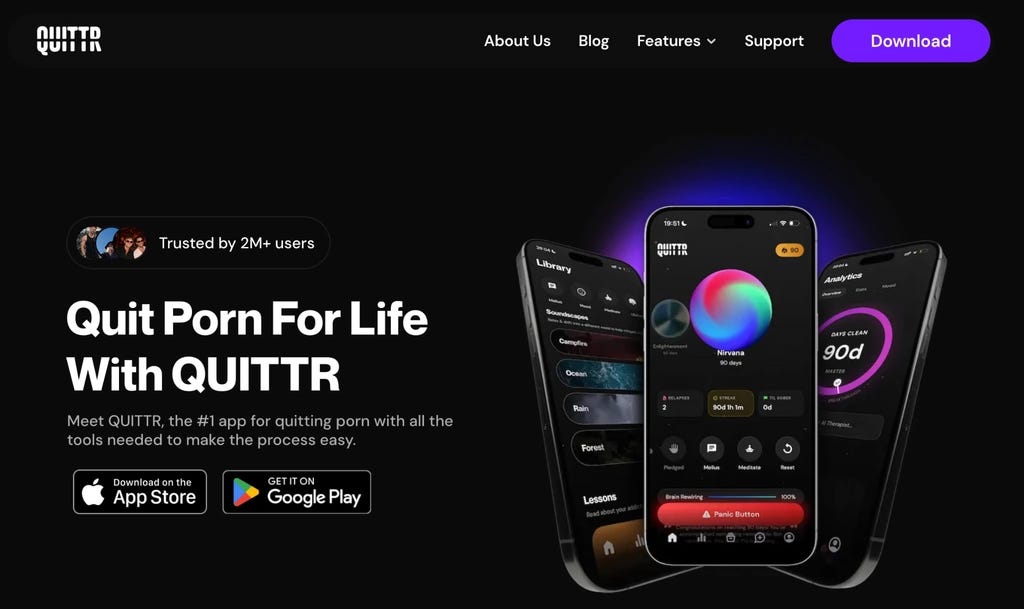
The core feature is a streak counter tracking how many days you’ve gone without watching.
On top of that: a panic button you hit when the urge strikes, an anonymous community where users encourage each other, an AI therapist named Melus available 24/7, and a virtual plant that grows as your streak grows.
Honestly, there’s nothing technically remarkable happening in this app.
But it landed. Hard.
We live in an era where OnlyFans and social platforms have exploded, and porn is flowing to young people constantly.
An enormous number of young men are struggling with it — and yet the only apps addressing the problem were relics that hadn’t been meaningfully updated in over a decade.
QUITTR was a Gen Z developer walking straight into a wide-open Gen Z market that nobody else would touch.
🤝 The Founding Story
So how did QUITTR come together? Let’s walk through it.
In my earlier piece, I covered how Alex met Zach Yadegari at a hotel in Miami and learned his TikTok marketing playbook.
Zach, of course, is the founder who built Cal AI at 17 and sold it in under two years.
And Zach, in turn, learned from Blake Anderson, so it’s fair to say Blake’s fingerprints are on QUITTR’s success too.
The chain of young app founders spreading out from Blake is honestly ridiculous.
But there’s another key figure behind QUITTR who shouldn’t be overlooked: Connor McLaren.
Alex is from London. He taught himself to code at 17, dropped out of university in the UK at 18, and moved to San Francisco.
There, he met Connor through Y Combinator’s co-founder matching platform.
The two hit it off, and the concept for QUITTR was born.
The third key player was Alex’s younger brother, Chris, who was 17 at the time. He handled design.
So the founding team was: Alex on code (19), Connor on marketing (22), and Chris on design (17).
Inject Zach’s and Blake’s influencer marketing and TikTok virality know-how into that team, and They get an app that scaled to $500,000 a month in a single year.
One more detail worth noting: Alex built the initial version of QUITTR in roughly 10 days.
In this era, if you have the idea and the willingness to move, a product can take shape in ten days.
🔥 A Product Hunt Flop → Reddit Guerrilla Posts → $3,000 Turning Into $37,000
If you assume QUITTR grew on influencer marketing from day one, you’d be wrong.
What’s surprisingly little known is how gritty and unglamorous the early launch phase actually was.
QUITTR first launched on Product Hunt — and completely flopped.
So they moved to guerrilla posting on Reddit.
They embedded themselves in r/NoFap, the main community for people quitting porn, and seeded posts and replies along the lines of “this app called QUITTR changed my life.”
To be clear, astroturfing like this isn’t something to celebrate.
Reddit explicitly bans stealth marketing, and they were in fact banned — after the tactic had generated about $2,500 in revenue.
That said, it’s also true that plenty of founders do some version of this early on. Companies that are publicly traded today were, in their first months, growing on exactly this kind of thing.
Among the app success stories I’ve covered in this newsletter, Some people used Reddit marketing to get early traction.
Now, they got banned. But the reaction they got through Reddit — plus $2,500 in revenue — gave them conviction that the app had legs.
So they made an unexpected bet.
With very little revenue in the bank, they put $3,000 into a promotion with a Christian influencer on Instagram.
I couldn’t track down the specific account or video, but the result speaks for itself: that $3,000 turned into $37,000.
From there, it became an infinite reinvestment loop.
They funneled every dollar of revenue back into influencer marketing, and the whole thing snowballed.
Margins ran around 90%, and essentially 100% of that profit was reinvested.
Founder compensation was kept to the bare minimum, with everything else poured into growth. That level of discipline is what powered the bootstrapped rocket ride.
Now let’s get into the real substance.
🎯 Best-in-Class: The Full Breakdown of a 25% Conversion Onboarding
Let’s start with QUITTR’s famously long onboarding, which I touched on briefly in the earlier piece.
The download-to-paid conversion rate is 25%. One in every four people who downloads the app pays.
What’s even more absurd: the completion rate on that 12-step onboarding is 99%.
Here’s the flow, laid out:
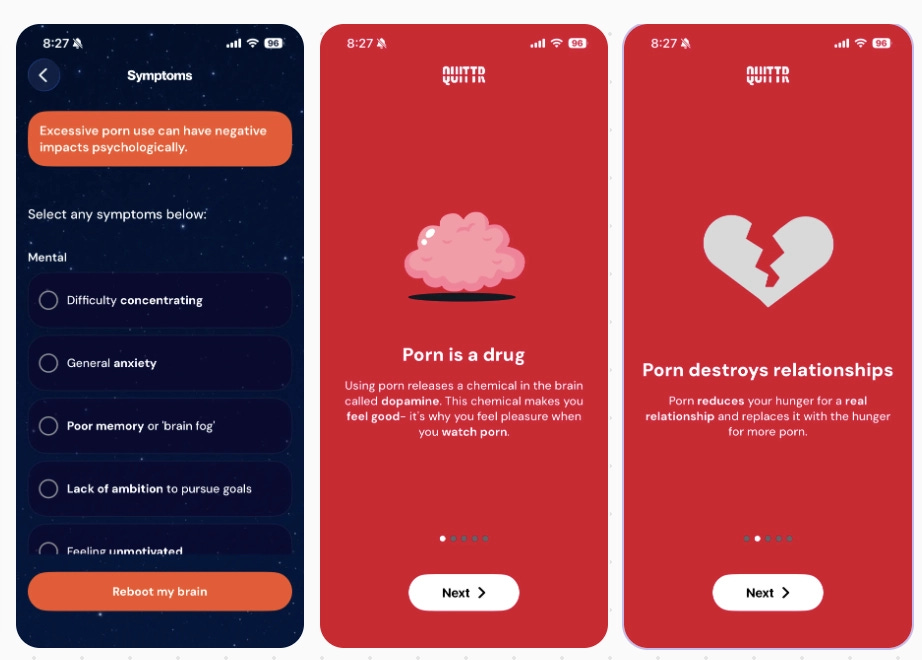
12 pages of questions — “When did you start watching?” “Has it been escalating?” — questions that force you to confront yourself
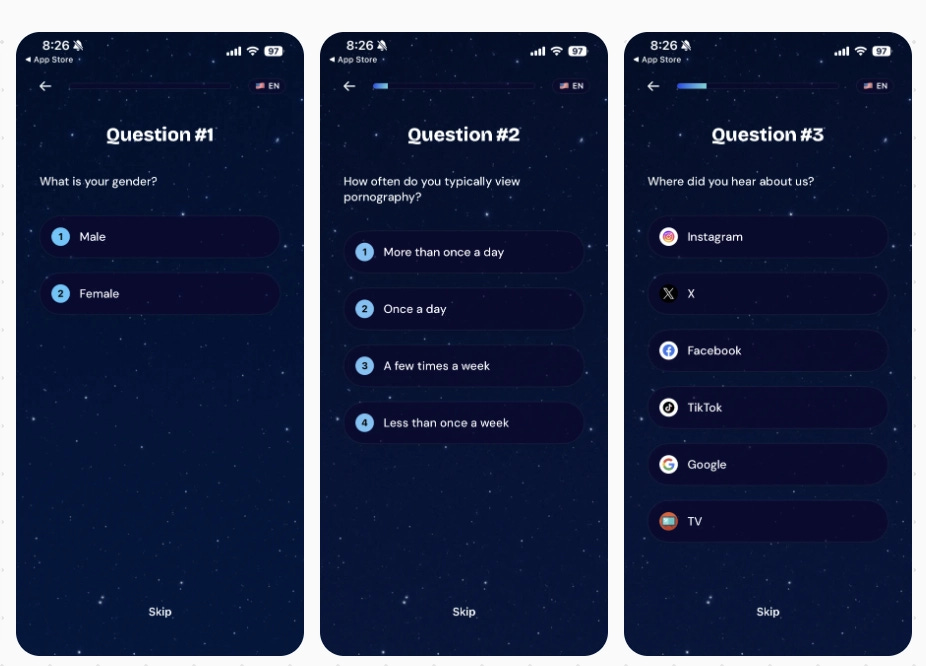
Select the symptoms that apply to you — low motivation, diminished interest in real-life partners, and so on
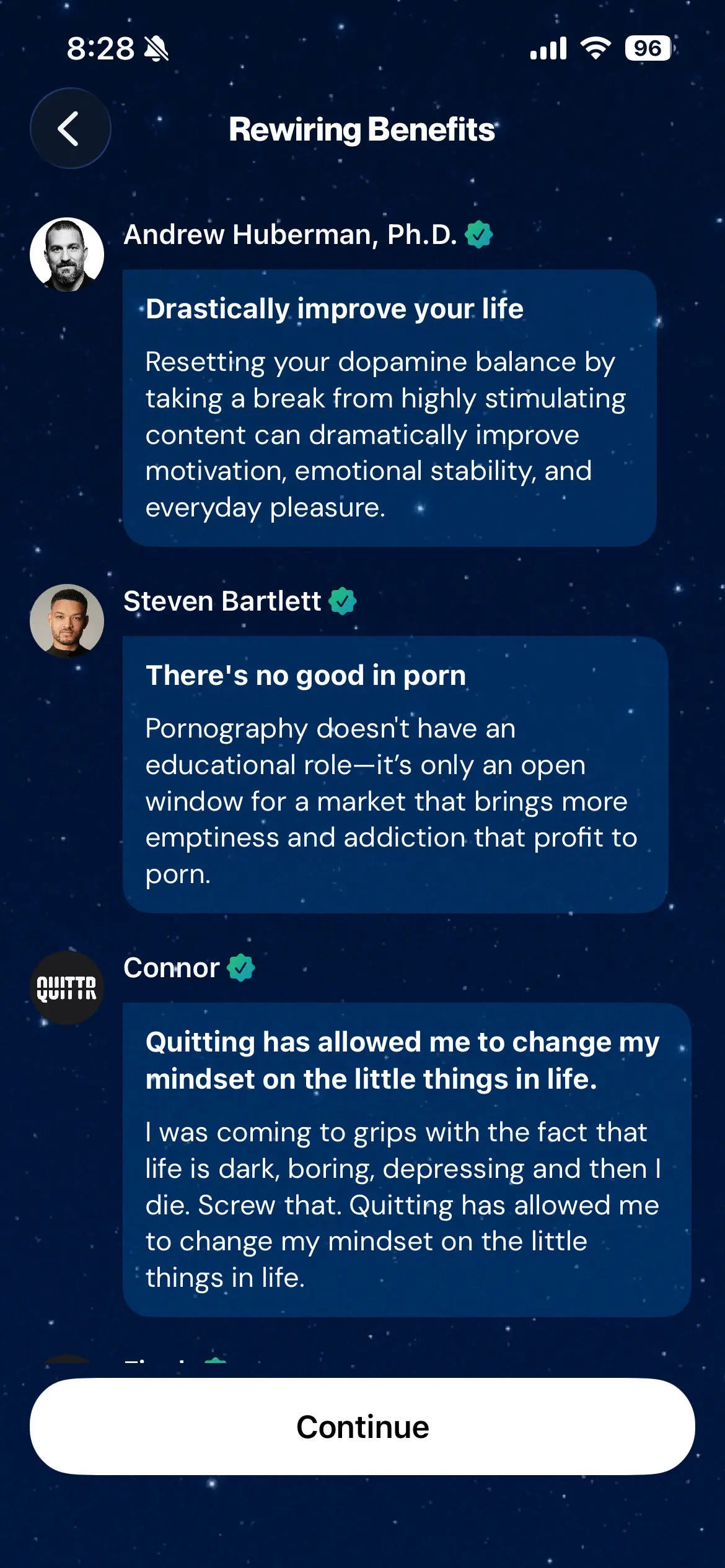
Testimonials from existing users whose lives changed
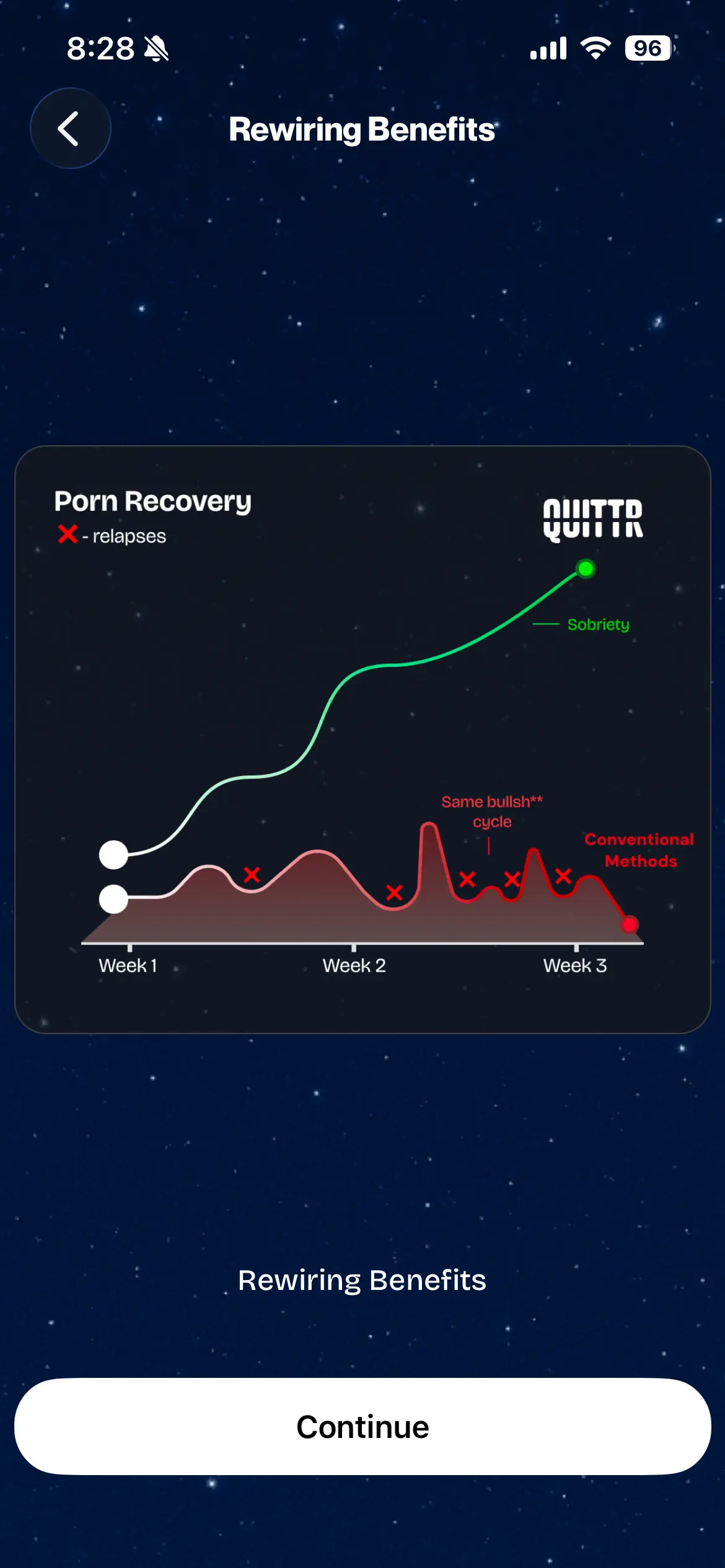
The negative effects of porn, and the benefits of quitting
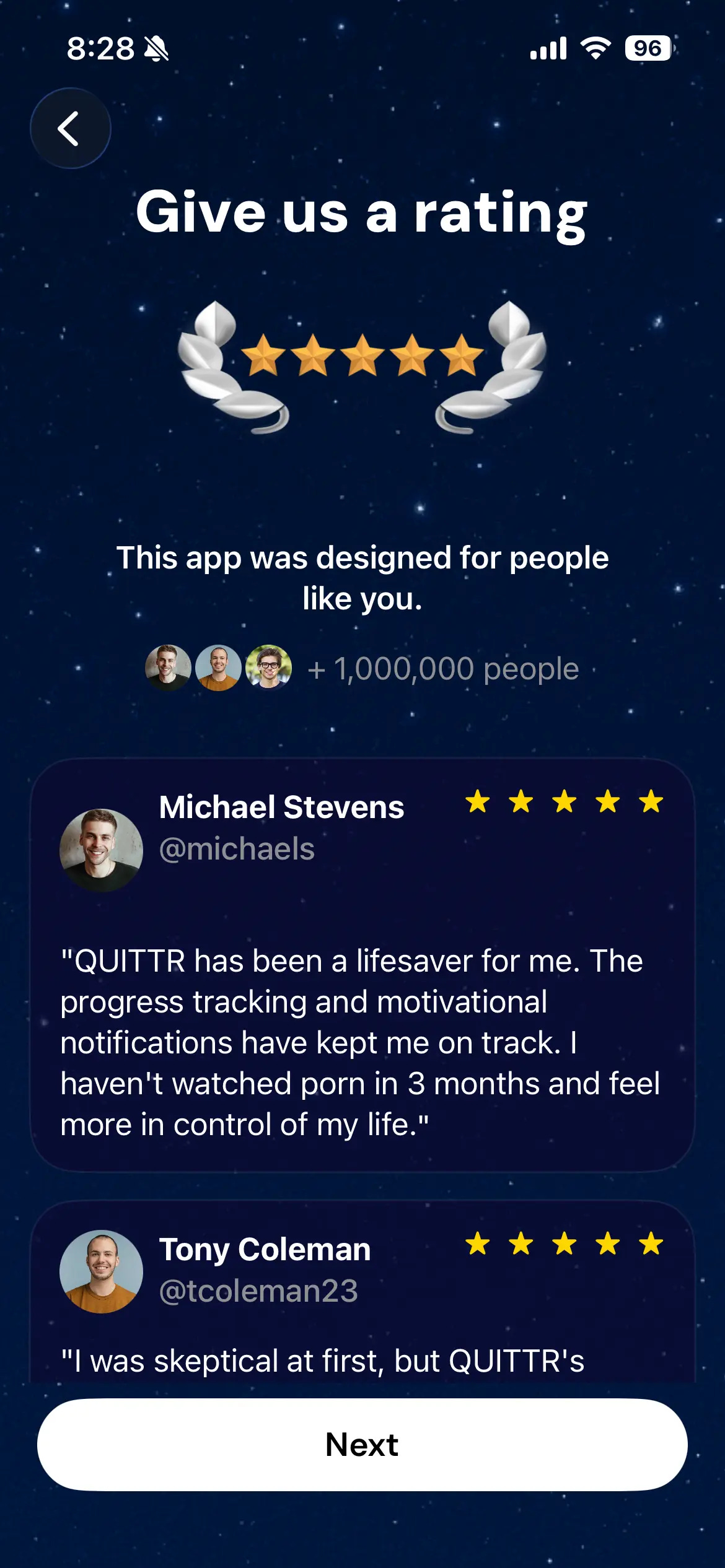
An App Store review prompt
A personalized plan, leading straight into the paywall
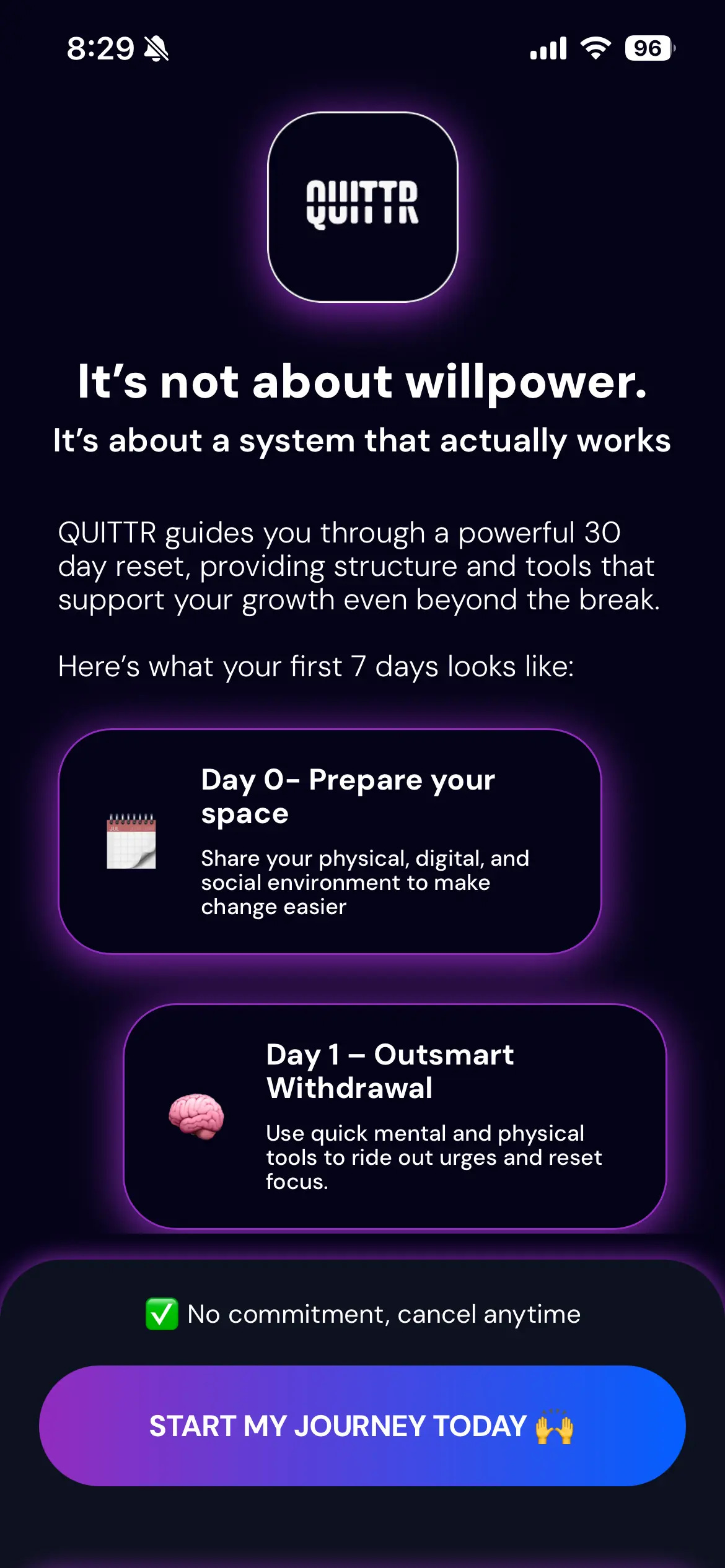
The mechanism is elegant. By answering the questions, users effectively diagnose themselves as having a serious problem. By the time the paywall appears, they’ve already resolved to fix it — and then they’re asked to pay.
And here’s the critical piece: they run a hard paywall with no free trial.
They tried a free trial once. Usage rates collapsed, and they pulled it immediately.
Because users pay upfront, they commit — “I am absolutely going to quit” — and both retention and ratings go up as a result.
They’ve gone as far as to say that without the hard paywall, revenue would have been 1/25th of what it is.
A 25%+ conversion rate with a hard paywall and no free trial is, frankly, insane.
For what it’s worth: the Japanese-learning app I run also grew on a no-free-trial hard paywall, but I started getting a steady trickle of one-star reviews complaining that you can’t use it for free — so I’m currently testing a free trial.
My gut says revenue is stronger with the pure hard paywall. But until you’ve accumulated a healthy base of reviews, adding a free trial may be the smarter move.
Most of the other apps I’ve covered do offer free trials, by the way. My sense is that close to 80% of them do.
On Onbo Hub — the product I’ve been building and running — you can inspect each app’s onboarding and check which ones use free trials. Worth a look:
One more thing about QUITTR’s onboarding: they didn’t invent it from scratch.
They screenshotted the onboarding flows of top apps doing $5–6 million a month, laid them all out side by side in Figma, extracted the common patterns, and adapted them for their own app.
Onboarding is one of those areas where simply studying what already sells will completely change your results. I’d strongly recommend analyzing a wide range of app onboardings yourself.
These days, QUITTR’s onboarding has become such an industry reference point that it gets copied constantly.
💃 The Influencer Deals, With the Actual Numbers
Now the acquisition side.
I mentioned last time that influencer marketing is QUITTR’s primary growth channel — this time, let’s get into the real numbers.
Who they approach: Christian, fitness, and self-improvement influencers — the audiences most aligned with quitting porn.
And they change the angle by niche. For religious audiences, it’s framed as a betrayal of faith. For fitness audiences, it’s lowered testosterone. For self-improvement audiences, it’s the performance gains that come from abstinence.
Here’s the clever part — how they make first contact.
They paid for a $50 consultation with a Christian creator to get a direct conversation. That single call ended up generating $1,000 a day in revenue. They repeated it with a $30 fitness consultation, with similar results.
Cold-DMing influencers gets you ignored. So instead, they put their own money down on whatever consulting or advisory offer the creator was already selling.
And then they pitched, live, on the call. It’s a phenomenal approach.
Here are the deal terms they used:
Compensation is proposed as a mix: flat fee ($2,000–$10,000/month), performance bonuses ($500 per 500K views), and CPM ($2–3 per 1,000 views)
Payment is 20% upfront, remainder on delivery of results
View guarantees built in — e.g. “$1,500 for four videos with a guaranteed 500K combined views”
If views fall short, the fee is prorated or additional posts are required
The app must be shown on screen in the video
The contract includes rights to repurpose the created video as a paid ad
That combination — view guarantees plus ad repurposing rights — is genuinely brilliant.
Influencer campaigns are wildly hit-or-miss. View guarantees cap the downside, while the right to scale winning creative through paid ads maximizes the upside.
The signature example: Jeremiah Jones, a creator with 2 million followers.
On a $3 CPM plus bonus deal, his post hit 9.9 million views — a mega-viral moment. It drove $40,000 in a single day and $100,000 in 65 hours for QUITTR.
Here’s the video:
Today, QUITTR has systematized this to the point where they put $40,000 a month into Meta ads and pull a 3–4x return.
Discover winning creative through influencers → scale it with paid ads. At this point, that’s the standard winning formula for consumer apps.
Their operations are equally systematized: influencer prospects are tracked in a Google Sheet, and virtual assistants handle DM outreach.
Even a team of two or three can run campaigns worth hundreds of thousands of dollars a month if you build the machine properly.
🧨 The Goal Is “Liquid Death”: Brand Strategy Beyond the App
Now for what’s emerged since my earlier piece — the next phase.
Once they passed $250,000 a month, their focus shifted to brand awareness.
Their model? A water brand, of all things: Liquid Death.
Liquid Death is the American monster brand that took plain water and, with punk skull-can branding, built it into a billion-dollar company.
They’re also reportedly eyeing research collaborations with YouTubers and neuroscientists to build authority.
From competing on app features to competing on brand and credibility.
And given QUITTR’s market position, that makes sense — features can be copied endlessly, so the only durable moat left is the brand.
They’re going after top-of-mind recall: quit porn = QUITTR.
At this level, it’s completely outgrown anything resembling indie development.
👑 At 20, He Hands Over the Crown and Moves On
Back to where we started.
In August 2025, he posted this on X:
I wish I could run multiple storylines at once. I want to be a footballer, an artist, an entrepreneur, and a politician simultaneously. Unfortunately each requires decades of focus. Not impossible — but definitely not short-term.
He’d scaled QUITTR at breakneck speed and made serious money at 19. But his ambition ran much further than that.
And then, in September 2025, he made the call to hand QUITTR to someone else:
Handing off management of a thriving $500K-a-month app to return to a phase where he can exercise his own creativity.
This move is quietly becoming a shared pattern among young consumer app founders.
Zach Yadegari sold Cal AI. Many of these successful founders aren’t clinging to the app that hit — they’re converting the winner into an asset and moving on to the next big swing.
For them, the app isn’t the goal. It’s the vehicle for a bigger ambition.
Broke at 19, hit app at 19, handed over the company at 20, already onto the next concept.
The pace is unreal.
🌃 The Next Habit App — and Why It Failed
After handing off QUITTR, the next thing Alex launched was an app called Reset:
The concept: rebuild your good habits in 60 days. Thematically close to QUITTR, with a nearly identical onboarding flow.
It also looks conceptually quite close to Life Reset, the very successful app I’ve covered before.
So how did it do?
Alex hasn’t explicitly commented, so it’s hard to say definitively — but it appears to have failed. The app seems to have been abandoned and left unmaintained.
Let’s dig into why.
When Alex launched a new app, it briefly generated buzz on X.
But it never had QUITTR’s explosive momentum, and the app’s reputation is poor — a 3.5 rating.
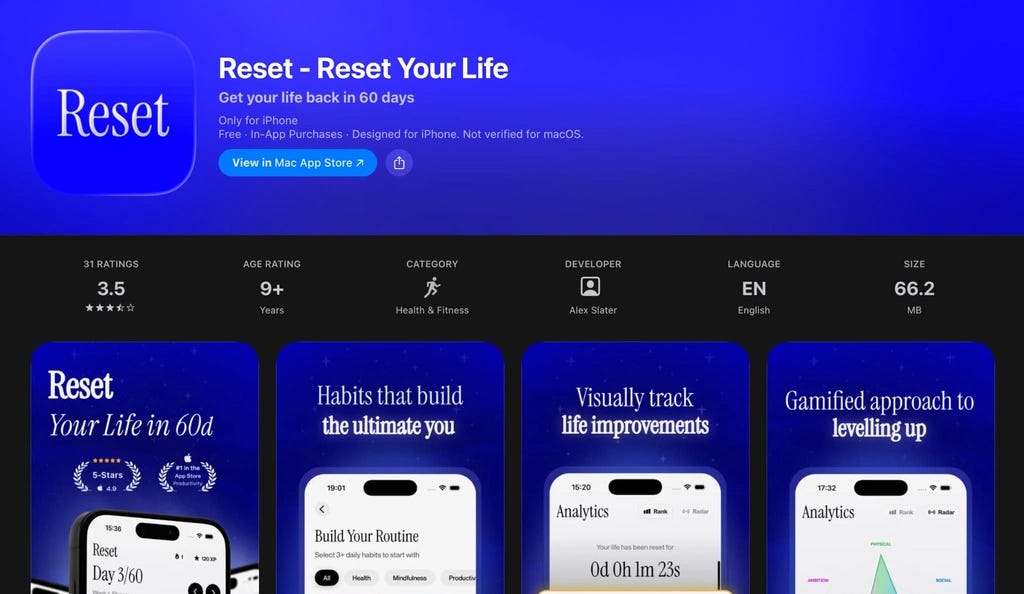
The app itself offered nothing new. It was essentially an inferior version of Life Reset.
Having built an explosive hit like QUITTR, there may have been a degree of overconfidence at work.
My best guess is that he became a true believer in onboarding and cut corners on the app’s core functionality behind the paywall.
Onboarding matters enormously for sales — but this was a stark demonstration that great onboarding is meaningless if the product quality doesn’t back it up.
On top of that, habit apps are everywhere, and there was nothing novel in the feature set. Nor was it narrowed to a niche target the way QUITTR was.
If you had to name the differentiator, it’s “change your habits in 60 days” — but as noted, that’s a second helping of Life Reset, and it reads as unremarkable to the exact users it needs to reach.
Which means it would have been extremely hard to make it go viral in short-form video.
The likely result: a temporary bump of traffic from Alex’s own X following, and a struggle to acquire users after that.
The lesson from Alex’s case is clear — no matter how strong your onboarding and TikTok skills are, if you miss on the core app concept or cut corners on the features, it doesn’t work.
Enormously instructive.
✈️ The Next Move: Launching Soar, an AI Flight Booking App
But Alex isn’t the type to be derailed by that.
The new venture he co-founded is Soar, an AI flight booking app.
Soar handles everything from flight search to booking in one shot. Here’s how he describes it:
Book flights in one tap without re-entering your personal details every time
Find cheaper fares than Google Flights or Skyscanner
Get flight updates — delays, gate changes — pushed to iMessage
An AI agent checks you in automatically and sends your boarding pass via iMessage
If the fare drops, it automatically secures the airline refund or credit for you
His claim: use it once and you’ll never go back.
I tried it myself, and the UI/UX is excellent.
And the early traction is already wild.
He’s publicly reported processing $250,000 in booking volume within 30 days of launch:
With Reset, I couldn’t shake the feeling that it was derivative — a second helping of an app that was already selling.
Soar, though, I find genuinely exciting.
Travel booking is a massive market, occupied by giants like Google Flights and Skyscanner.
But none of them have meaningfully evolved their UX in years, and no one is yet delivering an AI-native experience.
I travel constantly myself, and I feel the friction and awkwardness of travel tools every single day.
There’s every reason for an app with a genuinely AI-native, optimized UX to exist.
Maybe Alex is the one who replaces the legacy incumbents and cracks open that enormous market.
Taking on huge markets with huge problems, armed with Gen Z instincts — that’s how Alex and the founders like him fight.
Watching this makes me want to go after a giant market myself. Let’s not let them have all the fun.
📝 Wrapping Up
So that’s the follow-up on Alex Slater and QUITTR, about a year and a half after my first piece.
Pulling together what his success teaches:
Target the blank markets where the pain is deep but nobody has solved it. The themes that look strange are exactly where the opportunity lives
Build the product in 10 days. What you polish first is onboarding and marketing
But don’t neglect the product itself, or you’ll fail. Sharpen the core features
Study successful apps relentlessly and adopt what works. Don’t reinvent the wheel
Apps that require commitment don’t need a free trial. Use a hard paywall to make people buy in
Structure influencer deals as “view guarantee + ad repurposing rights” to cap downside and maximize upside
When something hits, systematize it, hand it to someone else, and go climb the next mountain
At the time of my last piece, he was “a 19-year-old who hacked TikTok.” Eighteen months later, he’d evolved into “a 20-year-old who built a brand, built an organization, handed over management, and launched his next product.”
Success in indie development isn’t the finish line. It might be where things actually begin.
Personally, this was a fresh reminder of how much the post-hit phase matters — systematizing and letting go. Plenty of us can grind our way to building and growing something. Very few indie developers have a plan for what comes after.
Time to get to work.
So — that’s this week’s deep dive on Alex Slater.
Thanks so much for reading! If anything caught your attention or you have questions, just hit reply to this email — I read everything.
And if you mention my X account with your thoughts, it genuinely makes my day. I always respond.
See you again.
References
https://x.com/alexsllater/status/1964809701717393773
https://x.com/alexsllater/status/1919394415719702715
https://x.com/alexsllater/status/1865109644508557806
https://www.youtube.com/@alexsllater
https://x.com/alexsllater/status/2056780379986579672
https://x.com/alexsllater/status/2069818878033637852
https://www.linkedin.com/in/alexsllater/
https://www.linkedin.com/company/flysoar/
https://boringcashcow.com/interview/interview-with-the-founder-of-quittr
https://startupspells.com/p/porn-addiction-app-quittr-250k-mrr-4-months