A 25-Year-Old Who Can't Code Built an App With AI and Hit $300K a Month in 8 Weeks
Here's the entire playbook — the video formats, the 38-screen onboarding, and the automated DM funnel behind it.
August 31, 2026

This newsletter breaks down real-world cases of people making serious money with apps in the AI era.
Today’s subject: Sarah Perl.
Zero programming experience. She has never written a single line of code in her life.
And yet she recently built an app using Claude Code and a handful of other AI tools — and that app crossed $300,000 in monthly recurring revenue just two months after launch.
Now, she’s an influencer with a large following on TikTok and Instagram. It would be easy to file this under “well, she already had an audience” and move on. That would be a mistake.
Having followers does not make this easy. Reaching this level of revenue at this speed is genuinely hard. I run marketing accounts for a Japanese-learning app, with more than 800,000 followers combined — and growing an app is still nowhere near simple.
More to the point, the audience itself was earned. This result exists because of years of work building that following in the first place.
So how did she actually get here?
Let’s dig in.
🃏 One Tarot Video That Pulled Her Out of a Tight Spot
Sarah grew up in a small apartment in Brooklyn, New York. Her family was never well off, and money was permanently tight. She’s said that her earliest associations with money were negative ones — pain, arguments, stress.
She didn’t let that decide her outcome. She saved money steadily through high school, graduated with straight A’s, and got into the university she’d dreamed of attending. Her goal was to become a teacher.
The tuition, however, was enormous.
People around her said it was ridiculous to take on student loans just to become a teacher. She trusted her gut and enrolled anyway.
At university she pursued two degrees while working two part-time jobs simultaneously.
The turning point came when a close friend introduced her to books and ideas about mindset. As she went deeper into that material, she experienced what she describes as her life repeatedly bending in a better direction. That personal transformation would later become the foundation of her entire business.
One day, on impulse, she pulled a tarot card, filmed herself doing it, and posted it to TikTok. Here’s the video:
She had fewer than 150 followers at the time. She had no expectations, put her phone down, and went out with friends.
When she came back and checked her phone, the video was at 30,000 views. Then 50,000. Then 100,000. It ended up above 900,000 views.
She describes it as a video she shot without thinking. But look closely and it’s packed with viral mechanics.
First, as the on-screen hook text tells you, she filmed and posted three versions of the same “pull one card and reveal it” video at once.
Second, she tells the viewer: the card you land on is the message you’re meant to hear.
So anyone who starts watching knows a card is about to be pulled and revealed — which triggers the desire to stay until the end.
And because different viewers get different cards, the comment section naturally fills with people reacting to whichever one they got.
Watch-through rate and comment engagement are both engineered directly into the format.
The other enormous advantage: this content can be produced infinitely. There’s always another card.
When you look at the posts that become the origin point of a viral career, an overwhelming number of them are not the ones the creator sat down and tried hard to make blow up. They’re the casual ones.
This tarot video is exactly that. In hindsight you can see every reason it worked. Going in, it was just something she felt like posting.
You can try to manufacture virality and mostly fail. Which is precisely why you shouldn’t overthink it — post a lot of different things and let the data tell you.
Worth noting: among the three tarot videos she made, the view counts varied wildly.
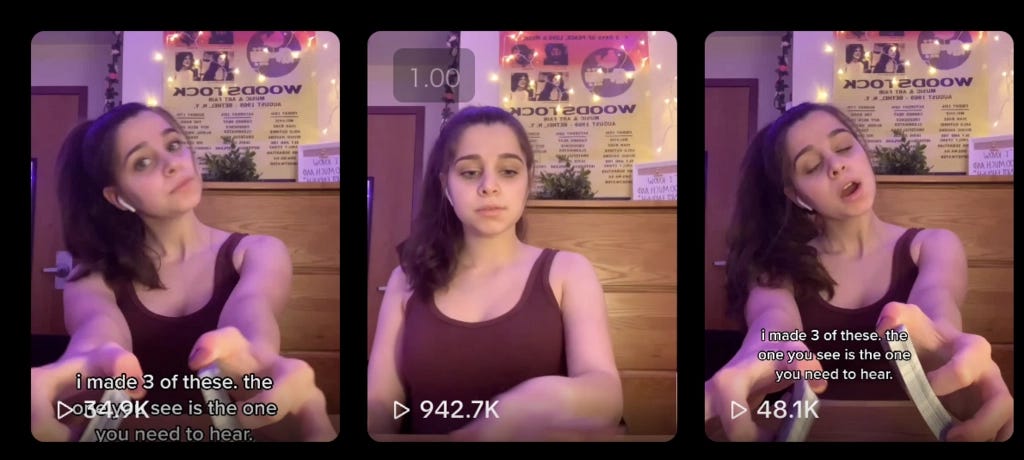
The top one hit 940,000. The other two landed at 48,000 and 35,000.
Clearing 10,000 views is respectable in its own right, but compared to 940,000 it’s a rounding error. Understand that short-form video produces this kind of variance even within the same format, and post relentlessly anyway.
From there she leaned all the way into the format and posted constantly.
What shows real instinct is that she kept the core concept — tarot — completely fixed, and varied only how the card gets revealed.
In this one, for example, the shuffle goes wrong and a card flies out of the deck, and she reads that card 👇
The accident adds motion, and it adds an unproduced, natural quality that reads as authentic rather than manufactured.
That video passed five million views.
Absurd. Five million views for pulling a single card.
💰 From Tarot Readings to a Coaching Business
Once the tarot videos took off, her DMs filled with questions.
How do I attract the life I actually want?
How do I switch into a successful person’s mindset?
People drawn to tarot content are, more often than not, people struggling with something in their own lives. It’s not hard to imagine the volume of DMs she was receiving.
Answering each one individually was impossible.
So she built an online course that answered them all at once: Manifest Magic.
“Manifesting,” in this world, refers to the law of attraction — the idea that you can steer your life in a better direction by directing your intention at it.
Personally, I don’t believe in tarot or spirituality. But the demand is undeniably, enormously real.
The result: she went from working two jobs alongside university to earn $100 a day, to a business with peak days above $50,000 in sales.
TikTok passed 2.8 million followers; across Instagram and YouTube the combined total cleared four million. On courses alone, she had built a million-dollar business at 23.
That alone would be a remarkable story. But this is where it actually gets interesting — because she then converted the entire coaching business into an app.
📱 Unsatisfied With Existing Self-Development Apps, She Decided to Build Her Own
Sarah was a heavy user of self-development products herself.
The problem was that nothing on the market was customized to her specific goals.
Everything served generic, one-size-fits-all content, and she found it consistently underwhelming.
She was convinced she could build something better. The obstacle: she knew absolutely nothing about programming.
But over the past few years, AI has advanced far enough that a complete non-engineer can ship a real product.
The moment had arrived. She finally set out to build the app.
Her stack: Claude Code for the actual coding, plus regular Claude and Google AI Studio for design and supporting work.
Her first working MVP took two days. Two.
Turning that into a polished production app took another two to three months.
Someone who has never written a line of code, finishing a working prototype in two days. That was unthinkable not long ago. It is now routine.
What came out of all this is an app called Stella — Manifest Anything.
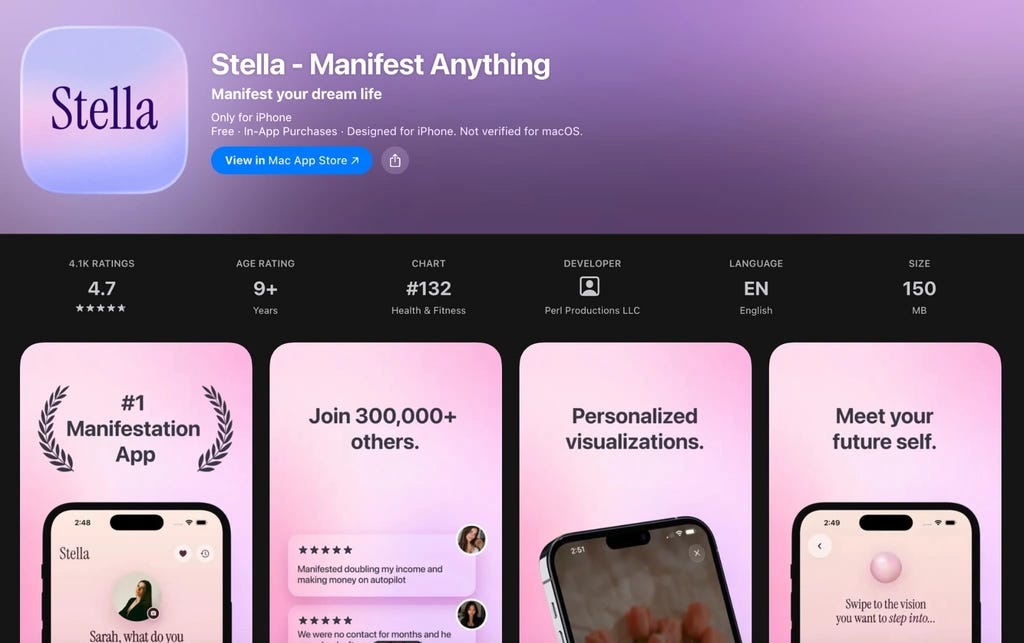
The user enters their desires and goals, and the AI generates guided audio content built specifically for them. Personalized affirmation messages also arrive daily.
📲 An Absolutely Punishing Onboarding Flow
I’ve said repeatedly in this newsletter that high-revenue apps tend to have long onboarding flows. Stella’s is, without question, the most demanding one I’ve encountered.
Thirty-eight onboarding screens in total.
The screen count is high, but that’s not what makes it brutal. What makes it brutal is that each individual screen takes real time to answer.
The standard formula for this kind of flow is “lots of questions × personalization.” Stella follows that formula — except an enormous share of the questions are free-text.
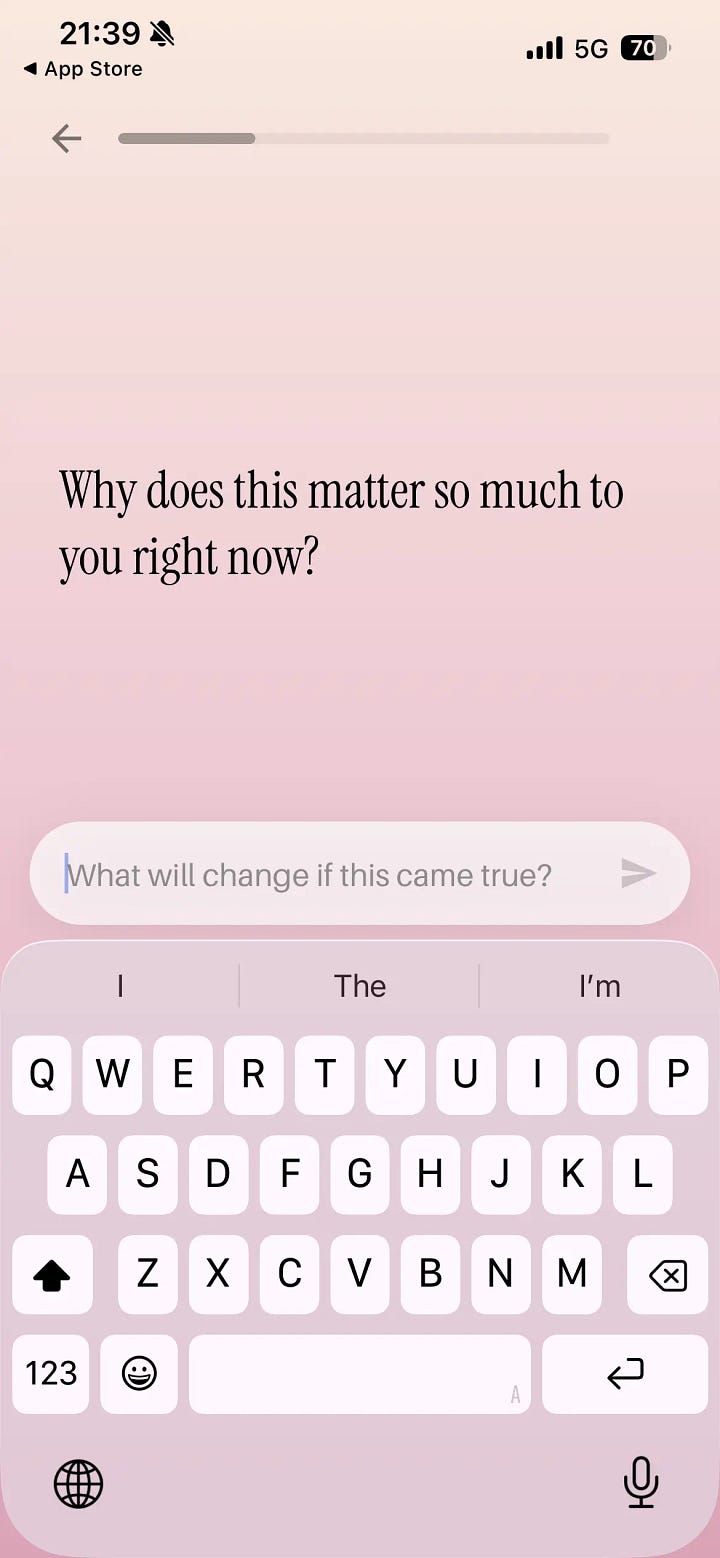
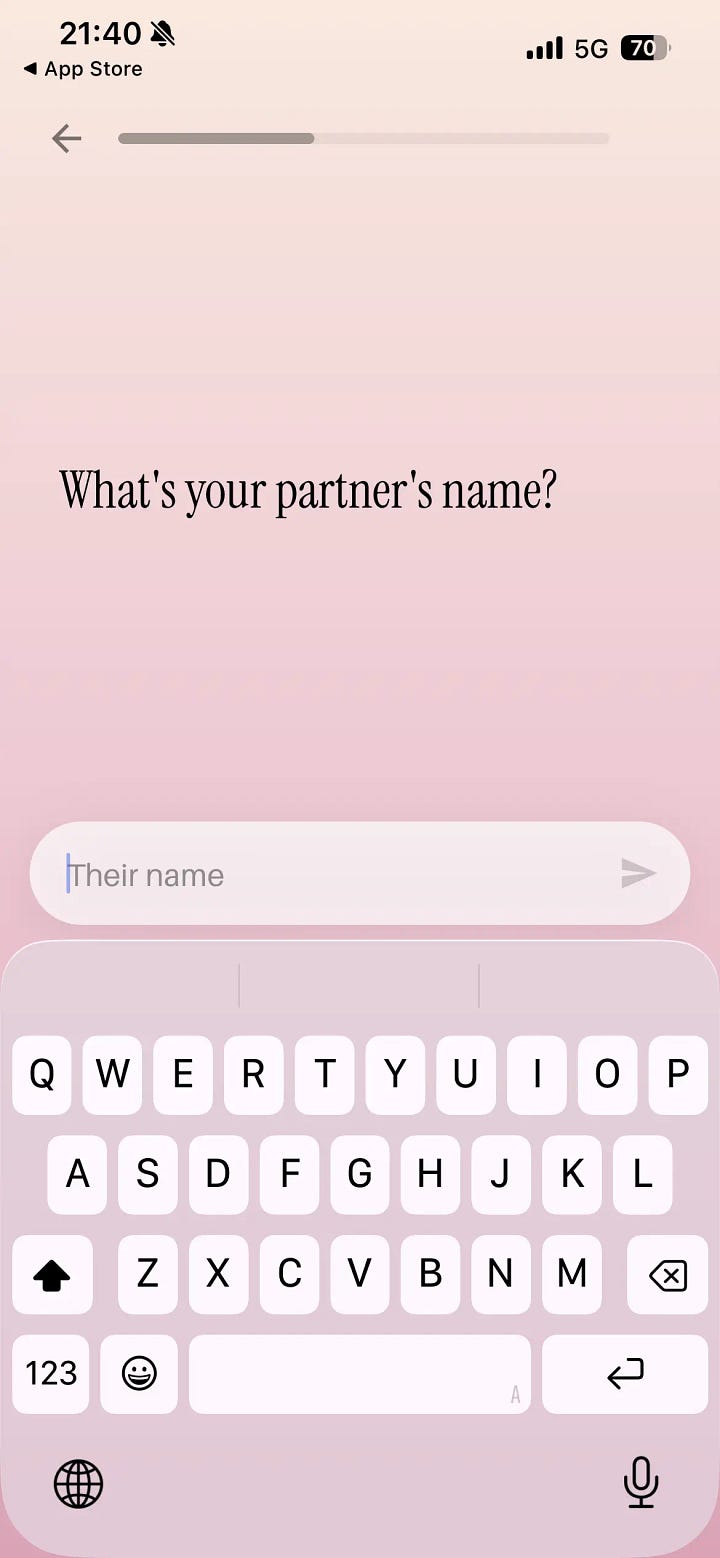
Almost every app I’ve analyzed asks a lot of questions but uses multiple choice, specifically so users can tap through without having to think.
Stella throws free-response question after free-response question at you.
Every single time, you have to stop, think, and type something before you can advance.
Normally I’d expect that to send drop-off through the roof. But for a self-development app, I think it does the opposite: it extracts more commitment from the user and raises conversion.
It even asks about your romantic partner.
My honest reaction was: you’re asking about that too?
And yet — precisely because of that — the conversion rate among people who finish answering all of it is almost certainly very high.
It depends on the category, but for self-development and spiritual apps, demanding this much free-text input from users may well be the right call.
At the paywall, a free trial button appears alongside a countdown timer 👇
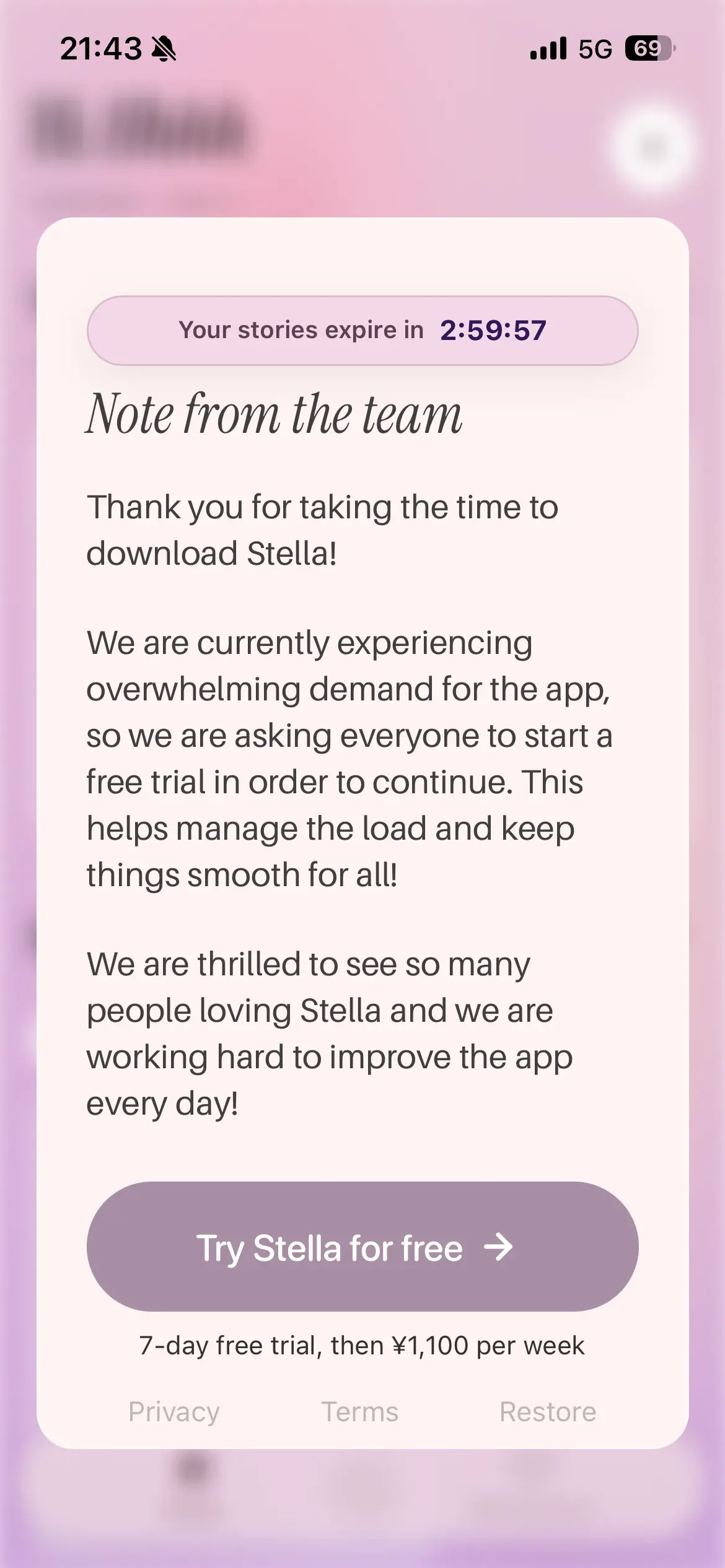
That final nudge is very likely driving a dramatic lift in conversion.
It’s an exhausting onboarding flow, but if you’re building apps solo, you should absolutely go through it yourself.
If you’d rather not, every screenshot is available on Onbo Hub, which I run 👇
I’ve also posted the onboarding for Aya, a similar spiritual app. Worth comparing the two side by side.
So that’s how she got to launch. Now let’s look at how she actually grew it.
Her existing reach was obviously a boost — no argument there. But $300,000 a month within two months is still savage.
Anyone who looks at a case like this and dismisses it as “she was just famous” is never going to succeed. She was unknown once too, and she has worked brutally hard since becoming known.
I went through her short-form videos exhaustively, and they are loaded with techniques that made me stop and take notes.
So below, I’ll go format by format through her videos and break down exactly why they’re so effective — plus the sales techniques she used after launch, and her method for growing followers from zero and then building an app on top of them.
This is genuinely useful material. Stay with me to the end.
⚡️ Short-Form Content Absolutely Packed With Viral Mechanics
Let’s go through her accounts and her videos.
She has YouTube as well, but it’s far smaller than TikTok or Instagram and barely updated now.
I researched everything she’s posted from the app launch through today, and the sheer volume of output and iteration is staggering.
What struck me most was how much promotion she did after launch. If a top-tier influencer is pushing this hard, the rest of us have no excuse for doing less.
So let’s look specifically at how she promoted the app.
Some of you are probably thinking: I don’t have followers yet — tell me how to get them first. I cover that later in this piece, so skip ahead if that’s your situation.
Stella launched between late January and early February 2026.
On January 30, she posted this:
It did roughly 250,000 views.
This single video contains a genuinely instructive approach.
It opens with the hook: “If you’re seeing this before Friday, it’s not a coincidence.”
She posted it on a Thursday US time — so obviously everyone watching qualifies. But saying it out loud manufactures a feeling of specialness.
It’s the same mechanic as Facebook ads that target by age or location and open with “Hey, you — 34 and living in Chicago!” Stating the obvious makes the viewer think wait, is this about me?
From there she moves into an affirmation, delivering it herself.
Then she adds: “Repeat this affirmation every day for the next seven days and your dream will manifest. Save this video so you can say it daily.”
Watching that, it clicked for me how well affirmations fit social media as a content type.
Because the user needs to repeat it daily, they’re highly likely to save the video.
And on today’s platforms, high save rates are enormously favored by the algorithm.
She goes further: after the affirmation, she asks viewers to comment “It’s mine.”
Videos with lots of comments are also algorithmically strong.
Then she slips in: “And don’t forget to follow — because I’m launching an app soon.” Casual app promotion, embedded naturally.
And she closes by asking for one more action: “Let me know if you want me to launch it.”
It’s ruthlessly well constructed.
To summarize what that one video does:
Opens with a hook that manufactures specialness and personal relevance
Delivers an affirmation, which drives saves
Specifies the exact comment text (”It’s mine”) so users don’t have to think, driving comments
Demos the app, then asks for an action
Genuinely elite. This is what it looks like when someone has made hundreds of videos go viral.
🎙️ The Podcast-Clip Format Is a Guaranteed Winner
That’s far from her only format.
She posted an enormous variety of content to promote Stella.
The video above was shot in a lived-in, everyday setting. She also produces videos shot in what looks like a proper studio, with a “this is a real recording session” backdrop.
Like this one 👇
1.1 million views.
Video podcasts are exploding right now, especially in the US, and short clips cut from long-form podcast episodes are everywhere — and consistently going viral.
Here’s the psychological effect: most people have been conditioned to see a clipped podcast segment and instinctively assume something important is being said here.
That’s exactly why Sarah’s version of this format performs so well.
In the video she’s saying things that made me think come on, no way — pure spirituality — but she’s saying it with total sincerity on a proper set, and you find yourself watching anyway.
And she routes it cleanly to the app.
This next one, apparently shot the same day in the same session, did 2.7 million views 👇
She also runs the interview version of the podcast-clip format 👇
In this one, her interviewer asks: “What do I do to make the person I like become obsessed with me?” — and Sarah responds with the exact phrase (the manifestation) you should repeat daily.
The video includes a “Save this video” prompt, and at the end the interviewer asks “How am I supposed to remember that manifestation?” — which sets up the answer: use Stella. Straight into the app pitch.
That podcast clip did 4.8 million views. Insane.
Across all her content, podcast-style short videos are clearly her most reliable performers by view count.
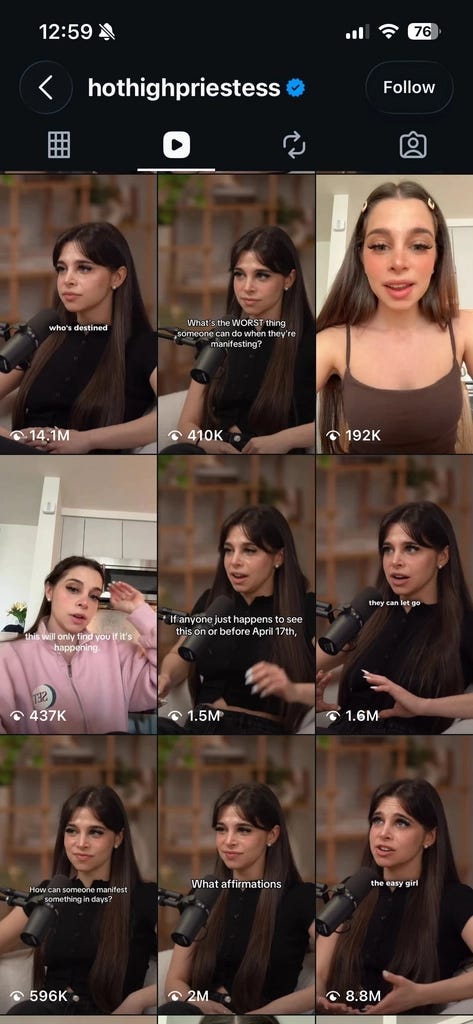
Podcast clips are undefeated.
💥 The Shocked-Face UGC Format Converts Best
She promoted the app across many formats — but the one that actually drove the most conversions is this one:
510,000 views.
Compared to the videos above, that’s a modest number. And yet it produced the most conversions of anything she made.
I find that result fascinating.
The hook is:
“wdym I’ve been manifesting for years and Now I’m finding this??”
It’s a UGC-style format. Rather than an influencer promoting an app she built, it’s framed as a regular person who stumbled across something great.
This format is extremely popular in overseas app marketing right now. What’s surprising is that it still works — and works best — even when the person running it is an influencer with millions of followers.
The power of the format is that it doesn’t read as a broadcast from a creator. It reads as a user spontaneously sharing something they found.
Which is presumably why it converted dramatically better than Sarah simply saying “hey, I made an app!”
Jay from nomadtable, used the same UGC format to go viral and drive conversions 👇
📹️ Other Formats Worth Stealing
There’s plenty more in her short-form library worth studying.
In this one, she overlays the text “repeat 3 times,” which literally instructs the viewer to rewatch the video repeatedly 👇
That pushes watch-time metrics up, which pushes distribution up.
The result: 3.9 million views.
She also uses a crying face — not just a shocked face — as the opening hook 👇
This one only did around 300,000 views, but leading with a strong emotional facial expression — crying, shock, disbelief — is consistently powerful.
📩 An Automated Lead-Capture Machine
Sarah captures attention at massive scale with short-form video. But capturing attention isn’t where she stops.
What she does with that attention afterward is the impressive part.
On Instagram, she uses a tool called ManyChat to automatically harvest leads.
In her videos, she tells viewers: “Comment ‘download’ and I’ll send you your personal affirmation.”
Comments pour in.
Replying to each one individually would be impossible.
So she uses the tool to trigger an automatic DM the moment someone comments — and that DM routes them straight to the App Store.
The genuinely clever part: she builds a review request into the same automated DM flow.
The message says: “If you leave a review, let me know — I want to thank you personally.”
That single line lifts both her app’s star rating and its store ranking.
I saw that and immediately decided I have to do the same thing.
Look at her Instagram content and her funnel design together and you see a beautifully constructed marketing machine. This is nothing like someone who got one lucky viral hit.
💰️ How to Grow Followers From Zero and Sell an App
Sarah argues that the raw follower count doesn’t matter much. What matters is the skill of making things go viral.
To prove it, she launched a brand-new TikTok account at roughly the same time as Stella’s launch and — without leaning on her existing audience — grew it to 40,000 followers in two months from zero.
She goes as far as to say: “If I started a new account from scratch today, I could hit 50,000 followers in three to four months with near certainty.”
So how do you actually do it?
According to her, the research phase at the beginning is what matters most.
First, search out the most viral content in your niche.
Then study why that content went viral. She says psychological principles are useful reference material here.
Then put the mechanics of virality into words as precisely as you can, and make your own. Make a lot of them.
The moment one video hits, replicate it endlessly.
She still posts the tarot card concept that first went viral for her years ago — and it still goes viral, still performs, still converts.
Once your following is growing and your videos hit reliably, she says, work backwards and ask yourself:
What product could I insert naturally into this video?
Your best reference here is the comment section.
Read the comments closely and pull out the unmet needs showing up in them.
“I wish something like this existed.” “This is the part I struggle with.” Those comments are the source material for your product idea.
Most founders operate in this order: build the product → find users → figure out marketing.
Her approach inverts it entirely: build the content and the distribution first, and only then build the product.
What’s interesting is that she explicitly warns against copying someone else’s product.
Her view is that Stella grew precisely because an app like it didn’t already exist.
Find the gap in the market with your own eyes, and build directly into it. That’s her approach.
Forgive me for using myself as an example, but everything I’ve done follows a pattern close to Sarah’s.
Distribution first, always.
Published relentlessly about AI and data science to build influence first, then launched an e-learning platform.
Built influence publishing in Japanese, then launched a Japanese-learning app.
Published app success case studies to build influence, then launched an onboarding analysis product.
And none of those products were copies of someone else’s app. I take reference from others, sure — but every one of them shipped out of a feeling of I wish this existed or why on earth doesn’t anyone make this?
Sarah’s approach is going to keep getting stronger. In an era where differentiating on features has become nearly impossible, whoever controls distribution wins.
📝 Wrapping Up
So: one tarot video changed her life, she built an app with AI tools and zero coding experience, and grew it to $300,000 a month in two months.
Looking back at her story, the thing that stands out most is how completely the combination of distribution × AI has dissolved the technical barrier to entry.
We’re in an era where anyone with distribution and an idea can grow an app, with no technical skill at all.
Within that shift, Sarah makes a clear prediction: female creators will have the advantage in the consumer app market going forward. She gives three reasons.
First, distribution. The majority of influencers on the major platforms are women, and she argues algorithmic reach tends to favor female creators.
Second, instincts for community building. She says women have a distinct feel for generating the kind of engagement that determines whether an app grows.
Third, a gap in problem discovery. In her words: “There are so many problems we experience as women that male founders would never even think of.”
People will disagree about that argument in various directions. But what’s not in dispute is that we’ve entered an era where the content creator and the marketer — the person who can move an audience emotionally — beats the engineer with the technical skills.
Marketing-native people are pouring into product development.
Let’s not get left behind.
Thanks for reading all the way through! If anything caught your attention or you have questions, just hit reply to this email — I read everything.
And if you post your thoughts on X and mention me, it makes my day. I always respond.
See you next time.
References
https://stan.store/blog/sarah-perl/
https://creatorinpublic.com/p/hothighpriestess-built-a-1m-tiktok-business-at-23