How Sebastian Röhl Grew a Late-Entry Habit Tracker to $100K a Month With ASO
German developer Sebastian Röhl's habit tracker, HabitKit has become a $602K-a-year business driven almost entirely by App Store search, and in January 2026 it cleared $100K in a single month.
October 7, 2026

Today's subject: Sebastian Röhl.
This is actually the second time I've written about him.
He's the developer behind HabitKit, an app that lets you track your habits on a grid that looks just like GitHub's contribution graph.
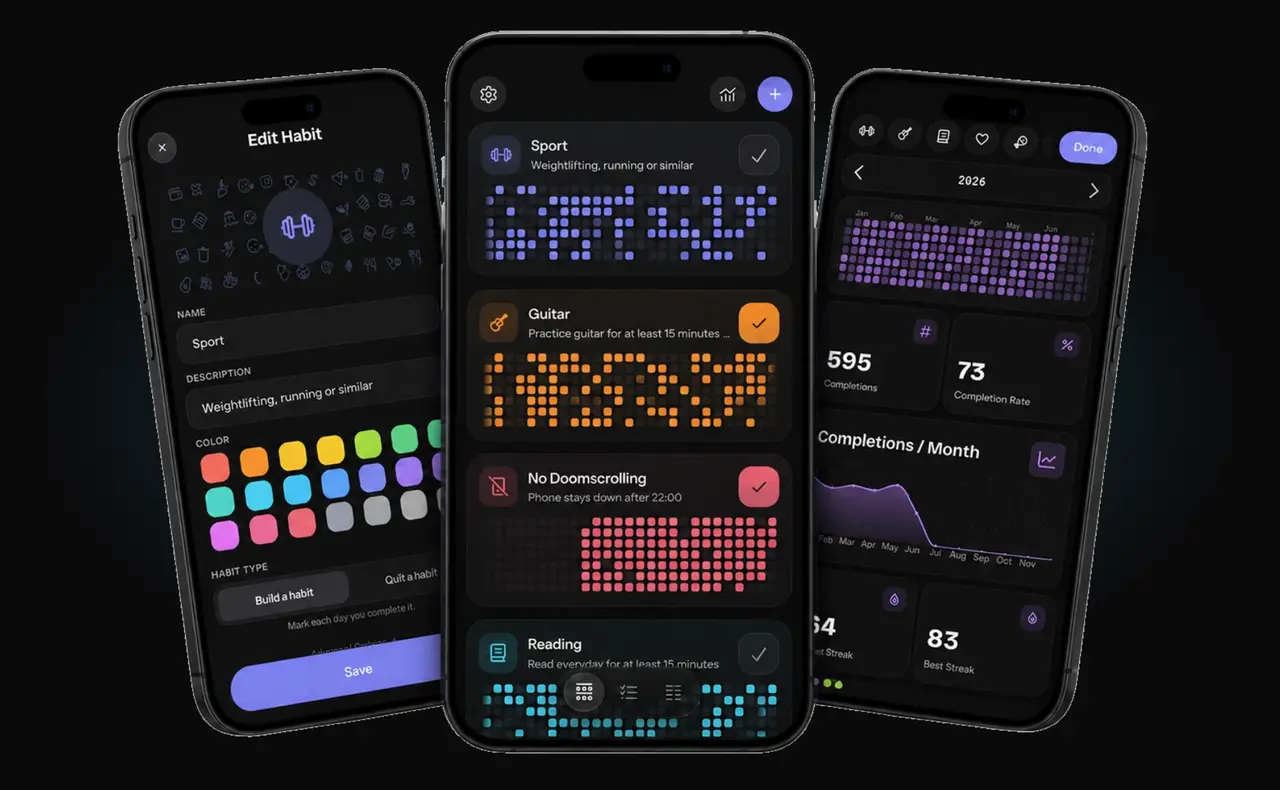
When I first covered him, he had just passed $33K in monthly revenue in January 2024.
About two and a half years later, his app has grown far beyond that:
$602K in total revenue for 2025
$112K in January 2025 alone
Over $100K in the trailing 28 days in January 2026, too
#2 on the US App Store for "habit tracker," one of the most generic keywords there is
January revenue runs high because that's when everyone decides, "This is the year I finally build a new habit." Apps in this category tend to sell like crazy around the New Year.
Here's the remarkable part: despite all this growth, he does almost no marketing right now.
About 98% of his users come from App Store and Google Play search. He didn't go viral on TikTok, and he didn't get influencers to promote him.
I've covered plenty of stories here about apps that blew up on TikTok and hit hundreds of thousands of dollars a month within a few months. Sebastian is the complete opposite.
When you can rank at the top for a major keyword through ASO, it's incredibly powerful. You don't need to pull off something as hit-or-miss as a viral short-form video.
Of course, ASO isn't easy either. Ranking near the top of a crowded category is extremely hard.
And yet Sebastian has secured top rankings in habit tracking, a red ocean packed with competitors, despite arriving very late to the party.
So this time, let's look at his ASO playbook.
I've grown my own apps mostly through social media marketing without paying much attention to ASO, so his approach was hugely instructive for me.
Let's dive in!
🔁 Quitting His Job to Go Indie
Sebastian studied computer science at a university in Germany and went on to work as an engineer at a German company.
But after three years on the same project, he couldn't hold back the urge to build his own product anymore.
So he quit, living off his savings, with a self-imposed deadline: build something real within 12 months.
He had no idea what that something would be.
The first thing he built was a workout logging app called Liftbear.
Over six months, it made a grand total of $100. (Honestly, making any money at all is impressive!)
Sebastian had run straight into the wall every indie developer hits: monetization.
But he didn't give up.
The next thing he built was HabitKit.
Before launch, he posted screenshots on X, and they got 800 likes. Convinced he was onto something, he built the whole thing in two months and launched it in November 2022.
The key was making a GitHub-style contribution grid the centerpiece of a habit tracker. That's really what it all comes down to.
It struck a chord with his followers on X, who were mostly developers.
A habit app with merely cute visuals probably wouldn't have worked. It took off because it was built around the GitHub grid, something developers instantly connect with.
I've said this many times: no matter how many followers you have, nobody will buy unless you give them a product that resonates with them.
That's exactly why Sebastian's first app, the workout tracker, didn't sell.
Fitness apps are visual-first, so they do well on TikTok and Instagram but poorly on X.
Sebastian had been growing an audience of developers on X by building in public, but he didn't have many fitness-minded followers.
If he'd wanted to grow a fitness app, he should have done it separately, through short-form video on TikTok and Instagram.
For example, Symmetry, built by Mauro, whom I covered recently, is a gym app that's growing like crazy.
Despite launching very late, in 2025, it's grown to $240K a month in just over a year.
And the team made 80,000 short-form videos in a single year. Gym apps are fundamentally apps you grow through short-form video.
It pays to figure out exactly where the users of your app actually hang out.
🚀 Growing HabitKit With Build in Public on X and Low Prices
From here, his app goes on to grow massively, mostly through ASO. But he wasn't designing for ASO from the start.
It's worth emphasizing that the initial boost came, without question, from posting on X.
His posts on X were the fuel. The app grew, eventually earned top ASO rankings, and became a business that earns consistently.
And what probably helped ASO most early on was keeping HabitKit's prices extremely low.
At the time, it cost just $0.99 a month, $6 a year, or $15 for lifetime access.
Here's what I want to highlight: your pricing strategy should be clearly different depending on whether you're acquiring users through ASO or through short-form video on TikTok and Instagram.
When ASO is your main channel, users search a keyword and compare the apps that show up.
So being cheaper than other apps is a competitive advantage. Lower prices raise your conversion rate, and a higher conversion rate should work in your favor in ASO.
That means if you're a latecomer aiming for the top of search, there's an incentive to keep prices as low as possible.
In that sense, Sebastian's strategy was right (though even so, those prices seem a bit too low).
On the other hand, when you acquire users on TikTok or Instagram, they basically discover the app in a short-form video and then search for it by name.
They generally don't compare it with other apps.
So there's much less incentive to undercut everyone else.
The better strategy is to push ARPU (average revenue per download) as high as possible.
That's why the short-form-driven apps I usually cover tend to have long onboarding flows and a hard paywall with relatively high prices.
HabitKit, by contrast, has almost no onboarding and runs on a freemium model.
In general, my impression is that apps acquiring users through ASO tend to have shorter onboarding and freemium models.
🔎 HabitKit Gradually Climbs the Search Rankings
By sharing HabitKit on X while keeping prices low, Sebastian gradually started ranking near the top for the keyword "habit tracker."
From there, revenue took off.
In 2023, the app had 120,000 downloads and $51K in revenue.
Here's his 2023 recap on X. 👇
Even crazier: in just January and February 2024, he made $60K, easily surpassing all of 2023.
As I mentioned at the top, habit apps tend to surge around the New Year.
Everyone gets fired up: "Next year, I'm building a new habit!" (Most habits don't stick, of course, so revenue usually peaks in January and then drops.)
Then in December 2024, while things were growing steadily, something happened that gave HabitKit's revenue another boost.
The team behind MKBHD, the world-famous tech YouTuber with over 20 million subscribers, runs a channel called The Studio. They published a video where staff members share the apps they actually use, and one of the editors, Adam, featured HabitKit.
And Sebastian didn't pitch them. Adam apparently found one of his posts on Threads.
It shows how important it is to keep showing up on other social platforms like Threads, not just X.
For what it's worth, the Japanese-learning app I'm growing right now gets its users mainly from short-form video on Instagram and TikTok, but I recently started posting on Threads too.
I just repost the short videos I've already made with some text attached, and even that gets a decent number of impressions.
And a handful of paying users have told me they found the app through Threads.
Running multiple social accounts is a hassle, but you can automate a lot of it, so I think it's worth spreading across as many platforms as you can. Instagram, Facebook, and Threads can all be posted to at once, so that alone is worth doing.
Thanks to the feature on a famous YouTube channel, downloads and reviews jumped, and on January 3, 2025, HabitKit finally reached #7 for "habit tracker" on the US App Store.
Then in January 2025, with New Year's resolution season and the YouTube effect stacking on top of each other, it made $112K in a single month.
It might look like pure luck, but MKBHD's team found him because he had kept sharing his building process across multiple social platforms for a long time.
I've gotten countless opportunities through social media myself. Posting consistently really, really matters.
As a result, here's what his 2025 looked like. 👇
Annual revenue: $602K
Monthly revenue stayed above $40K all year
25,000 active subscribers
Downloads: 272K on iOS, 290K on Android
Ratings: 4.8 on iOS (6,630 ratings), 4.6 on Android (9,443 ratings)
Top 5 for "habit tracker" on the US App Store
And in January 2026, revenue passed $100K. Generating that almost entirely through ASO is remarkable.
The power of ranking at the top of store search is hard to overstate.
So what exactly has he done for ASO?
Let's look at his specific tactics and the thinking behind them!
All of them are things you can start copying today. If you're building an app, please read on!
🔍 ASO Starts With Your App Name and Subtitle
It may sound obvious, but the thing he emphasizes most is the app name and subtitle.
Here's his step-by-step process.
Step 1: Research keywords before you choose a name
Don't jump straight into naming the app. First, find out what users are actually searching for. ChatGPT or Claude are great for brainstorming keywords.
Step 2: Validate them with an ASO tool
Use an ASO tool to confirm that the keywords you brainstormed actually get searched.
The tool he uses is called Astro.
Astro comes up a lot among developers who grow their apps through ASO, so I finally signed up myself, a little late to the party.
Until now I'd focused on acquiring users through short-form video and hadn't paid much attention to ASO. After trying Astro, I honestly regretted not starting sooner.
Astro is a desktop app you download to your computer. If you've ever used an SEO rank tracker, think of it as the ASO version of that.
It lists Popularity and Difficulty scores for each keyword, so you can see which ones are realistic targets.
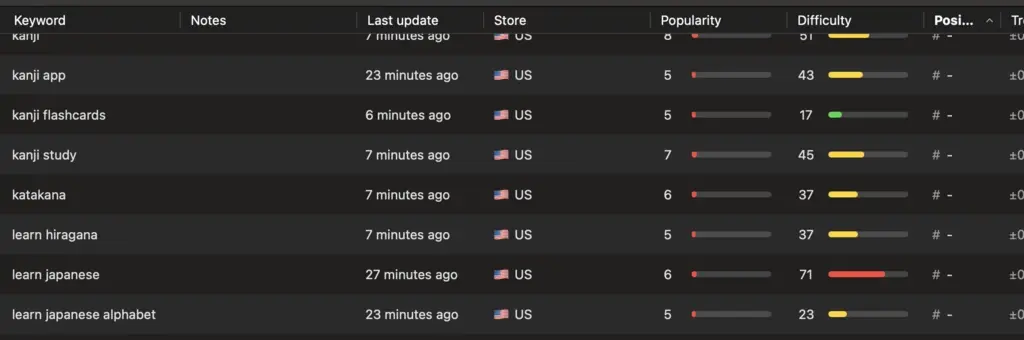
You can also add your own app and check where it ranks for each keyword.
And here's the best part: Astro offers an MCP server, so you can call it through Claude Code and have it find and register promising keywords and run analyses for you!
Incredibly handy. It made me realize how sloppy my ASO had been...
If you want to monetize an app, I think you should give Astro a try.
Unfortunately, the only option is an annual plan at $108 a year. That's roughly the same as the Apple Developer Program fee. At that price, treat it as an investment and just buy it!
The ideal keyword to target is one with high popularity and moderate difficulty.
That said, Sebastian argues that it's better to compete for a valuable keyword, even a hard one, than to rank #1 for an easy keyword with little search volume.
Sure enough, HabitKit goes head-to-head with "habit tracker," one of the most competitive keywords in the category.
I think this depends on the person.
Sebastian competes on a big keyword, while Max, mentioned above, builds lots of apps targeting long-tail keywords (keywords with lower search volume) and monetizes them that way.
Step 3: Put your most important keyword at the front of the app name
HabitKit's name on the App Store is actually "Habit Tracker - HabitKit."
The brand is HabitKit, but the keyword "habit tracker" is far more valuable, so it goes first.
Not many apps are this deliberate about keywords.
My own apps put the brand name first, so I want to test what happens when I move the keyword to the front.
Step 4: Put your second and third keywords in the subtitle
The subtitle gives you another 30 characters, so that's where your secondary keywords go.
HabitKit's subtitle is "Streaks & Accountability."
One thing to watch: don't repeat the same word in the name and subtitle.
Apple treats the two as a single string, so repeating words wastes precious space.
Step 5: Use all 100 characters of the keyword field
App Store Connect has a 100-character keyword field that users never see but Apple reads for search.
Here are the five rules to follow. 👇
Separate keywords with commas, no spaces
Don't repeat words already in your app name or subtitle
If you include the singular, skip the plural
Don't include competitor app names (you risk rejection)
Use as close to all 100 characters as you can
I'd been setting my keywords more or less on instinct, so there's clearly room for me to fix things.
🖼️ Screenshots That Communicate Value Beat Pretty Ones
Next up: App Store screenshots.
ASO rankings almost certainly reflect user behavior data too, such as:
whether users tap on an app when it appears in results
whether they then download it
From Apple's perspective, it would rather rank apps that people actually download than apps that sit at the top and get ignored.
And what drives taps and downloads on that page are your screenshots and reviews.
Let's start with screenshots! He follows three rules.
Rule 1: Put your most impactful feature in the first screenshot
For HabitKit, the first screenshot is that grid-style habit view.
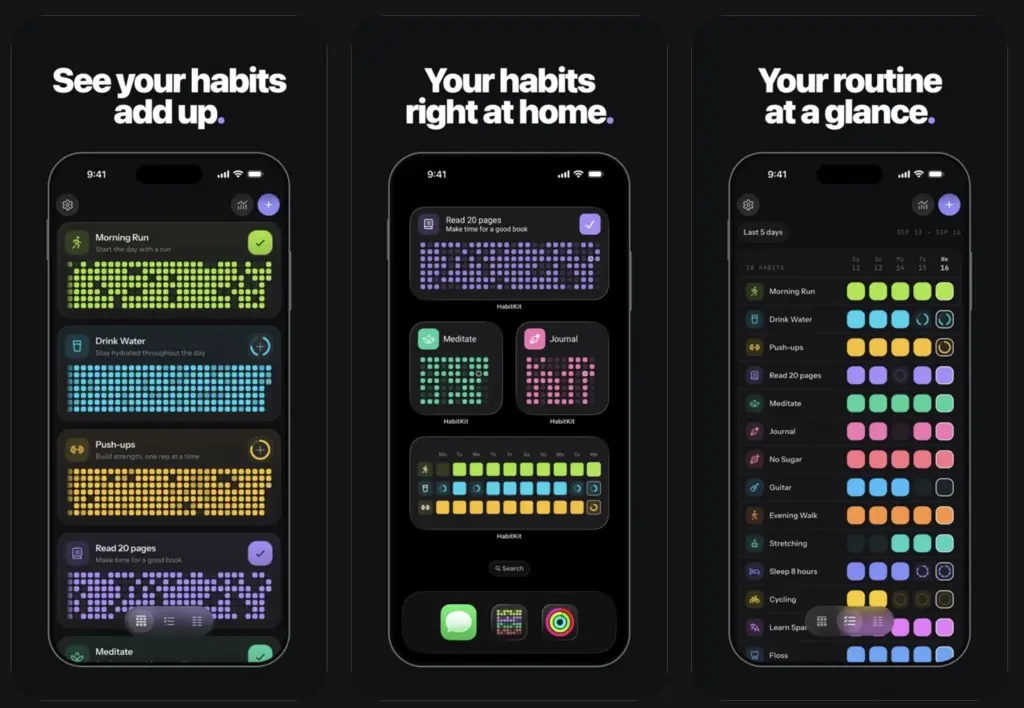
It's unique and colorful, and at a glance you can tell how it differs from other habit apps.
Rule 2: Show the UI simply
Users want to see what they'll actually be using.
Add too many abstract illustrations or photos, and the screenshots might look stylish, but they won't communicate what's inside the app.
Look at HabitKit's screenshots and you'll see they're just the UI with two lines of white value-proposition text on top. Extremely simple.
Rule 3: Always A/B test
Apple has a feature called Product Page Optimization that lets you test multiple versions of your App Store page.
And here's an interesting story.
Sebastian recently hired a designer to create new screenshots for HabitKit, and they looked clearly better than the ones he'd made himself.
He was sure they'd boost conversions.
But when he ran the A/B test, the winner was his old, plain, homemade set.
Don't assume the better-looking version will win. Always test. Sometimes authenticity beats polish.
That one really clicked for me.
Maybe screenshots that are too polished start to look like ads.
Short-form video works the same way. Amateurish videos often go more viral than highly produced ones.
⭐ Ask for Reviews at the "Happy Moment"
Next: reviews.
Reviews matter enormously for ranking at the top in ASO.
HabitKit has collected over 7,400 ratings on iOS (averaging 4.8) and over 10,000 on Google Play (averaging 4.6).
So how did he collect them? Here's what he points to.
1. Timing is everything
Ask for a review at the moment the user is feeling good.
HabitKit shows the review prompt right after a user completes a habit for the first time.
The key, I think, is that it's after the first completion, not when the habit is first set up.
It's easy to imagine that showing the prompt right after users feel that sense of accomplishment boosts the review rate.
Think hard about where the first moment of success is in your own app!
2. Reply to every review
Ever since he started building the app, he's replied to every single review: thanks for the good ones, help for the bad ones.
Some users even update a one-star review to five stars after their problem gets fixed.
Honestly, when a bad review comes in, my first reaction is "Ugh!" and I don't feel like replying at all. But if a thoughtful reply might get the rating raised, it's worth writing one.
Other users comparing apps might also feel reassured when they see those replies.
3. Put the ask in your email signature
HabitKit gets a lot of support emails. Every time he replies, he ends with this line:
"If you're enjoying the app, I'd really appreciate it if you could leave a review."
When you've just gotten thoughtful support from the developer himself, you naturally want to write one.
I think this kind of unglamorous, persistent asking is what really matters.
📣 $100 a Month in Ads... for ASO?
Sebastian also runs just $100 a month in Apple Search Ads.
The goal isn't to acquire users directly from ads. It's to push up his rankings, in the hope that Apple might favor developers who advertise.
Does that actually work?
In SEO, I remember a theory that running Google search ads helps you rank higher, but I suspect any effect there is indirect, coming through behavioral data.
It's possible that showing up at the top via Apple Search Ads, getting users to tap and download, and accumulating that behavioral data could eventually lift your organic ranking.
But I seriously doubt that simply running Apple Search Ads earns you algorithmic preferential treatment.
So if you're nowhere near the top in ASO, running Apple Search Ads to build up user data might be worth a shot.
💰 Raising Prices
Now let's look at pricing, which matters a lot for revenue!
I mentioned earlier that Sebastian's app was originally dirt cheap. It's much more expensive now.
As of June 2024, HabitKit cost $0.99 a month, $6 a year, or $15 for lifetime access.
Now it's roughly $5 a month, $25 a year, and $65 for lifetime access.
That's more than four times the original prices, but honestly, this feels like the right price.
Keeping prices low at first to climb in ASO, then gradually raising them once things stabilize, seems like the right strategy to me.
Interestingly, HabitKit sells quite a lot of lifetime plans.
Unlike many recent apps, HabitKit has no AI features, so it doesn't have to worry about API costs.
That's probably why he can comfortably sell a lifetime plan people can use forever.
For my AI-driven products, I don't offer lifetime plans. But I do offer one for Onbo Hub, which has no built-in AI features. (Onbo Hub does provide an API and a Skill.md file so users can analyze its data with their own AI, but I don't cover those AI costs.)
And in fact, quite a few Onbo Hub users buy the lifetime plan.
It depends on your app, but if your product doesn't have high running costs, offering a lifetime plan is worth considering.
📲 When to Show the Paywall
Another key to profitability is when you show the paywall.
HabitKit is free to use, but it shows the paywall at well-chosen moments to boost revenue.
First, the paywall appears right after onboarding.
The onboarding is a single screen.
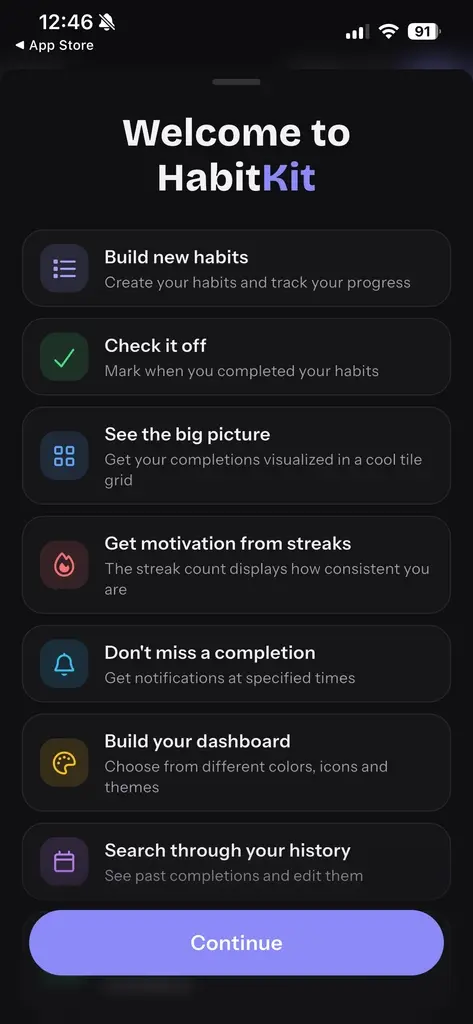
Then the paywall appears.
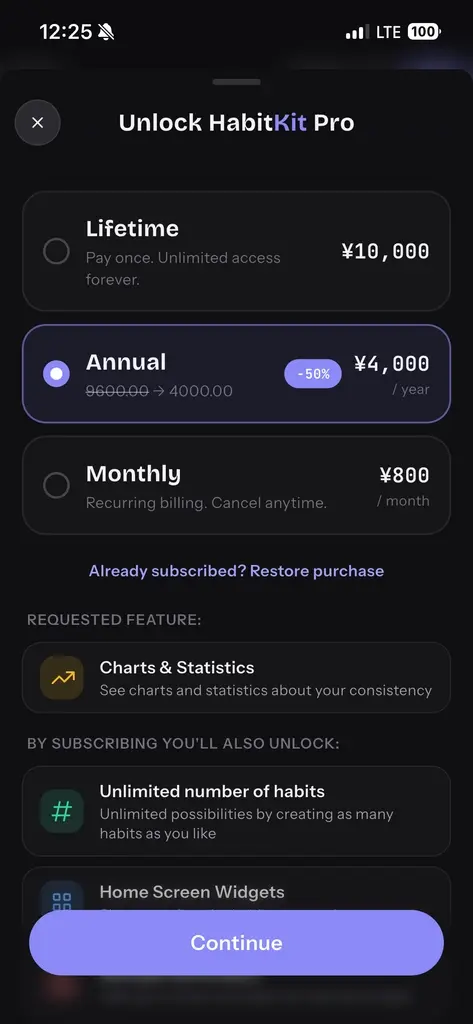
Even with a freemium model, showing the paywall early on may convert some users right away.
Then, as you keep using the free version, the paywall appears at specific moments:
When you try to track more than five habits
When you try to open analytics
When you try to add a widget to your home screen
After an app update
On December 31 and January 1
Without being too pushy, he shows the paywall exactly when it's relevant, and that's how he raises revenue.
📝 Summary
So that's a look at Sebastian Röhl, who took his habit tracker HabitKit past $100K in a single month, almost entirely through ASO.
Ranking at the top through ASO really is a powerful position.
Acquiring users through short-form video forever is exhausting, so I think it's worth building channels like ASO that keep bringing in users without constant effort.
I haven't invested much in ASO myself, so I'm using this as a chance to revisit a lot of things.
Your title, subtitle, and keywords are quick to change and pay off fast, so optimize them first.
I also recently redid my store screenshots, which until now didn't really show what the app does.
Keep ASO in mind and keep improving!
That said, building apps has become dramatically easier, and so many new apps are flooding the stores that ASO is getting more competitive by the day.
In the end, I think the way to win right now is to use other channels like short-form video while patiently growing your ASO alongside them.
It's a blunt conclusion, but do everything you can!!!
Time to get to work!
That's a wrap on Sebastian Röhl.
Thank you for reading all the way through! If anything caught your interest or you have questions, feel free to reply to this email anytime!
And if you mention my X account when you post your thoughts, I'll be absolutely thrilled. I'll always respond!
See you again next Monday!
References
https://sebastianroehl.substack.com/p/2025-the-year-that-changed-everything
https://sebastianroehl.substack.com/p/2024-my-indie-app-business-year-in
https://sebastianroehl.substack.com/p/my-app-store-optimization-strategy
https://sebastianroehl.substack.com/p/from-flutter-to-swiftui-a-case-study
https://sebastianroehl.substack.com/p/building-an-indie-app-business-72
https://sebastianroehl.substack.com/p/building-an-indie-app-business-85
https://sebastianroehl.substack.com/p/building-an-indie-app-business-86
https://sebastianroehl.substack.com/p/building-an-indie-app-business-102
https://sebastianroehl.substack.com/p/building-an-indie-app-business-105
https://sebastianroehl.substack.com/p/building-an-indie-app-business-108
https://sebastianroehl.substack.com/p/building-an-indie-app-business-109
https://sebastianroehl.substack.com/p/building-an-indie-app-business-110
https://sebastianroehl.substack.com/p/building-an-indie-app-business-111
https://www.revenuecat.com/blog/growth/sebastian-rohl-habitkit-launched-podcast-2026
https://apps.apple.com/us/app/habit-tracker-habitkit/id6443918070