The Hidden Secret Behind Coconote: How an AI Tool Hit $6.7M ARR in Just 18 Months
Acquired by flashcard giant Quizlet just 18 months after launch. ARR of $6.7M. Profit margin around 50%. Over 1 billion cumulative views across social media.
August 31, 2026
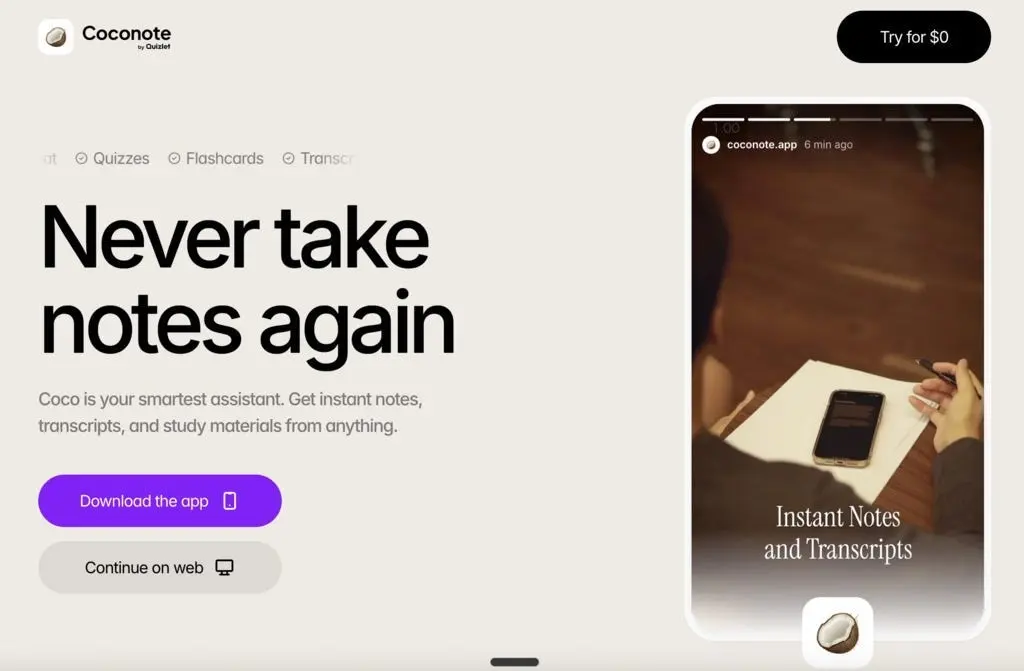
Today’s feature: Zack Hargett and Brett Bauman!


What they built is an AI note-taking app called Coconote.
Just record or import a lecture or YouTube video, and it automatically generates a transcript, summary, flashcards, quizzes, and even a mind map — a tool built for students.
Hearing only that, you might think, “Ah, just another one of those AI wrapper tools.” But the numbers are insane.
Acquired by flashcard giant Quizlet just 18 months after launch
ARR of $6.7M
Profit margin around 50%
Over 1 billion cumulative views across social media
Zero outside funding, and almost zero paid ads
Completely bootstrapped, barely any ad spend, and they took it this far and sold it in under two years. Absolutely incredible.
So today, let’s take a deep dive into how these two built a product doing $6.7M a year from scratch in 18 months — and carried it all the way to an exit. We’ll break down the full story and the marketing strategy behind it!
👨💻 Zack Hargett’s background: a career built in startup country
First, you can’t talk about Coconote without covering the co-founders’ backgrounds.
Zack Hargett is a guy who has consistently worked in and around product management at hypergrowth startups.
Right after college, he joined the fast-growing startup “YikYak.” YikYak was a location-based anonymous social app that exploded in popularity on US college campuses at the time. It had so much momentum that it raised a Series B of around $64M from Sequoia Capital. Zack joined as a product manager and experienced the inner workings of a product growing explosively.
After YikYak, he joined the video communication tool “Loom” as its 9th employee. Loom, of course, went on to be acquired for a massive sum — a famous product.
With that résumé, Zack built Coconote out of his own personal pain point.
Originally, it was something he made to scratch his own itch: he found it a hassle to compress all the information he was bombarded with — YouTube links, long articles, lecture materials, meeting notes — and actually get it into his head.
A tool built to solve your own problem ends up becoming a product that saves millions of students. This pattern really is incredibly common.
🛠️ The other genius: indie developer Brett Bauman
And the other co-founder is Brett Bauman.
He’s also a Loom alum, where he climbed all the way to principal engineer — seriously talented. At the same time, he’s a hardcore solo developer too. He’s built a ton of products on his own:
A golf app, “TeeTimer”
An AI playlist-generation app, “PlaylistAI”
An open-source note-taking tool, “Notepad”

On top of that, he even runs a site to help students find software development internships — a developer through and through.
These two hit it off at Loom, and what they built together is Coconote.
📱 The product philosophy: “Never take notes again”
Now, let’s get to the heart of it — the product itself, Coconote!
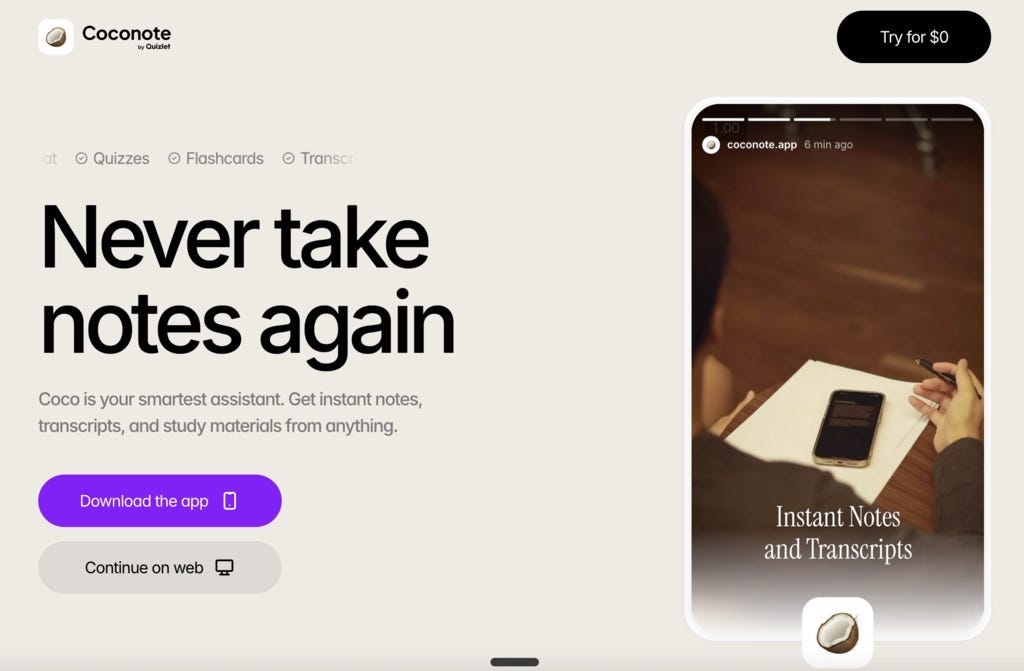
Coconote’s tagline is striking:
“Never take notes again.”
Products that take off have a powerful tagline. The genius “Roy Lee” I featured before also led with a fierce tagline for his product — “Cheat on everything” — and grew it at breakneck speed.
Now, using Coconote is simple. Feed it recorded audio, documents like PDFs, or links such as YouTube videos, and it extracts the information and outputs it in all kinds of formats.
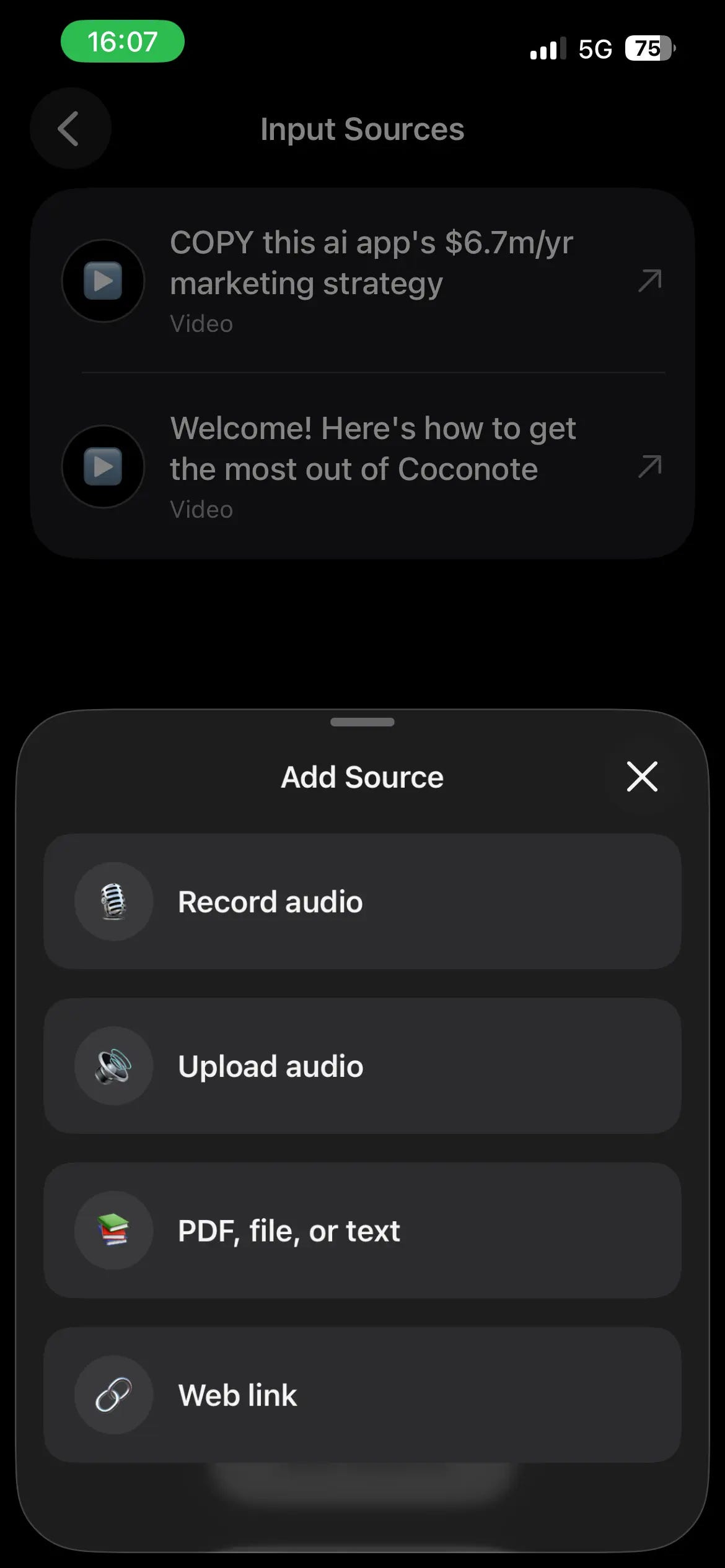
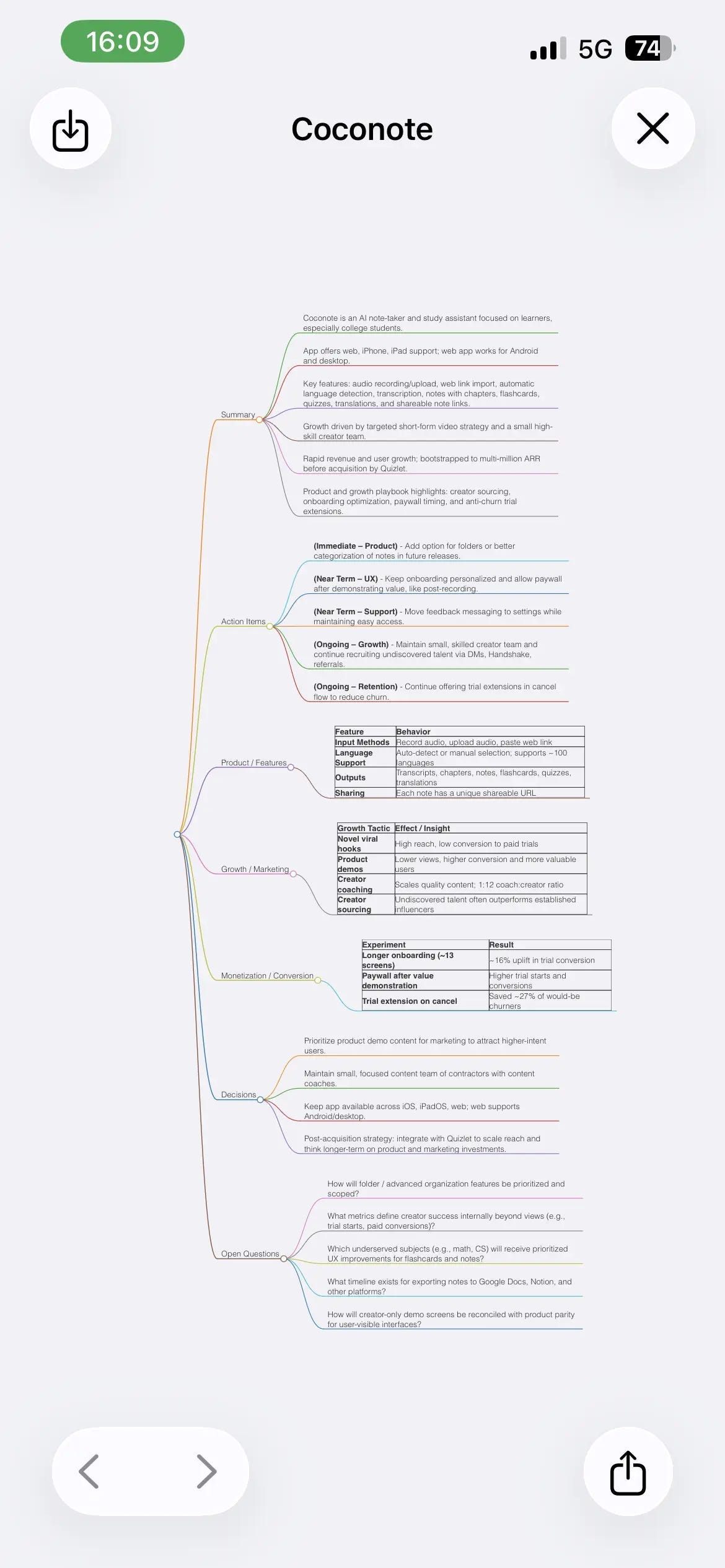
It doesn’t just summarize and organize the information — it generates quizzes, flashcards, podcasts, mind maps, and more, all in one go!
Jungle, which I featured before, was flashcard-focused, but Coconote generates everything — flashcards included — all at once.
This app especially resonated with students. Why? Because all they have to do is hit the record button during class, and the AI handles everything.
When the recording ends, Coconote gives you a complete transcript plus personalized study materials made just for you (flashcards, podcasts, mind maps, and so on), all generated at once.
This lets students focus on what the professor in front of them is actually saying, instead of frantically copying down notes.
Here, Zack draws a clear line. The world is flooded with AI tools that’ll write your essay, solve your math homework, even write your college application essay for you. But in his words, a lot of those are just “cheating tools.”
“We want to be on the right side of AI history. We want to help students actually learn.”
It might sound like a bit of a rationalization, but it’s true that this does set it apart from the countless AI cheating tools out there. Coconote isn’t an AI tool for easily spitting out answers — it’s an AI tool for making the learning experience thoroughly better.
📲 Onboarding designed to maximize CVR
I say this every time, but an app’s success or failure hinges on how thoroughly you’ve polished the onboarding.
So once again, I went through Coconote’s entire onboarding and analyzed it. And I spotted some interesting design choices you don’t see in other apps.
First, like other top-selling apps, it opens with a long string of questions 👇
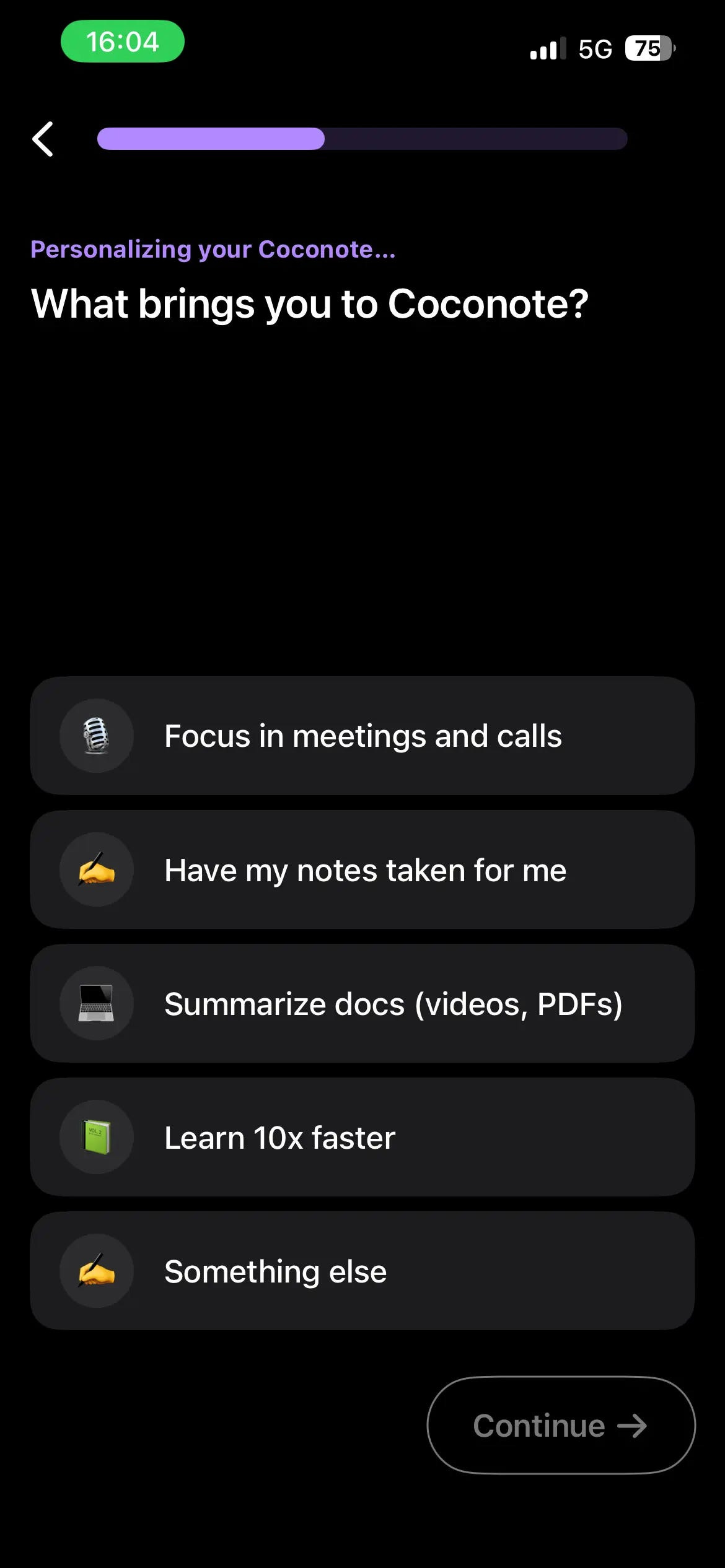
Actually, they initially set the number of questions low, but at some point they doubled it.
You’d worry that too many onboarding screens would increase drop-off — but the result was a 16% increase in trial starts. By inserting questions like “What are you studying?” and personalizing the experience, they make users feel “this app was built just for me,” delivering the value before users even enter.
By deliberately adding friction, they actually increased the share of highly motivated users.
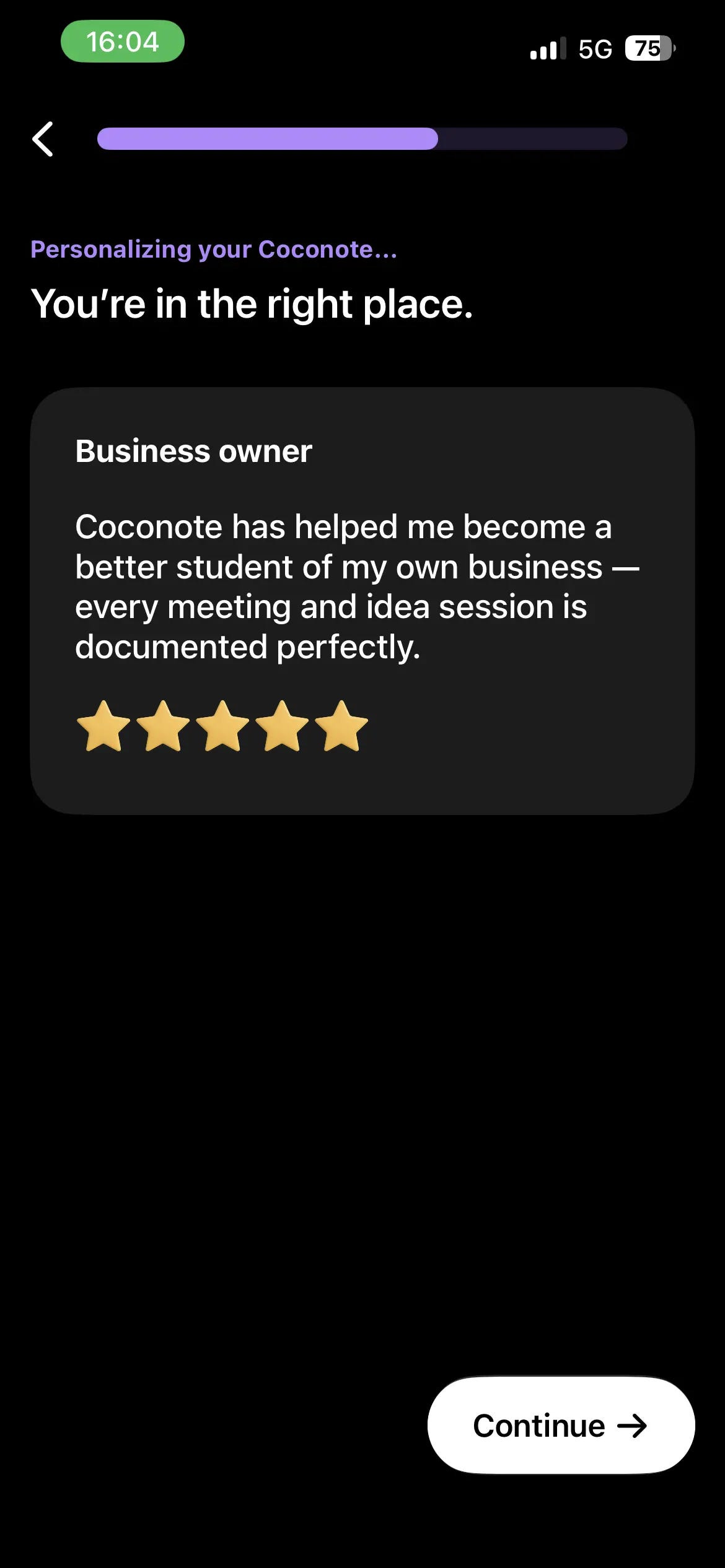
That said, the personalization screen below isn’t all that flashy. I feel there’s still a bit of room for improvement here 👇
And here’s the interesting part: the paywall design.
They tested the paywall’s position, UI, and design relentlessly. The winning pattern they found was to show the paywall before account creation.

This let them retain roughly 10% of users who had been dropping off for the reason “I don’t want to create an account before I’ve seen the product’s value.”
And what’s even more interesting is the “cancellation-prevention” technique. The moment a user tries to cancel their trial, they’re presented with an offer. That offer is a “7-day free trial extension.” Since the trial is 7 days free to begin with, that’s a total of 14 days free being offered 👇
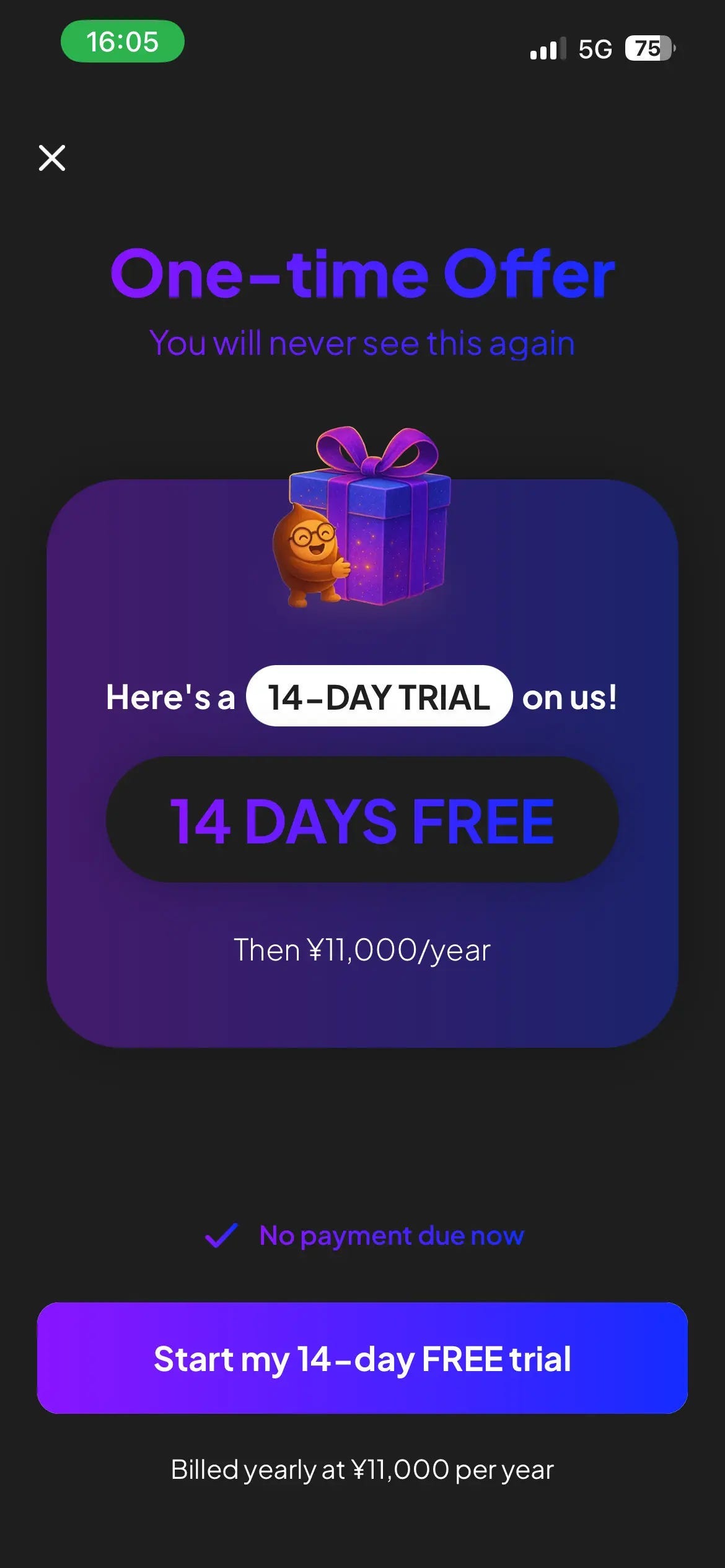
This is incredibly clever. Normally, when you try to stop a cancellation, you reach for a discount. Across the apps I’ve featured in this Blog, most have offered discounts. None offered a trial extension.
But after trying all sorts of things and looking at the data, they concluded that this trial extension was the optimal move. Fascinating.
Honestly, I think a discount offer is more forceful and would lift CVR more. But that also lowers your average revenue per user. So when you look at it through the lens of LTV, there’s a very real chance the trial-extension offer is more effective.
By the way, this tactic succeeded in retaining about 27% of users who were trying to cancel.
Don’t “lower the price” — “give them time.” A time-extension offer isn’t the right move for every app, but I think it’s worth testing.
And here’s the kicker: users who close even this extension offer get sent to the login screen. And once they log in, they can just… use Coconote for free!
Halo AI, which I featured last week, had a similar design. Disguising it as a hard paywall when in fact you can use a little of it for free if you cancel seems like a seriously effective technique.
By the way, after getting past the paywall you can use up to 2 resources for free, but the design shows the paywall when you try to add a 3rd resource. The onboarding and paywall are thoroughly thought to maximize LTV. Impressive as always.
And as usual, you can check out every screen of Coconote’s onboarding on Onbo Hub below, so please go take a look!
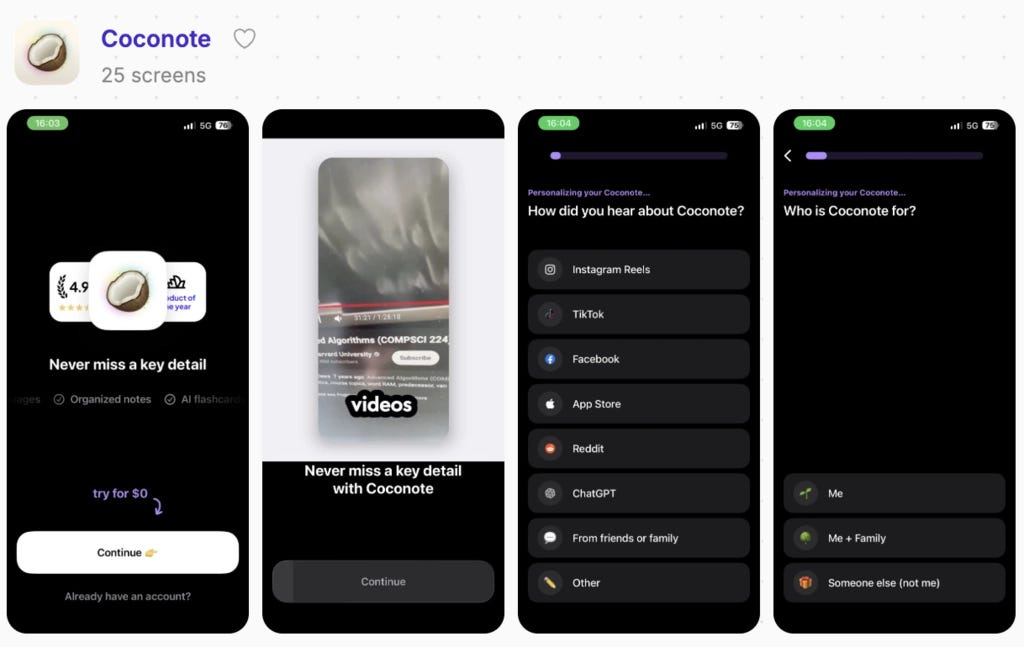
https://onbo-hub.com/apps/coconote
So, from here, let’s look at how Coconote grew to $6.7M a year in 18 months! Zero VC money. Almost zero ad spend. And still, $6.7M a year within 18 months of launch. A brutal growth rate.
Behind these numbers, there’s a genuinely repeatable growth playbook. Let’s get into it!
Specifically, I’ll cover:
The “YouTube × SEO” auto-mass-production machine that drove 400K monthly visits with zero ad spend
The two genius techniques baked into a short video that pulled 10M+ views
The insane tool they built purely to go viral, and how it generated 40M views
The magic pricing that grew both users and revenue at the same time
And at the end, I’ve summarized how we can put this case to work for ourselves. I research all kinds of cases every time, and they’re all instructive — but this one was packed with even more techniques worth borrowing than usual. There are tons of techniques you could bring into your own app right away. Please read all the way to the end!
🔍 Mass-producing SEO content from YouTube sources
OK, so the product is good. The question is “how did they get it in front of users?” In the end, this is the make-or-break hurdle for every app founder. Their growth strategy is genuinely impressive, so don’t miss this.
The first pillar is the “YouTube × SEO” machine. Coconote automatically transcribed and summarized hundreds of thousands of YouTube videos and mass-generated them as pages on its own site.
This made it possible to pull in huge amounts of traffic on long-tail keywords. For example, when someone searches for a super long-tail keyword like “summary of [famous YouTuber]’s video,” a Coconote page shows up. For every niche search intent out there, a Coconote page becomes the catch-all.
The result: over 400K visits per month from Google alone. With zero ad spend, they built a state where organic search traffic just pours in.
And on top of that, those users already have the intent of “I want to easily read a summary of a YouTube video” — a dead-center bullseye for Coconote’s target. That makes funneling them into Coconote smooth too.
🏫 Going viral with short videos showing Coconote being used in class
Next up, the key piece — as always — is short video.
First, they took the obvious route and aimed for virality with short videos of Coconote being used during class. As they put it: “If the product itself has powerful novelty, you can go viral early on just by putting out the classic hook + demo video.”
I’ve mentioned this many times in this Blog, but products that are genuinely unique are easy to make go viral. The experience of just recording with Coconote and having it instantly turned into a summary, flashcards, and a mind map is exactly that — unique. It’s a genuinely jaw-dropping experience.
Sure enough, the videos went massively viral. Take the one below.
This video got 16M views and 340K likes. A brutal growth record.
Dropping a powerful hook text over an ordinary classroom scene and then funneling into an app demo is the royal-road pattern. Student-focused apps mostly grow like crazy with this format.
Now, this wildly viral video has two genuinely unique points. Did you catch them?
Appeal to the decision-maker who actually pays
The first is that the hook text reads “my mom just changed my college life forever.” Can you see why?
Because even when the user is a student, the person making the payment decision is often the mother. For college students it’s one thing, but for middle and high schoolers, paying $20 a month for an app is a tough sell.
So they dropped in the word “Mom” to directly approach the target who actually pays. It also makes it easier for a student who sees it to go beg their mom, “Buy it for meee.”
As they put it: “What matters is identifying who the true buyer is, and who has the strongest intent to purchase.” This is marketing that cuts straight into consumer insight!
Build a separate UI that performs in short videos, distinct from everyday use
There’s one more technique hidden here — small, but genius. It’s the “creator-only screen”!
Watch the video and you’ll see a mesmerizing “rainbow” wave screen that you can’t help staring at. But here’s the thing: that screen doesn’t actually exist in the real app’s UI!
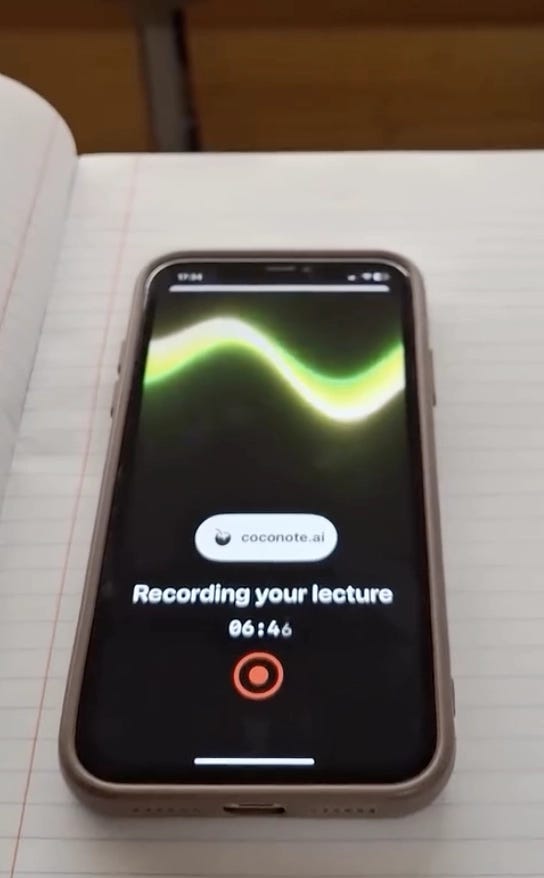
Why build something like that? The answer is “camera appeal.” They deliberately prepared a video-only visual effect for one purpose: to create a “whoa, what is this?!” wow moment in the video and pull the trigger on a download.
Separate from practical utility, they intentionally design a “look built to go viral.” Man — they’ll go that far? Impressive.
In the Halo AI case I featured last week, they also designed the app’s UI so the app’s logo and name appear large on screen 👇

 Onbo Hub
18 Months of Failure, a $100K Loan, and a Bet That Took an AI Photo App to $300K/Month in Just 2 Months
After 18 straight months of failure, he bet everything on a single viral TikTok format. The result: $300K in monthly revenue within 2 months. It's a genuinely insane growth story.
Onbo Hub
18 Months of Failure, a $100K Loan, and a Bet That Took an AI Photo App to $300K/Month in Just 2 Months
After 18 straight months of failure, he bet everything on a single viral TikTok format. The result: $300K in monthly revenue within 2 months. It's a genuinely insane growth story.
What matters is thoroughly thinking through the path from short-video virality to conversion, and then meticulously building the features and design to serve that path!
🎬 Going viral with absurd content: “turn a PDF into a brain-melting video”
So, while explosively growing the app with the short videos above, they ran an interesting experiment. It was building a little tool purely to go viral, and using it to funnel users in.
With this thinking, what they built was “a tool that takes a document like a PDF and converts it into a short video where the text is overlaid on Minecraft gameplay footage.”
The video introducing this tool got a staggering 30M views, with over 2M likes 👇
An astonishing number.
So they built a tool that converts dense, complicated text into brainrot videos purely to go viral, and posted videos depicting the process in a funny, entertaining way.
The one below uses the same format 👇
It shows a woman, frustrated that a guy won’t read the long text she sent, turning it into a brainrot video and sending that instead. This got over 40M views. In the end, videos originating from this tool apparently racked up hundreds of millions of cumulative views. Genuinely incredible.
That said, they note that going viral this way still produced low CVR. Even so, as a top-of-funnel awareness play, it served the role of making an absurd number of people aware that Coconote exists.
Building a hook tool purely to go viral — again, I thought, “they’ll really go that far?” Doing all of this with no VC money, fully bootstrapped, barely running ads, and actually going viral over and over — that’s impressive. Truly impressive.
This isn’t the time to just sit and admire it, but it really is impressive. I’ve got to do it too. And whoever you are reading this — I want you to think through your features, tools, and design from a virality-first standpoint, just like they did.
🧑🤝🧑 How they recruited creators
We’ve looked at their viral-video know-how, but what underpins all of it is the group of creators producing the content. The founders sought out promising creators and signed them to contractor agreements. Their recruiting criteria and methods are interesting, so let’s get into them.
First, they don’t go after influencers who already have clout. What they target are undiscovered diamonds in the rough — creators with around 5,000 to 10,000 followers and high engagement on their videos.
They also say users who list a “personal email address” in their bio are the ones to target. If a creator’s contact email looks like “@sunsetagency.com” — anything with even a whiff of “agency” to it — they say you shouldn’t reach out. If they’re already signed with an agency, the agency takes almost all the margin. Find the ones who aren’t with an agency — the diamonds in the rough, before they’ve blown up!
Zack also tells an interesting recruiting story. One of their top creators was actually a Spanish teacher he found through online lessons. One day, while Zack was studying Spanish on an online lesson service, he met a really charismatic teacher. Her gestures and body language were packed with exactly the elements that go viral in content marketing. He recruited her on the spot. In the end, she became a top creator.
Recruiting opportunities are lying around everywhere. I’m currently building a multilingual learning app myself, and I thought Zack’s approach is really effective for recruiting creators for this kind of app. Using online 1-on-1 lesson services to learn from a variety of teachers, and recruiting the good ones when you find them, is a seriously smart move.
💸 Raise the price, and lift both CVR and revenue!
They also share some thought-provoking insight on pricing.
They first released the app at “$99 a year, $19.99 a month.” That’s a pretty high price compared to similar apps, but they deliberately competed at a higher price band to signal credibility.
As it turned out, even at the higher price it sold just fine, with roughly 80% of users buying the annual plan. I can confirm this myself — having launched on iOS at the end of March, the annual plan sells like crazy. The share of annual-plan purchases on iOS is far higher than when I was running on the web.
Now, here’s where their story gets interesting. From there, as one of their early experiments, they ran a test raising the annual price to “$129.” And strangely, a magical phenomenon occurred: “user count went up, and revenue went up at the same time.”
Bold pricing really does matter. Most founders and developers underestimate the value of their own product and get their pricing wrong. I myself had been running the web version of an app I’m growing overseas at $5/month, but I launched the iOS version at $12.99. I thought it might be a bit too high, but it sells just fine. And recently I raised the web version to $9.99.
Price boldly! Raise it with confidence!
🎯 Ads didn’t work
By the way, they say they barely ran any ads on the way to $6.7M a year. Super interesting.
They had videos growing organically, and figured, “OK, let’s just run those exact videos behind paid ads!” But surprisingly, just because something grows organically doesn’t mean it performs as an ad.
After that, just to test it, they handed their best-performing organic video assets to an ad agency to rework for ads. Performance improved considerably — but the ROI still didn’t pencil out. From this experience, they learned that just because something grows organically doesn’t mean running it as an ad will work.
I’ve recently been running ads with short videos that perform well organically too, and they just don’t convert. I’m feeling it in my bones: a good organic video doesn’t necessarily work as an ad.
That said, Desmond and Mau, both of whom I featured before, grew their apps explosively with ads — so depending on how you do it, growing with ads is absolutely possible.
In any case, they grew the app explosively through organic acquisition rather than ads. As a result, they crossed $100K ARR within 45 days of launch, broke $1M ARR within 4 months, reached roughly $2M ARR within 5 months, and hit $5M a year later. An abnormal growth rate.
🤝 The sale to Quizlet
And now, the climax of this story.
Just 18 months after launch, having reached $6.7M ARR, they decided to sell to the long-established learning platform “Quizlet.”
Quizlet is a flashcard giant — it’s private, but its revenue is estimated at roughly $130M a year. They succeeded in selling to a major player like that.
Because this AI era is so volatile, there’s a chance for newcomers to grow an app explosively all at once. But on the flip side, there’s also a chance the market gets taken from you all at once. In this era, I came to think a strategy like theirs — grow fast, then sell it all off — might genuinely be a viable play.
💰️ So how will we put this success story to work?
Finally, let me ramble through how we should put this success story to work — doubling as a wrap-up of this case.
First, the product Coconote crams in basically everything AI can do, all at once. It’s not flashcard-focused, not recording-transcription-focused, not summary-focused. It’s a “we threw in everything” app that takes any input — recordings, website links, documents — and outputs anything: flashcards, summaries, mind maps, you name it.
Intuitively, the features feel “too much,” and I thought it might rack up enormous API costs while not really resonating. But this “it can do anything” quality — whether or not users actually use it all — makes it easy to produce a “whoa, amazing!” moment in short videos. In this era, what matters is how well you can stop someone’s scroll in a short video. In that sense, you could call Coconote the ultimate app. As a result, as a do-everything app, it went viral over and over in short videos.
They built multiple tools purely to go viral. They also built a creator-only screen just to go viral. Brutal. Thinking about the product and features from a virality-first standpoint is just too strong. In the era ahead, you don’t make something and then think about going viral. You have to build from virality first.
Also, quietly, summarizing YouTube sources into articles and pulling in tons of traffic via long-tail SEO is too strong. SEO is said to be fading, but it’s still powerful. Unlike short video, the strength is that it keeps acquiring users continuously. And they don’t just acquire — they thoroughly run experiments to lift CVR too.
So, what can we learn from this case?
First, anyone building an app from here on should think virality-first. If you already have an app, it’s also worth thinking up and adding a viral feature, or building video-only visuals.
Also, in terms of raising LTV, I felt you should experiment relentlessly with the paywall’s position, the way it’s presented, and the price. If you already have an app, I think it’s worth trying the elements from this case:
Move the paywall before login
A soft paywall disguised as a hard paywall
A trial extension when someone cancels
Boldly raising your price
I myself am testing this stuff day in and day out, going back and forth. Let’s keep experimenting!
References
https://www.revenuecat.com/blog/growth/brett-zack-coconote-sub-club-podcast-2026/
https://hypepotamus.com/companies/b2c/coconote-ai-study-app-atlanta/
https://thegrowthhackinglab.com/case-studies/coconote-300k-revenue-30k-downloads/
https://stormy.ai/blog/reverse-engineering-virality-spytok-coconote-strategy