This AI Study App Hit $12.9M ARR in 3 Years by Making Influencers Start From Zero Followers
Eight million users, $12.9M ARR, and a growth engine built on brand-new, zero-follower influencer accounts — inside StudyFetch's three-year run, plus the 10x infrastructure cut and B2B pivot behind it.
September 8, 2026
Today's subject: StudyFetch, an AI study app.
In three years, it's grown to roughly 8 million users and crossed $12.9M in ARR.
Its founders, Esan Durrani and Ryan Trattner, were just named to Forbes' 30 Under 30 list in education.
This time I want to focus less on the founders and more on the product itself — and on the marketing engine behind it, which includes one move I haven't seen documented anywhere else.
StudyFetch went through a fairly recent rebrand, and the UI/UX is genuinely polished. The go-to-market is just as sharp, and in one specific way, unusually original.
Worth noting: they bootstrapped the company for the first 18 months before raising outside funding in 2025. Right now, this app is on an absolute tear.
I think education x AI is an enormous space. I've spent years building education products myself, and the app I'm currently growing for an overseas audience is also in the education space — Japanese-language learning — so AI-powered education apps are something I follow closely.
Let's get into how StudyFetch actually grew.
📒 It Started as an Essay-Grading Tool
StudyFetch was founded by two people: Esan Durrani and Ryan Trattner. Childhood friends from Los Angeles. Esan is CEO, Ryan is CTO.
Before StudyFetch, the two of them were actually running a different tool — one that used AI to grade and generate essay reports for students. Same broad territory as StudyFetch today (education), but a completely different use case.
By their own account, that essay tool was doing reasonably well.
And that's exactly when they made a big call: they shut the essay tool down and pivoted the whole company into a study platform instead.
Their logic was straightforward. A tool that writes a student's essay for them is one bad framing away from just being a cheating tool. They wanted to actually contribute to education, not build a shortcut around it.
I've covered an app before called Coconote, which is fairly similar to StudyFetch in concept — it turns recorded lectures and class documents into study material via AI. Coconote's founders said almost exactly the same thing: they wanted to build something that helps students learn, not something that helps them cheat.
On the other side of that line, there are products that have grown fast by leaning directly into the cheating use case. Tools like NaturalWrite and ConchAI, for example, take AI-generated text and rewrite it to read as human-written — explicitly built to get past AI detectors. Those apps are also growing extremely quickly.
Personally, I don't think these "cheat" tools are inherently bad. AI is going to fundamentally reshape education, full stop. If an assignment can be entirely solved by a tool like this, that probably says more about the assignment than about the student using the tool.
Nobody gets to say "using AI is cheating" once they're actually out in the working world. So I think students should be using AI as much as possible, right now, while they're still in school.
Which means the burden falls on educational institutions — they need to rethink how they design coursework and assignments under the assumption that AI use is the default, not the exception.
📚 The Launch
So, pivoting away from the cheating-adjacent tool and rebuilding from scratch, StudyFetch officially launched on September 15, 2023.
It's available across three platforms: web, iOS, and Android.
Since it started out as a web-first product, there's likely still a substantial share of users on the web version specifically.
Let's take a quick look at what the product actually does.
First, the design: it's polished, with a color palette that honestly reminds me of Claude's interface.
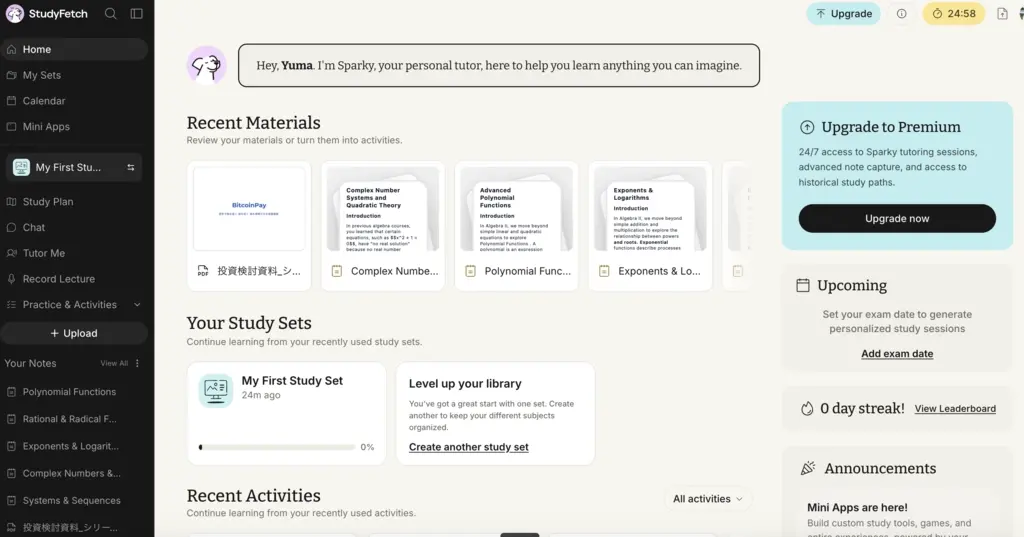
They've been investing heavily in their branding lately, and shipped a full redesign in August 2026.
Functionally, you upload a document or paste in a link, and the app generates various forms of study content based on that material.
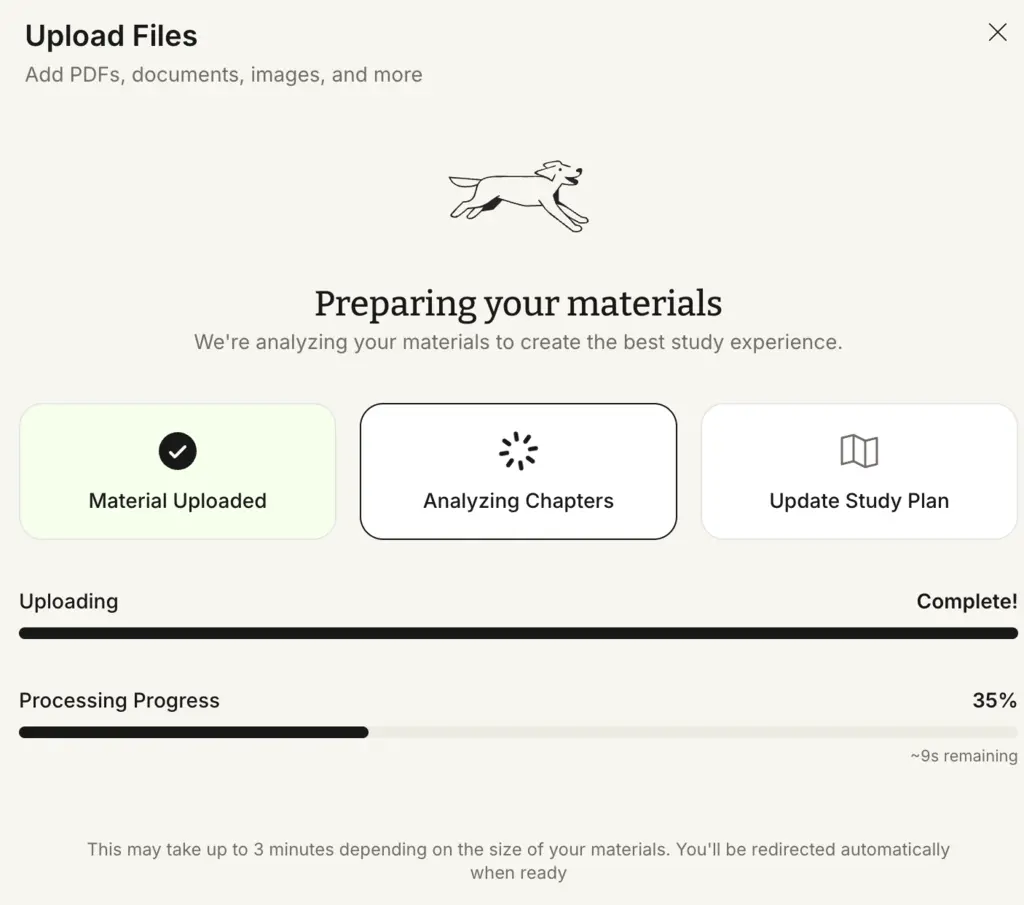
There are several different formats for how that learning content gets presented.
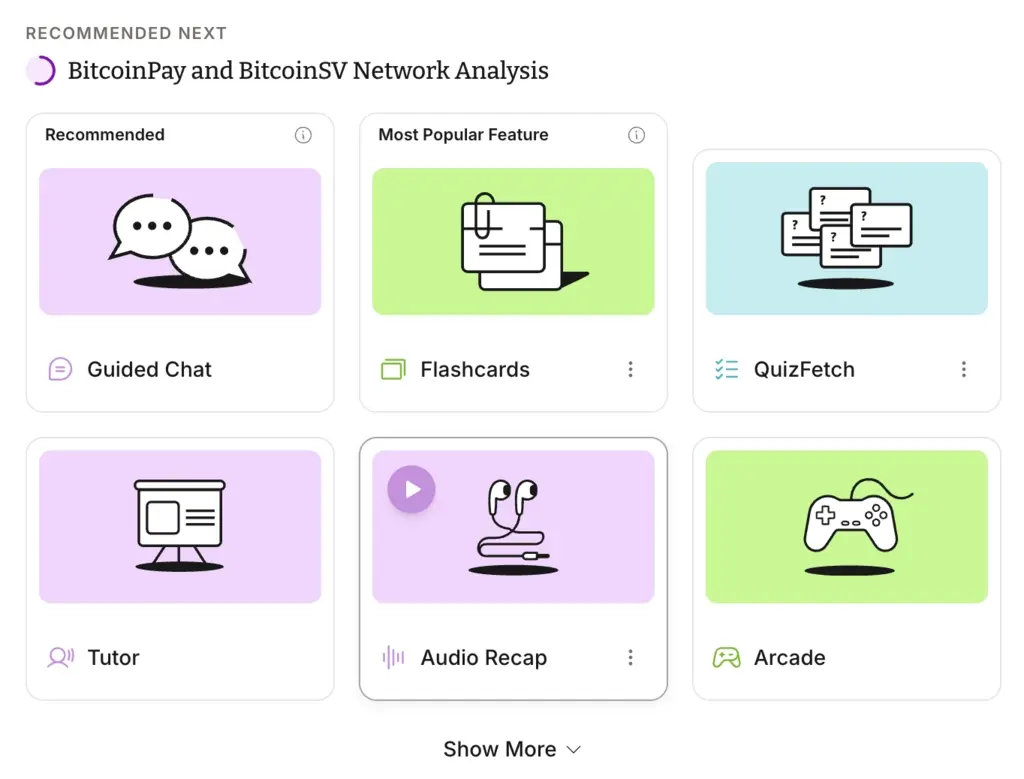
There's also a game-based study mode.
Usage is free up to a certain point, after which payment is required.
Pricing comes in two tiers: $19/month or $96/year.
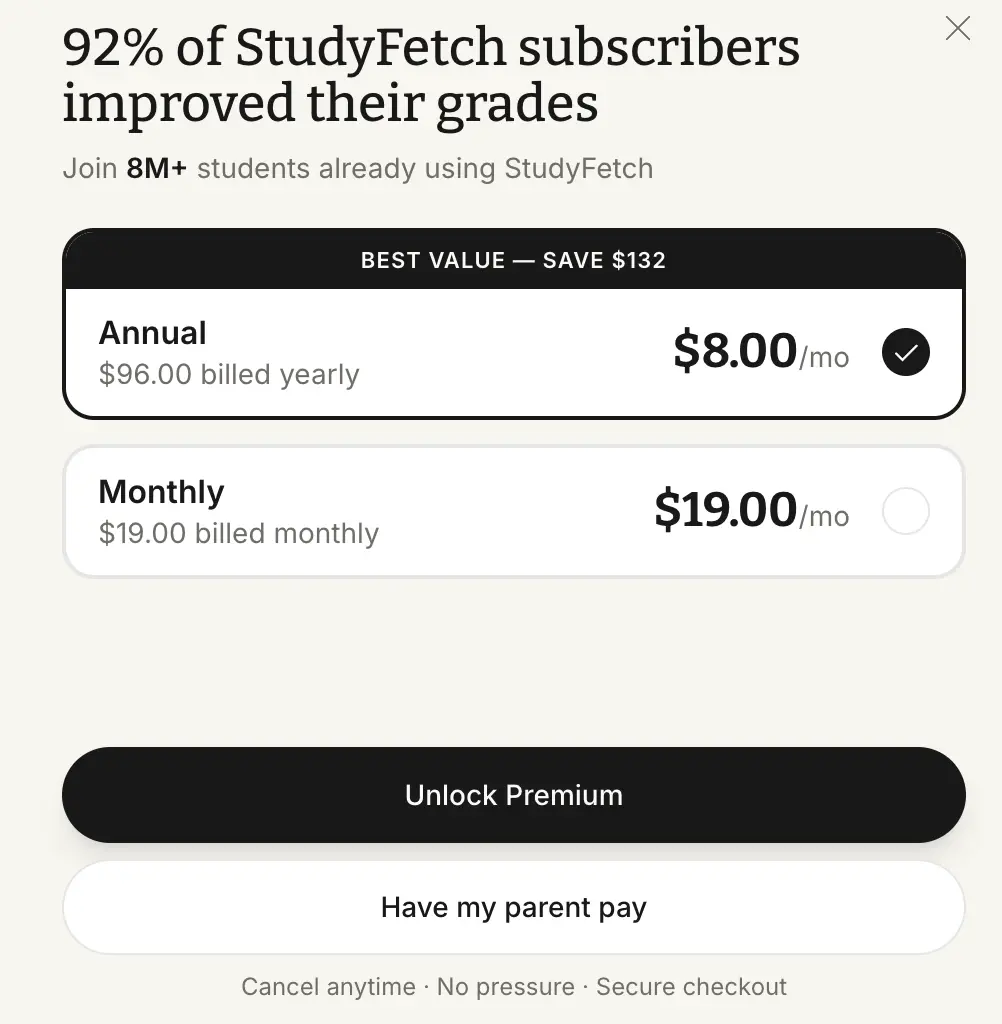
One detail I found genuinely interesting: there's a button on the paywall that says "Have my parent pay."
Since the target audience is students, this use case — getting a parent to cover the bill — is presumably common enough to be worth a dedicated button.
Tapping it surfaces a flow for sharing the payment request with a parent.
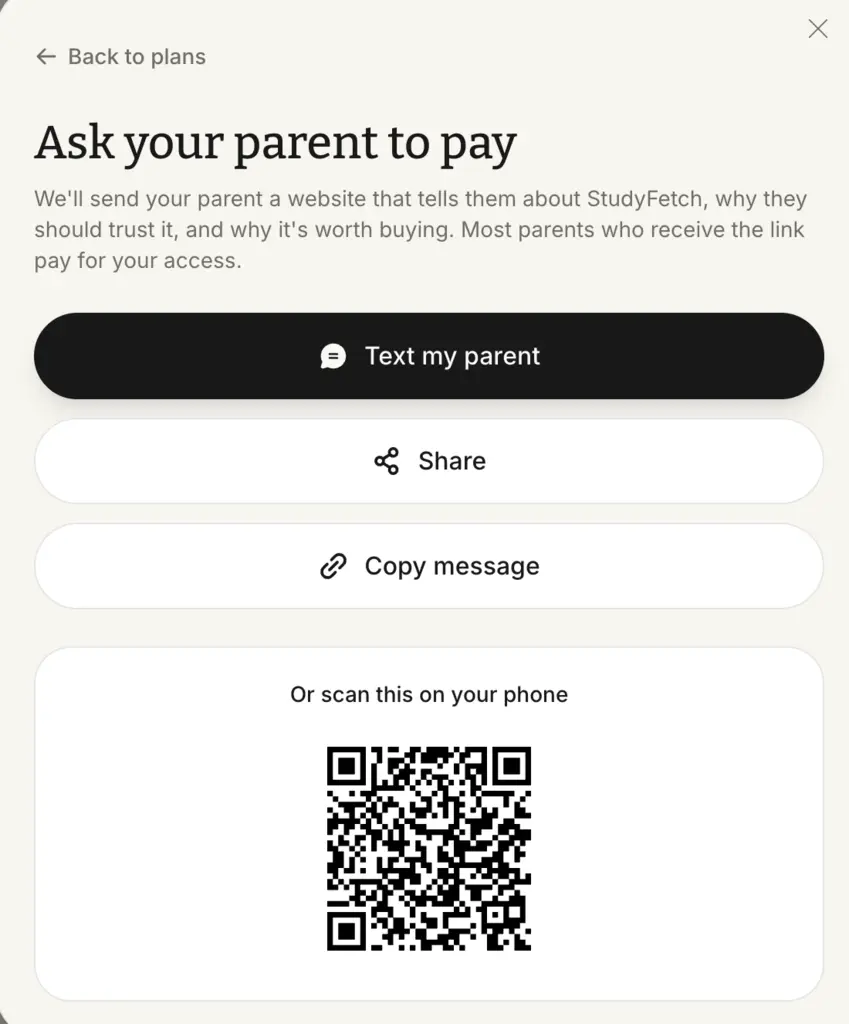
That's almost certainly nudging the conversion rate up by a meaningful margin. Smart.
Another feature I personally found useful as a reference point: Study Timer.
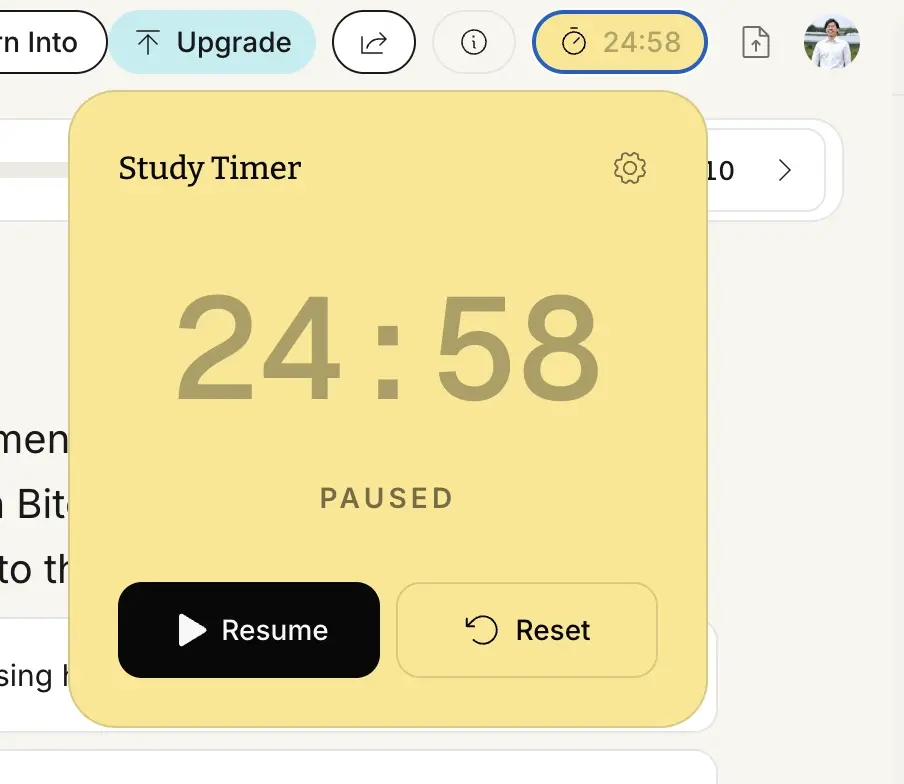
You can set your own timer and track study sessions with it.
There's also a built-in Pomodoro mode — alternating between focused study blocks and short breaks.
And the app keeps a running record of total study time, so you can see cumulative stats over time.
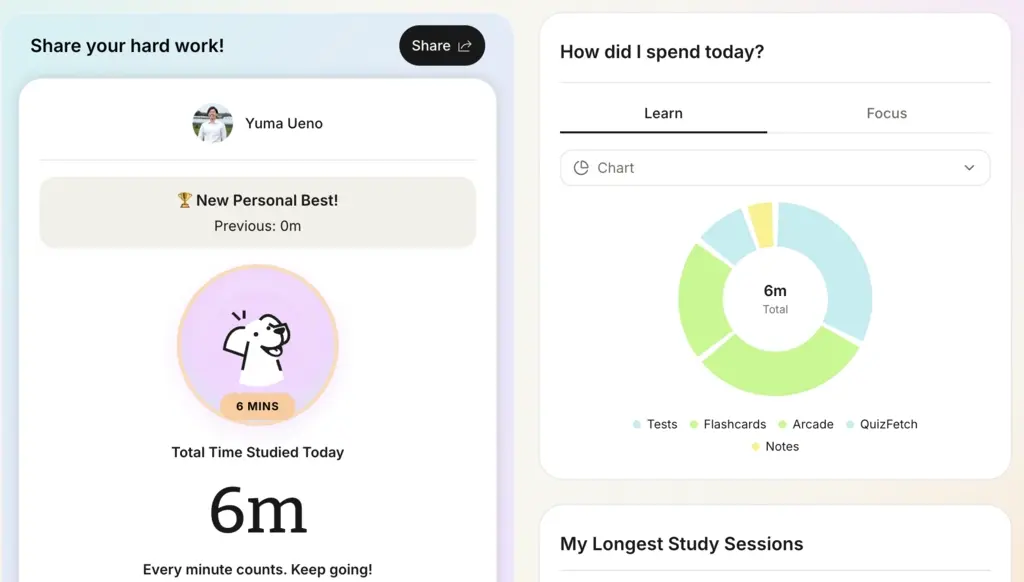
For an education product, "time spent studying" is exactly the kind of metric that should be tracked — and it's something my own Japanese-learning app doesn't track at all right now. I need to add it.
The app also supports a large number of languages, letting you pick from a long list.
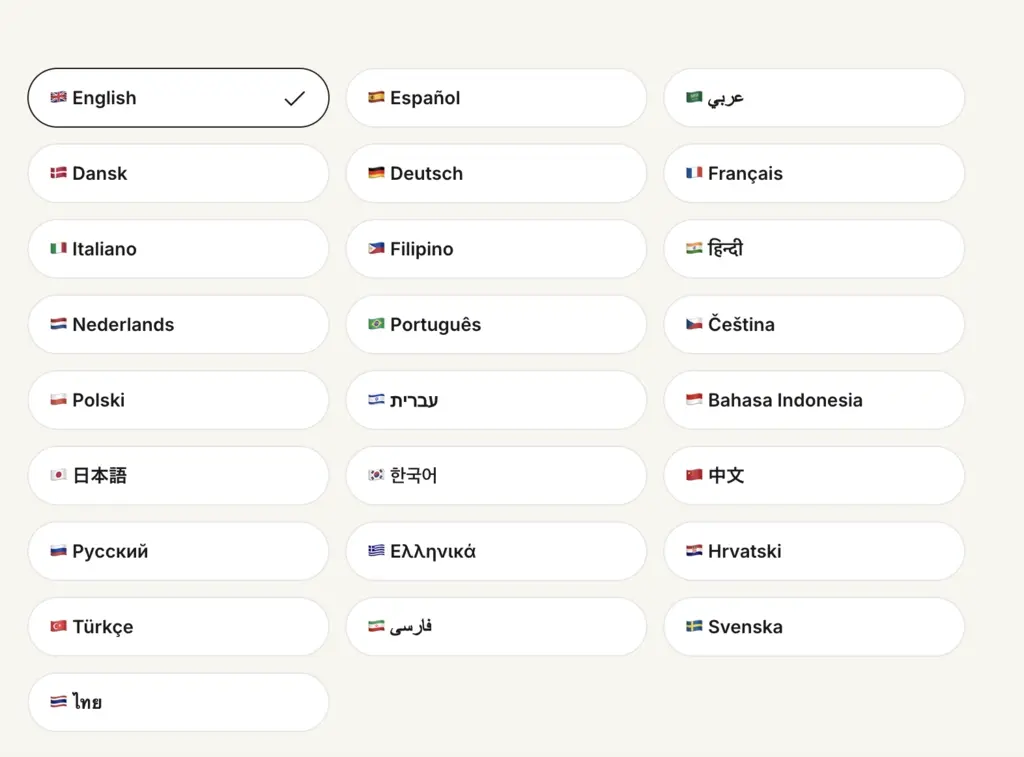
Supporting 25 languages is genuinely impressive. These days, AI has made multi-language support relatively cheap to implement, so if it's feasible, it's worth doing.
🚪 The Onboarding
Next, let's look at the onboarding flow — something I cover in basically every issue of this series.
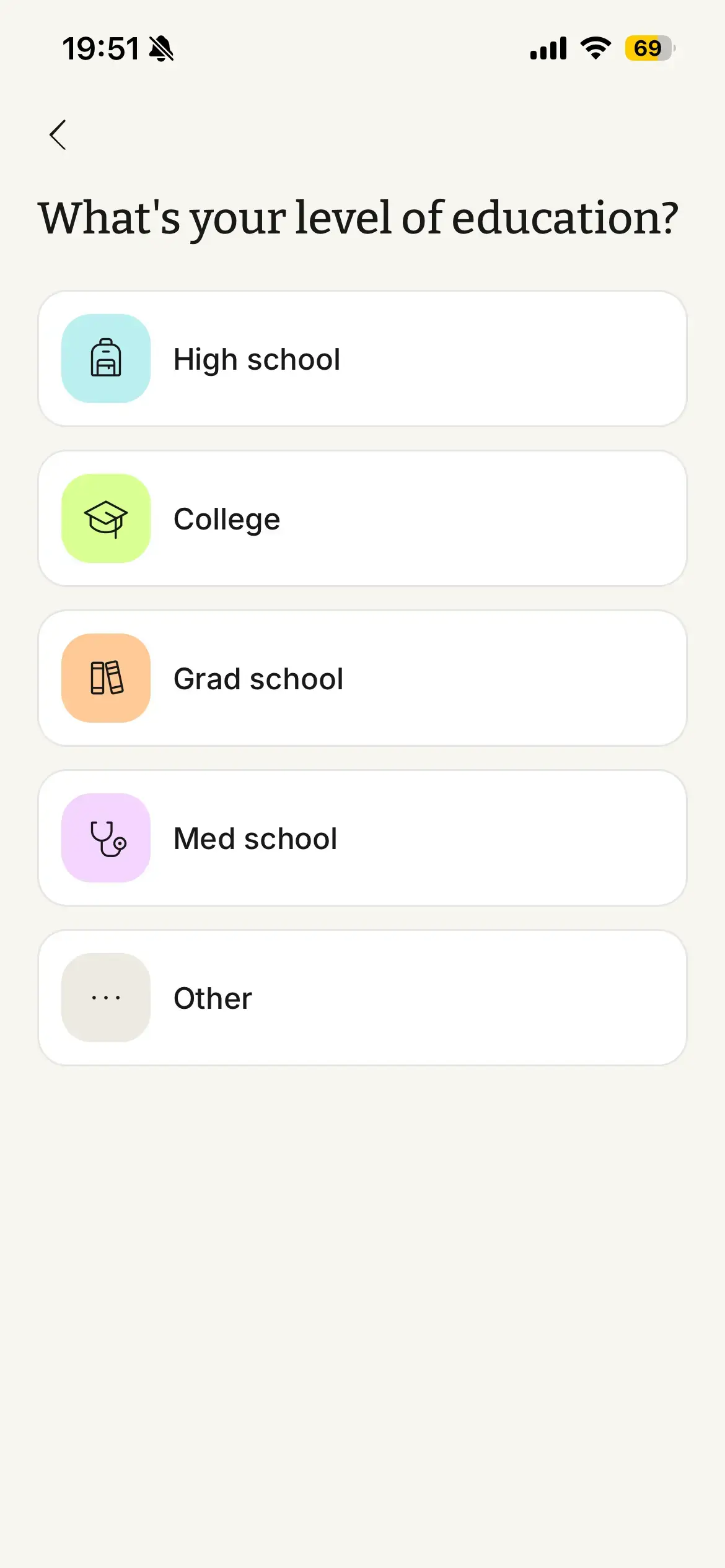
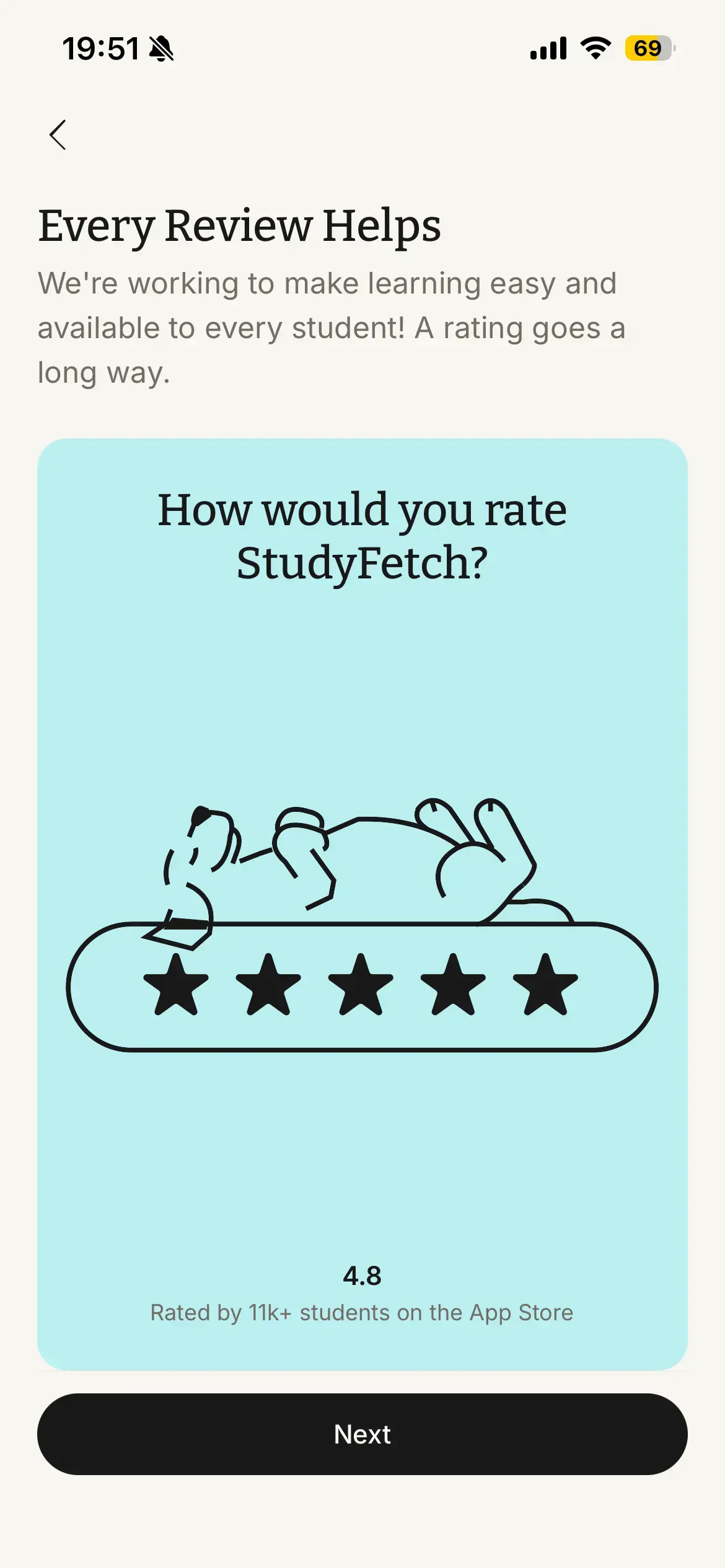
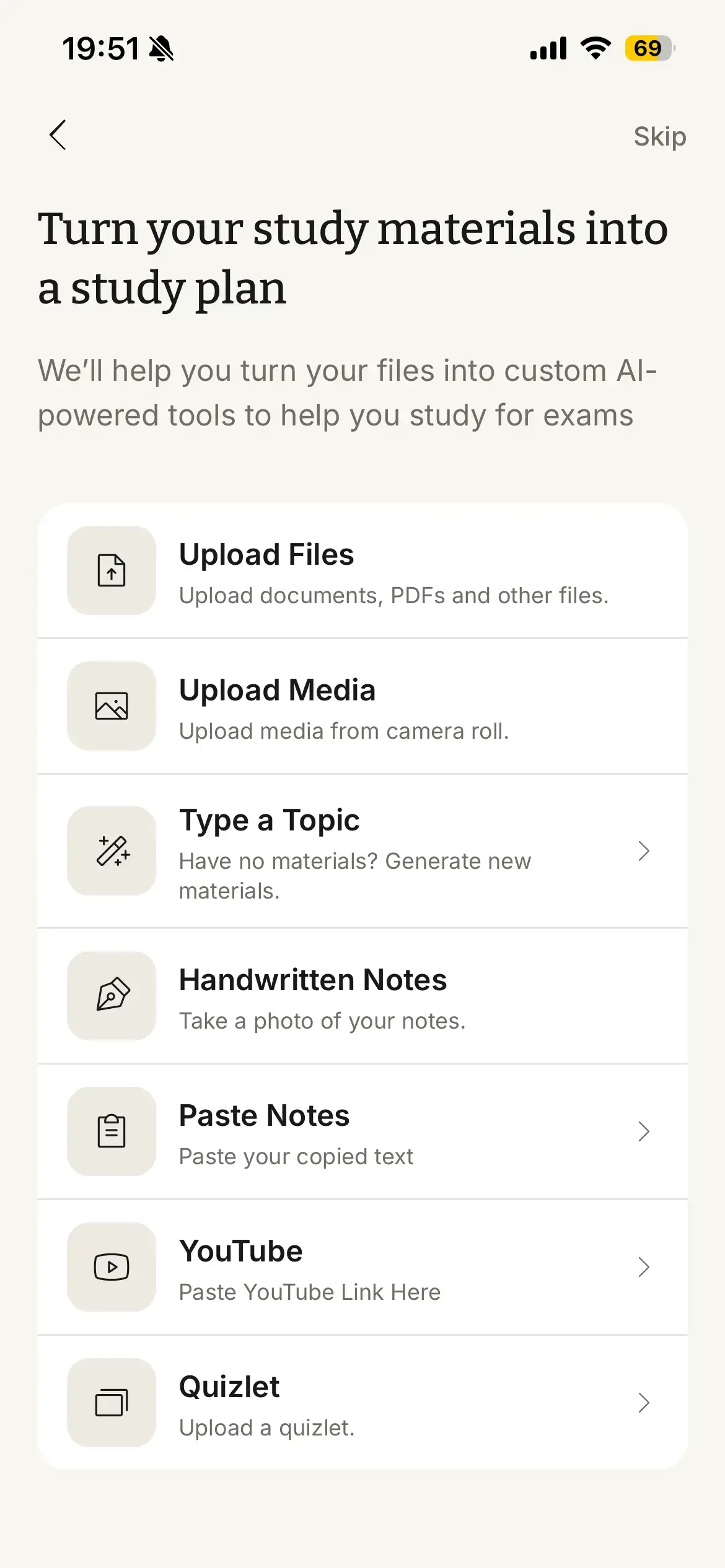
StudyFetch's onboarding runs 13 screens, which is on the shorter side.
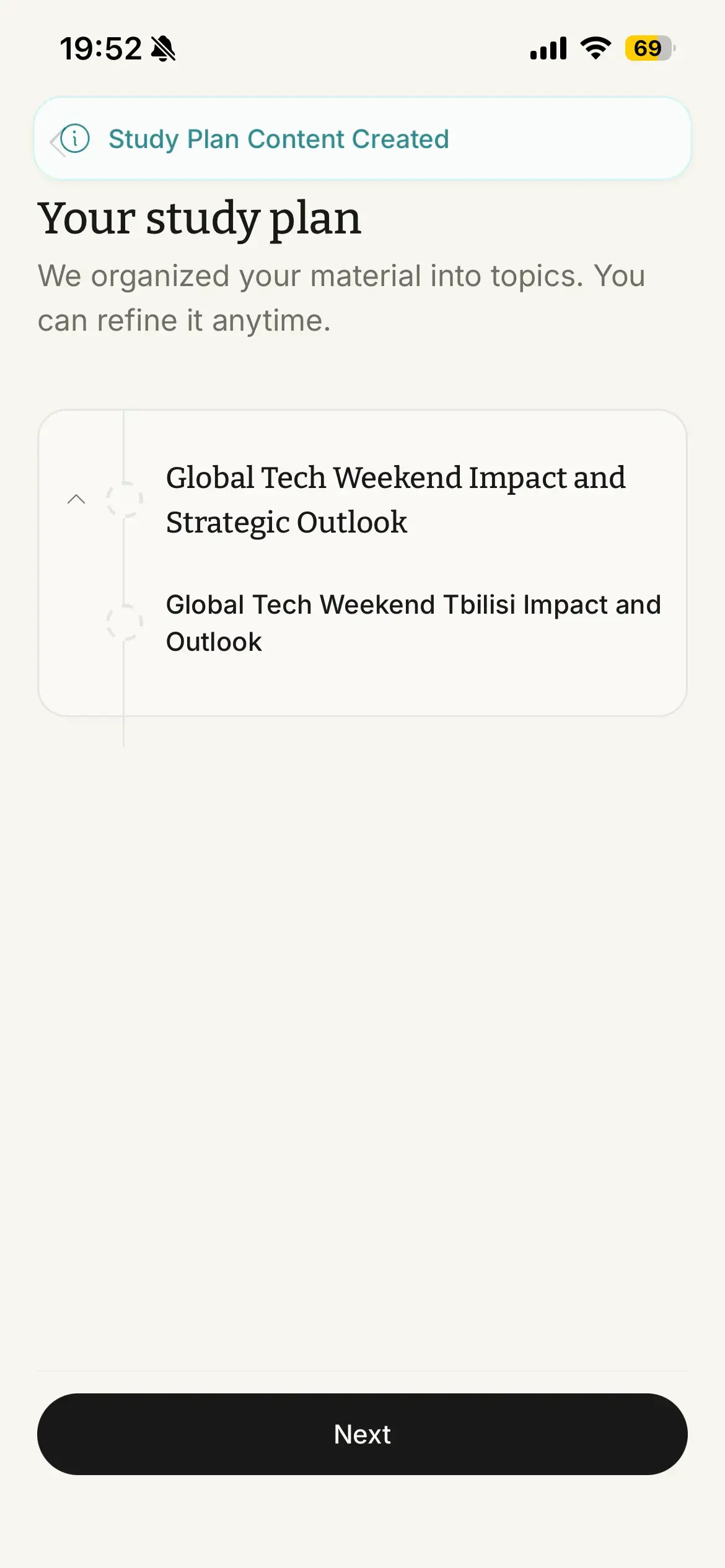
It opens with a handful of essential questions, then slots in a request for a review, then prompts a document upload, then gives you a glimpse of the "StudyPlan" generated from that document, and finally lands on the paywall.
That paywall can be skipped, and the app is usable for free.
But trying to upload a third document requires payment. It's usable for free, but showing the paywall early is a smart strategy for maximizing conversion.
Also, because the document-upload-to-StudyPlan step itself functions as personalization, there's no need to run through a long chain of questions the way a lot of other apps do.
I think this really comes down to the app's specific theme. If it's the kind of app where a user uploads something, the app analyzes it, and shows a result — onboarding probably doesn't need to be that long.
Interestingly, StudyFetch's web version trims onboarding down even further — just 7 screens before hitting the paywall.
In general, web apps tend to have shorter pre-paywall onboarding than native apps, and StudyFetch follows that same pattern.
So that covers the product and onboarding side of StudyFetch. But the real question is: how did they actually acquire users?
As mentioned up top, they've hit a monster of a number — $12.9M in ARR in three years.
And behind that, unsurprisingly, is TikTok marketing.
I've covered a lot of TikTok marketing case studies before, but StudyFetch's approach is a bit different.
Their core strategy centers on having influencers build a brand-new account entirely from scratch.
On the surface, it seems like it'd make more sense to post from an influencer's already-strong existing account.
But there's actually a rational reason why building from zero works better.
From here, let's look at the unique approach StudyFetch is taking, the formats that have gone viral for them, and — further down — how they cut their AI API costs by 10x.
StudyFetch's growth playbook is genuinely worth studying closely, so I'd encourage you to read through to the end.
🎯 The Format That Kept Going Viral
Now let's actually look at how StudyFetch grew the app.
Unsurprisingly, the key to their success is TikTok.
Their official account is here:
They've tried a lot of formats, but the one that first broke through was a video showing that you can paste in a YouTube link and have the AI summarize it and answer questions about it.
That one hit 2.3 million views.
The same basic format went viral again here:
3.9 million views on that one.
And this one hit 7.2 million views:
They kept running this same format over and over, and it kept going viral every time.
Once you find a format that works, you should absolutely keep running it into the ground.
The next format to break through was a video showing off the feature that records a real lecture and turns it into notes:
That one hit 6.4 million views.
For a student-facing AI product, "here's the shocking way this makes studying easier" is clearly a proven, reliable format.
This whole run of videos happened in late 2023.
At that point, almost no AI study tools like this existed yet.
That's exactly why "I've never seen technology like this" hit so hard.
If you released the same technology with the same format today, you almost certainly wouldn't get anywhere near these view counts.
That said, I think there's always a version of "wait, what?" you can build given the current moment.
For example, an app I covered before called Halo AI launched right as Nano Banana came out and dramatically improved image-generation quality — they built an image-generation app around that moment and grew it fast through short-form video marketing.
 Onbo Hub
18 Months of Failure, a $100K Loan, and a Bet That Took an AI Photo App to $300K/Month in Just 2 Months
After 18 straight months of failure, he bet everything on a single viral TikTok format. The result: $300K in monthly revenue within 2 months. It's a genuinely insane growth story.
Onbo Hub
18 Months of Failure, a $100K Loan, and a Bet That Took an AI Photo App to $300K/Month in Just 2 Months
After 18 straight months of failure, he bet everything on a single viral TikTok format. The result: $300K in monthly revenue within 2 months. It's a genuinely insane growth story.
Right now, I think video and audio technology are the areas worth aiming at for this kind of "wait, what?" moment.
By the way, I've started storing viral social posts inside a product I'm building and running called Onbo Hub.
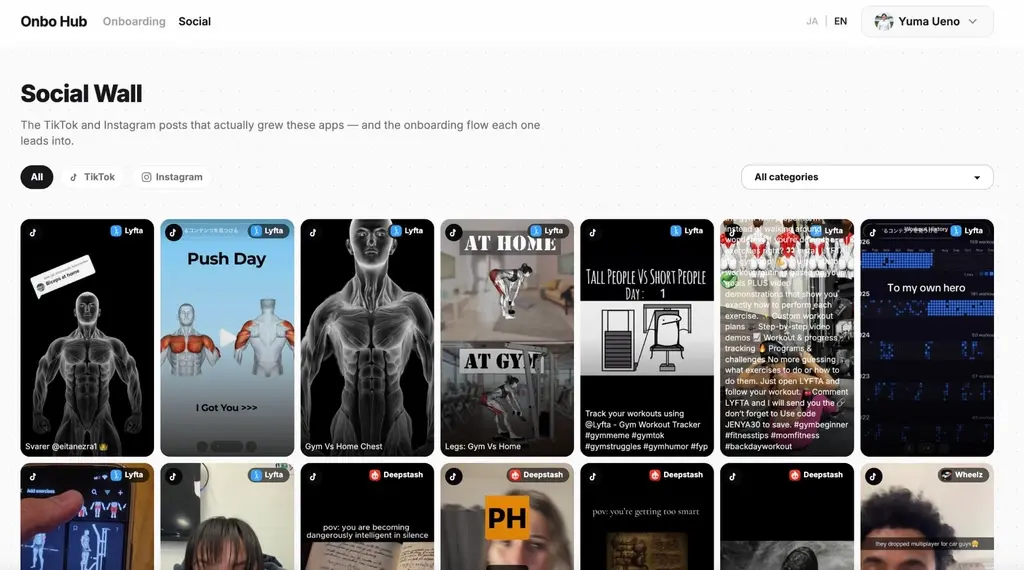
Previously it only cataloged onboarding flows for various apps, but since I end up researching viral social content just as often, I figured it made sense to have a place to keep that research too.
That means Onbo Hub now covers both sides of what actually drives an app's revenue — the monetization side (onboarding) and the acquisition side (social content).
These two things aren't everything, but they're both enormously important levers for growing an app's revenue, so it's worth checking out.
🎯 The Zero-Follower Influencer Strategy
So StudyFetch built up a strong base of viral videos on its own official account. But that approach has a ceiling on its own.
So the next strategy they layered on top was a creator and influencer program.
StudyFetch's creator strategy runs on a combination of three distinct approaches.
The first is ordinary UGC (user-generated content) creators. They keep several hundred creators active at any given time, and at peak, that number has scaled up to nearly 1,000. That's a serious operation.
The second is one-off sponsored posts from an influencer's main, established account.
These first two are common playbooks — most fast-growing apps right now are largely built on some combination of these two.
StudyFetch adds a third layer on top of that.
That third layer: the influencer sub-account strategy.
They approach influencers who already have a large following and specifically ask them to launch a brand-new account from zero.
Apparently, this third approach tends to work surprisingly well — often outperforming posts made from the influencer's main account.
Let's dig into how this actually works.
First, they reach out to influencers who already have hundreds of thousands of followers, and ask them to build a completely new account from scratch.
And on that new account, they always make sure the StudyFetch name is front and center.
For example, they had an influencer named Jemma Violet — who already had over 700K followers — build a brand-new account.
Here's her original account:
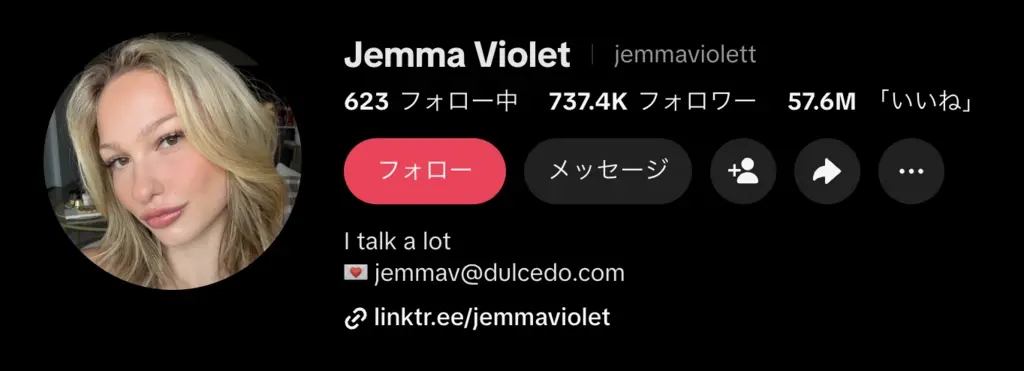
And here's the new account they built:
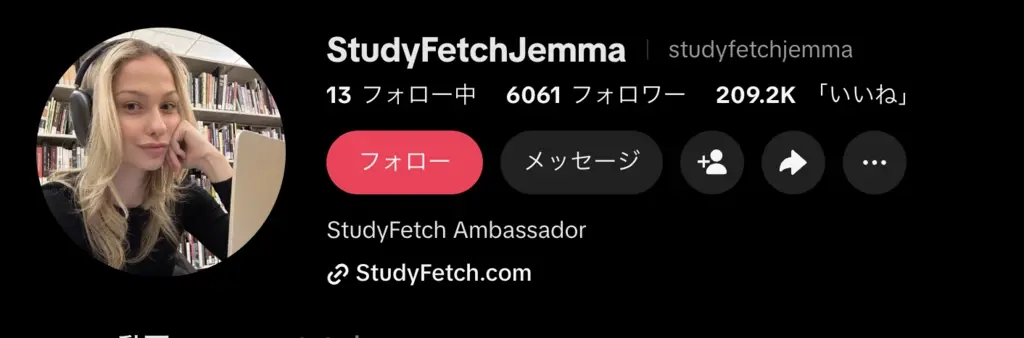
You might think, "wouldn't it just be better to post from the existing account?" But it turns out that's often not the case.
Posting from an account that already has a large following risks reaching that existing audience first — and not necessarily the audience you actually want to reach.
In her case specifically, she also posts beauty content, so a lot of her existing followers skew toward that audience. That audience isn't StudyFetch's target user, so racking up views from them doesn't actually mean much.
There's also a theory — and I stress this is a "theory" — that TikTok gives new accounts a visibility bonus that makes them easier to get in front of people, meaning a brand-new account may actually grow faster in some cases.
In my own experience growing a Japanese-learning app on TikTok, I saw explosive growth for roughly the first three months, and then growth slowed sharply after that. I'm fairly convinced there's a real "new account bonus" on TikTok early on.
From the creator's side, there's also a benefit: building a new account means they don't have to risk diluting the brand equity of their existing account.
So this ends up being a genuinely win-win setup.
For context, Jemma had previously posted in a specific format on her main account that performed extremely well:
That one hit 10 million views.
So they carried that same format over, adapted to promote StudyFetch, on the new account:
That one hit 400K views.
I thought this strategy was a genuinely clever insight.
🔍 How They Recruit Creators
So how does StudyFetch actually find these creators?
They do have an official creator application page (creators.studyfetch.com) that brings in inbound applicants. But what they actually rely on most is outbound — reaching out to people directly.
It makes sense when you think about it: genuinely excellent creators around the world rarely apply on their own. If you don't proactively reach out and recruit them yourself, it's hard to get the best people on board.
Their outbound channels include DMs on TikTok and Instagram, email, and — for people they're really serious about landing — even LinkedIn outreach.
As for selection criteria, they specifically prioritize "engagement" over raw follower count — and within engagement, comment count in particular.
They also say that once they spot a creator who's already performing well on TikTok, they always check that same creator's performance on Instagram.
If a creator is doing well on TikTok but underperforming on Instagram, they'll often pass, even if the TikTok numbers look good.
📲 Is TikTok Really Better Than Instagram?
When it comes to StudyFetch's marketing, TikTok's contribution apparently massively outweighs Instagram's.
Even the same video tends to convert better and go viral more easily on TikTok.
There's an entire genre called "StudyTok" that's become well-established, which speaks to how well education content fits the platform.
TikTok also does location targeting more precisely — an account built in the US will mostly reach a US audience.
Instagram, on the other hand, tends to spread to a much wider range of countries even from a US-based account.
That's likely part of why TikTok converts better in their case.
That said, I think it's a bit early to just declare "TikTok is better" outright.
I've run both TikTok and Instagram myself, and Instagram is, without question, the one that builds into a durable long-term brand.
TikTok has real explosive potential, but it tends to be short-lived.
People end up becoming fans of the content, not necessarily the account. So even as your follower count climbs, it's genuinely hard to sustain high view counts.
TikTok is clearly the better fit for a creator-at-scale strategy like StudyFetch's. But if you're trying to build a long-term fanbase, I'd lean toward recommending Instagram instead.
For reference, I personally have 450K followers on TikTok versus 200K on Instagram — and yet the same video regularly gets more than 5x the views on Instagram.
🎬 Let the Product Be the Star
Another thing that apparently performs especially well for them: videos that put the product's own feature entirely front and center.
According to the team, whenever the product itself is the actual reason the video is good, it reliably works.
On the flip side, if a video only tacks the product on as an afterthought in the last five seconds, it might still rack up views, but conversion rates don't budge.
Because of that, they say they now design new features from the ground up while asking, "will this actually look good in a video?"
I think that's a genuinely important mindset.
Working backward from what will go viral in short-form video, and building the feature to fit that, feels like it's becoming a defining trait of modern product development.
They reportedly go as far as building creator-specific UI elements purely to make short-form video content go viral more easily.
🚀 Cutting Infrastructure Costs 10x With NVIDIA
Another interesting piece: their infrastructure costs.
StudyFetch originally used a standard AI model API for its audio transcription feature, but at some point migrated to self-hosting an open-source model instead. The model they landed on was NVIDIA's speech recognition model, Riva.
As a result, they reportedly cut their transcription-related AI costs by a full 10x.
Before the migration, transcription alone was apparently costing them hundreds of thousands of dollars a month — so the impact here is substantial.
They're currently processing several hundred thousand lecture recordings a month.
This kind of infrastructure-cost work matters more and more as scale increases.
My own service isn't anywhere near that level of AI cost yet, but once it gets big enough that the cost becomes impossible to ignore, this is clearly something I'll need to seriously look into.
🏢 The Move Into B2B
StudyFetch is also pivoting beyond pure consumer, into B2B.
In October 2025, they launched a free reading-comprehension support platform called StudyFetch Read, positioned explicitly as a response to America's "literacy crisis."
Then starting in 2026, they rolled out a new brand aimed at institutions and enterprises: Honen.
Through Honen, they launched a program delivering AI-literacy coursework to more than 250,000 high school students, and in May 2026 they launched Honen for Enterprise, a corporate-training version of the product.
You can see a clear, deliberate shift here — from "an app for students" to a company positioning itself as skills-education infrastructure for the AI era.
📝 Wrapping Up
That covers what's behind the growth of StudyFetch, the AI study platform.
The two things I found most useful: their virality-first approach to building content, and the influencer sub-account strategy.
I haven't personally tried the influencer-partnership approach yet, but I keep telling myself I need to (I feel like I say this every time).
Build a genuinely strong, hook-worthy feature into the app, and push it front and center in your content. Once you find a format that actually works, partner with influencers and creators to scale it from there.
That's increasingly becoming the standard playbook for scaling an app. For now, my own near-term goal is hitting $10k a month in revenue — I'll keep at it.
So that's a full look at StudyFetch this week.
Thanks for reading all the way through! If anything caught your attention or you have questions, just hit reply — I read everything.
And if you post your thoughts on X and mention me, it makes my day. I always respond.
See you next time.
References
StudyFetch: https://www.studyfetch.com/
Buzzsprout — How StudyFetch used creator-led growth to hit $10M ARR in 3 years: https://www.buzzsprout.com/2432582/episodes/19322888-how-studyfetch-used-creator-led-growth-to-hit-10m-arr-in-3-years
Esan Durrani on X: https://x.com/esandurrani
NVIDIA case study — StudyFetch: https://www.nvidia.com/en-us/case-studies/studyfetch/
Built In LA — StudyFetch: https://www.builtinla.com/company/studyfetch
Dupple review — StudyFetch: https://dupple.com/reviews/study-fetch