 DeepstashStory
Vladimir Oane's Deepstash: The Social Media Antidote That Made ~$11M
After selling uberVU to Hootsuite, Vladimir Oane fell out of love with social media and built Deepstash, now an estimated $11M in lifetime revenue. See the onboarding that sells it as a doomscrolling replacement.
"i found the tiktok alternative for smart ppl." A short video with that caption got 5.4 million views on TikTok.
It's promoting Deepstash, an app that turns the key ideas of books into "ideas" you can read in a few minutes. It has made an estimated $11 million in lifetime revenue, runs about 6,000 active ads, and has even raised $9 million just to spend on advertising. Here's how it was built, with the real screens.
The founder: an entrepreneur who grew up in a house full of books
Deepstash was founded by Vladimir Oane from Romania. He was born near the end of the communist era and grew up in a small town about two hours from the capital. His father was a history teacher, and he describes their home as something like a bookstore or a library.
In his first year of university, he heard a talk by an entrepreneur who had sold antivirus software to Microsoft. What struck him most was the idea that you could do something without asking for permission.
First company: landing in London the day Lehman collapsed
His next company was uberVU. It started as a tool for companies to publish videos and articles. Then the well-known American blogger Robert Scoble told him that most companies have nothing to say, and that what they really want is to know what their customers are saying. So he rebuilt it into a tool for analyzing what people say on social media.
uberVU was one of five companies chosen out of about 500 for Seedcamp, a startup program in London. On the very day he rented a place in London, Lehman Brothers collapsed. He still raised money and grew the company, and in 2014 uberVU was acquired by the social media management platform Hootsuite.
Falling out of love with the industry
After the acquisition, he spent three to four years as an executive at Hootsuite, and social media changed. Watching the controversies around elections and Mark Zuckerberg testifying before Congress, he realized he didn't like the industry anymore.
A reader who reads books with a pen in hand, he started again from zero in 2019 with Deepstash. In a 2021 interview, he said they wouldn't charge money for a while and that ads weren't a good fit for an app like theirs. Today, analytics estimates put its lifetime revenue at about $11 million.
Onboarding, part 1: the enemy is doomscrolling
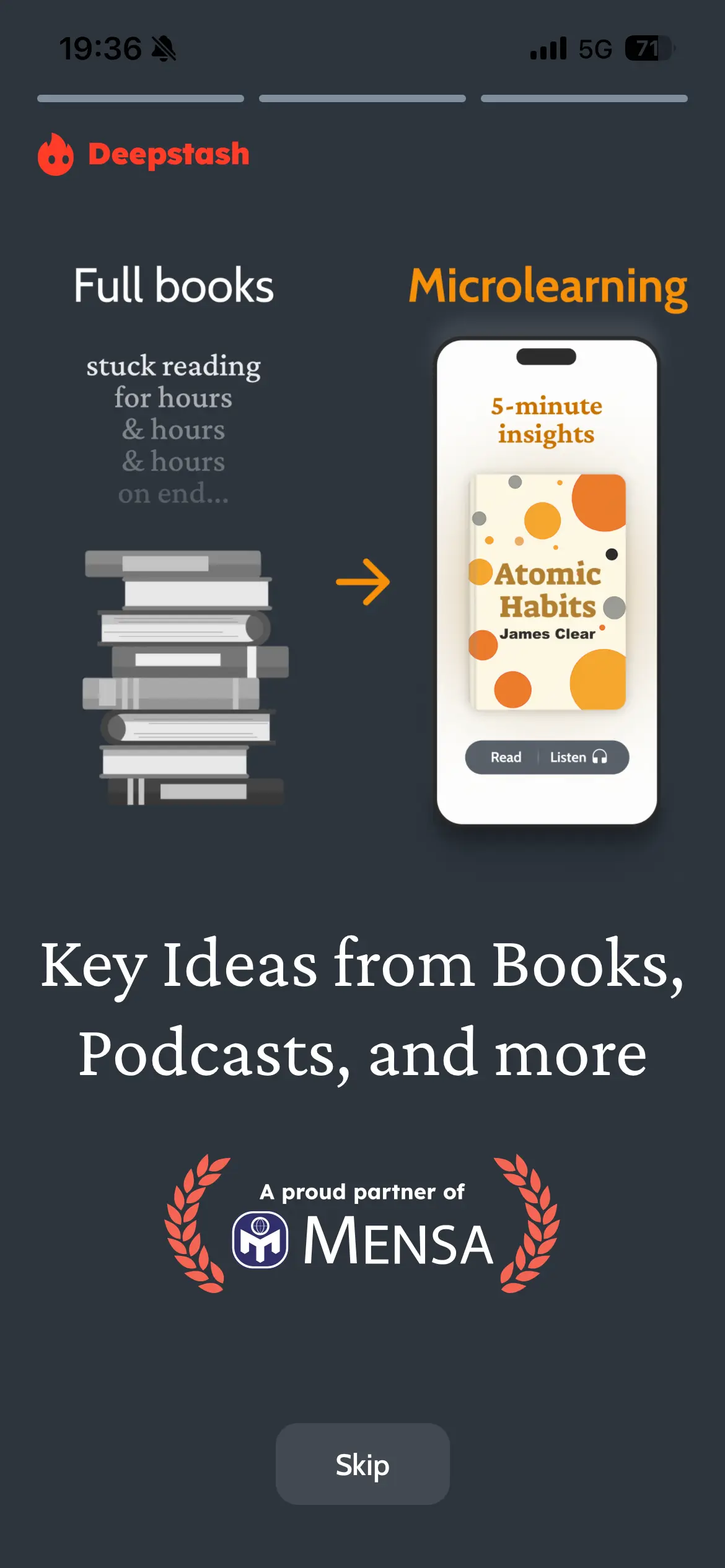
The first screen compares a pile of books with five-minute key ideas on a phone. Once you create an account, the app asks what you most want to do here, and the first option is replacing your social media time.
Next, it asks whether you feel you spend so much time on social media that it affects your life. Then it shows a chart comparing how energized people feel after social media versus Deepstash, presenting Deepstash as the best replacement for doomscrolling.
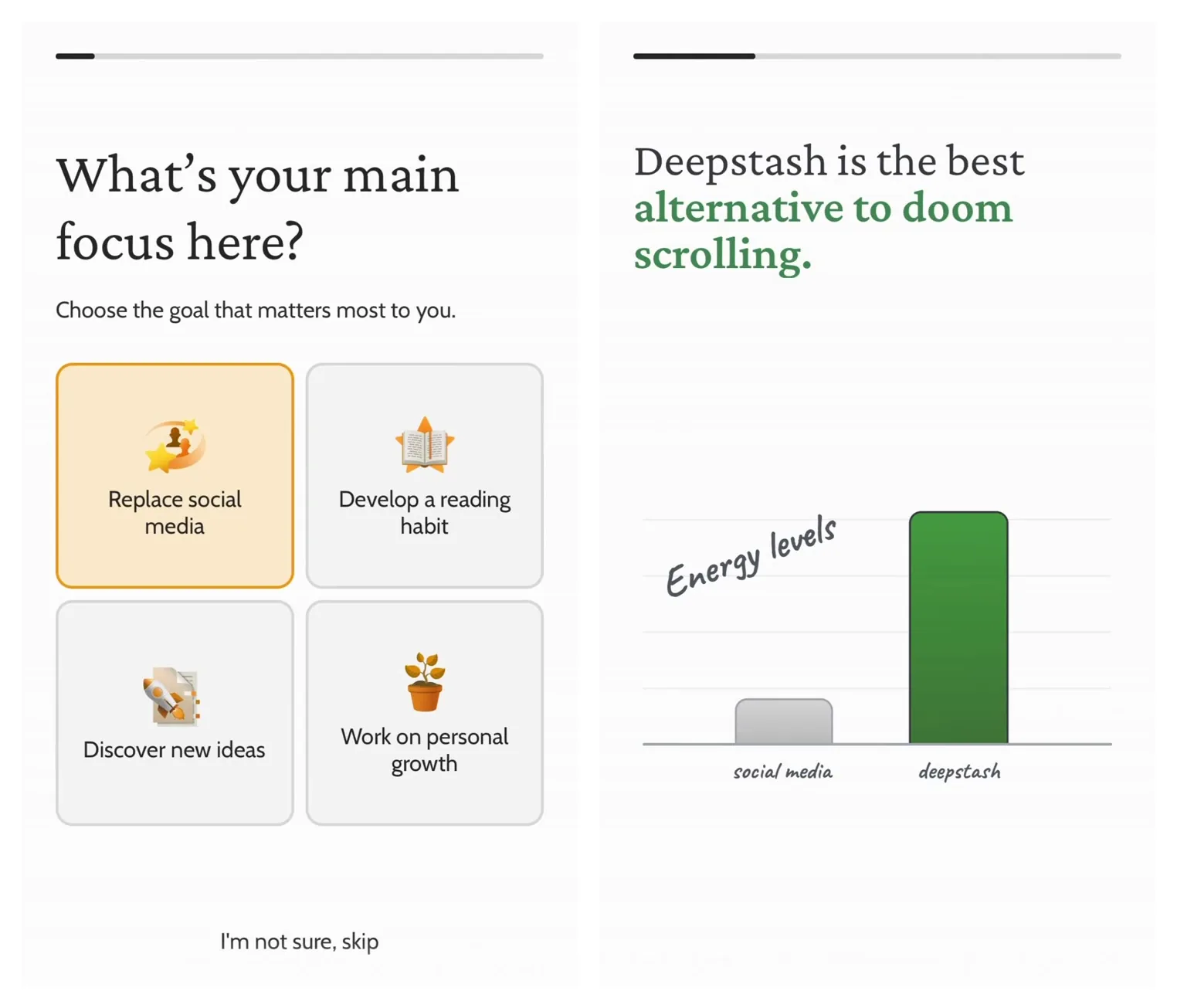
Even the testimonial is about someone who wanted to get away from social media and found the app instead, calling it a useful version of Instagram. Before explaining the app, Deepstash reminds you of yourself, scrolling.
Onboarding, part 2: swipe through books like Tinder
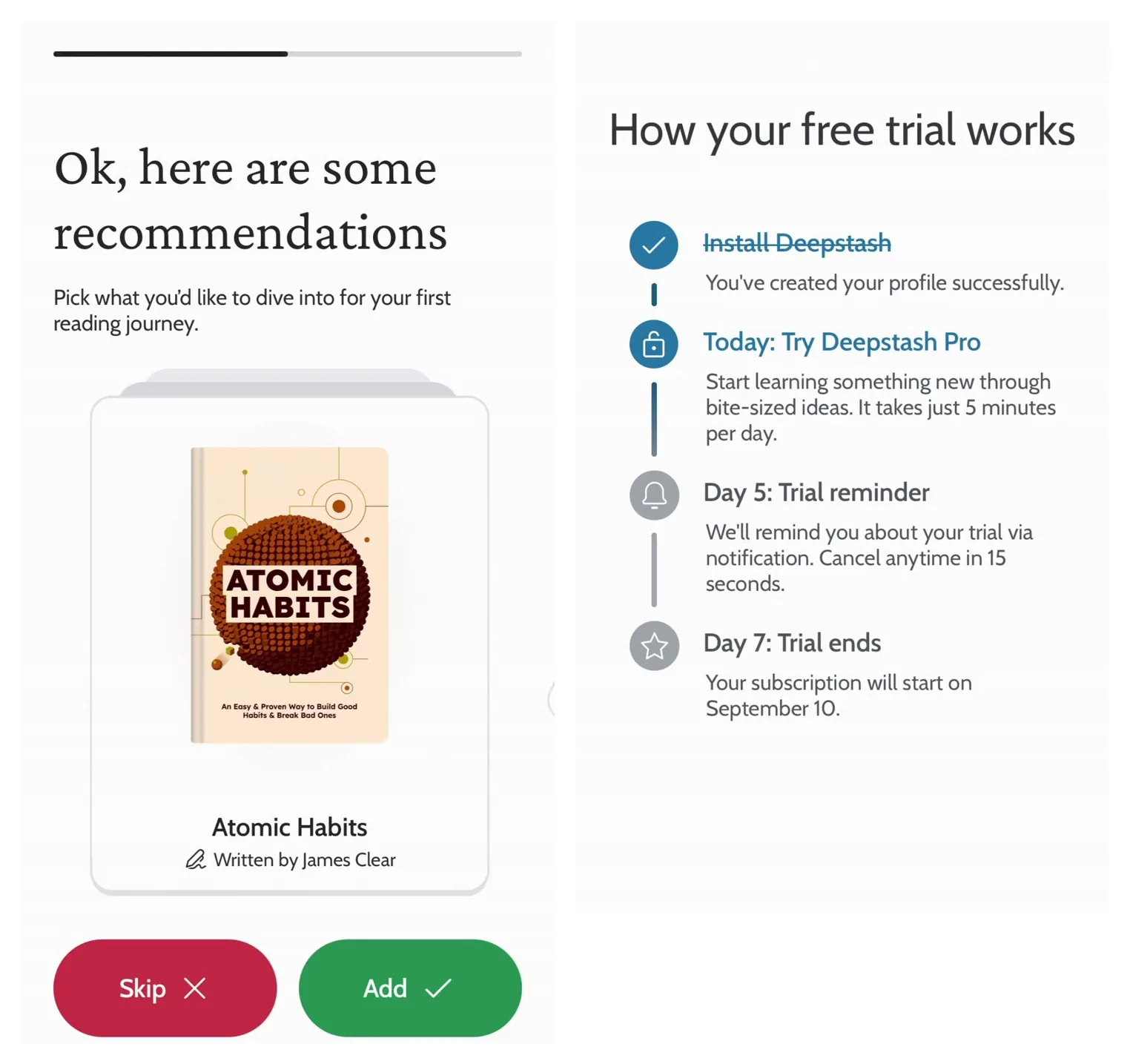
Then books appear one at a time, such as The 48 Laws of Power and Atomic Habits. You add the ones you like and skip the rest, Tinder-style, and the books you add become your first reading list.
After you choose when to get ideas and which topics interest you, the app says it's building your personal experience. While you wait, it shows a community of more than 3 million, more than 200,000 key ideas, and coverage in outlets like Forbes.
Paywall: easy to start, easy to stop
Before the paywall comes the free trial timeline: start today, get a reminder on day 5, get charged on day 7. It even says you can cancel in 15 seconds. Then a bell appears with a promise to remind you two days before the trial ends.
The paywall offers an annual plan with a 7-day free trial, shown as a monthly amount. Above the button, it says it takes two taps to start and you can stop anytime. Open the full list of plans and you'll also see a monthly plan and even a seasonal fall deal on the annual plan. Instead of leading with the cheapest option, it shows the discount only to people who look for it.
Growth: "the TikTok alternative for smart people" and about 6,000 ads
The official video with 5.4 million views is captioned "pov: you're getting too smart," with "i found the tiktok alternative for smart ppl" layered over old diagrams and notebooks full of equations.
The Meta Ad Library showed about 6,000 active ads (as of October 23, 2026), including ads run from creators' accounts. The team also rides seasonal moments, like collecting ideas from vampire books for Halloween.
More than half of paid subscribers now sign up on a web page outside the app. Oane says he was sure at first that it would never work, but kept going because his co-founder pushed to keep testing. In 2025, Deepstash raised $9 million specifically to fund advertising.
Note: Lifetime revenue is a third-party estimate from a Sensor Tower screen shown on the "two & a half gamers" podcast (about $11.04 million for Deepstash alone). The ad count is the number of active ads found by searching "Deepstash" in the Meta Ad Library. The $9 million figure comes from Dealroom (October 2025). View counts are as of when this story was written.
 Bible Chat
 Keiki
 Reframe